Peter Buwalda - Bonita Avenue
Здесь есть возможность читать онлайн «Peter Buwalda - Bonita Avenue» весь текст электронной книги совершенно бесплатно (целиком полную версию без сокращений). В некоторых случаях можно слушать аудио, скачать через торрент в формате fb2 и присутствует краткое содержание. Год выпуска: 2015, ISBN: 2015, Издательство: Crown Publishing Group, Жанр: Современная проза, на английском языке. Описание произведения, (предисловие) а так же отзывы посетителей доступны на портале библиотеки ЛибКат.
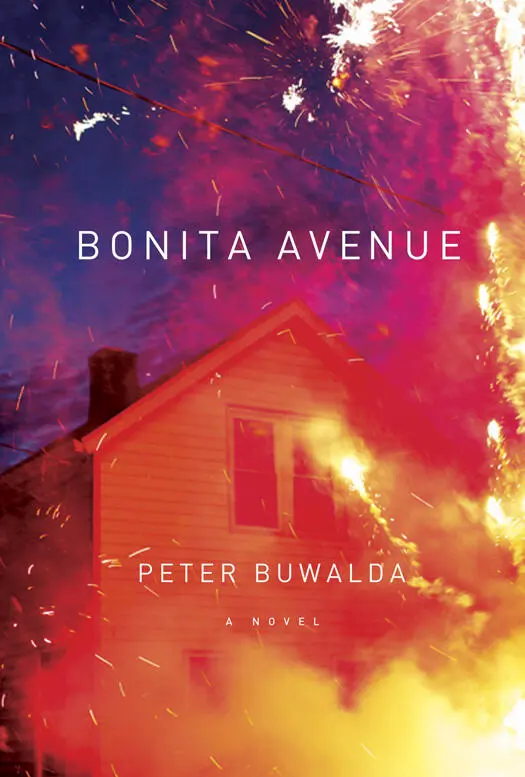
- Название:Bonita Avenue
- Автор:
- Издательство:Crown Publishing Group
- Жанр:
- Год:2015
- ISBN:978-0-553-41786-9
- Рейтинг книги:4 / 5. Голосов: 1
-
Избранное:Добавить в избранное
- Отзывы:
-
Ваша оценка:
Bonita Avenue: краткое содержание, описание и аннотация
Предлагаем к чтению аннотацию, описание, краткое содержание или предисловие (зависит от того, что написал сам автор книги «Bonita Avenue»). Если вы не нашли необходимую информацию о книге — напишите в комментариях, мы постараемся отыскать её.
A riveting portrait of a family in crisis and the ways that even the smallest twists of fate can forever change our lives,
is an incendiary, unpredictable debut of relationships torn asunder by lies, and minds destroyed by madness.
Bonita Avenue — читать онлайн бесплатно полную книгу (весь текст) целиком
Ниже представлен текст книги, разбитый по страницам. Система сохранения места последней прочитанной страницы, позволяет с удобством читать онлайн бесплатно книгу «Bonita Avenue», без необходимости каждый раз заново искать на чём Вы остановились. Поставьте закладку, и сможете в любой момент перейти на страницу, на которой закончили чтение.
Интервал:
Закладка:
But he, Sigerius— he was burned up. It insulted him. He took Bluming’s bluster personally. For him it was an honor to stand on Geesink’s straw mats; for him and for the rest of humanity Geesink was a judo god, a hero, a leader. When he lay mangled on his cot in the Kromhout barracks after an evening at the Jansveld gym, he thanked the good Lord he could train with Anton Geesink. It was awesome —the most fantastic judokas inhabited that upstairs gym, every one of them technical and explosive. You had Pierre Zenden, you had Joop Mackaay, and of course Menno Wijn. The Snijders brothers, identical twins from his battalion, they had to move heaven and earth to be given leave four times a week to go to that dojo together. It was amazing. He had recently watched Geesink capture the world title in Paris, from the bleachers; he still lived at his father’s place in Delft. He and a few of the guys from the club drove to Paris in a Renault Dauphine, bought tickets like everybody else for the Stade de Coubertin and cheered the towering Hollander as he beat one Jap after another; and now, hardly a year later, this same ace stood there advising him on how to improve his shoulder throw, gave pointers on honing his lefthanded techniques, said it was time he became a real man and bought some barbells. “So you’re from Delft?” Geesink asked with that deep, sluggish voice of his. “Good. Next time you’re on leave you can come by bike, Simon, not by train. For years I cycled to Antwerp every month. Trained with Strulens. Cycling is good.”
Sometimes, as he drifted off to sleep at night, his head resting on a straw-filled pillow, he let Geesink loose on that animal Bluming, and of course in his fantasy Geesink beat the bejesus out of Bluming four out of five times, but the last round was often a painfully different story, then he saw how Bluming chastened his hero, mercilessly dragged the world champion across the mat, for he still wasn’t entirely sure; Bluming, as the story goes, was no sissy, he carried bullet wounds from the Korean war, he claimed to be not only fifth dan in judo but also a black belt in Asian martial arts they can’t even pronounce here without stuttering.
But here they were in their locker room, three burly Amsterdammers, Rinus Elzer, somebody named Hoek, and a grinning blond bear with a torso they’d dug up in Rome with a shovel — was that Bluming? Smaller but more muscular than he had imagined, younger too. No one spoke. They were more than welcome, of course, Geesink was gentlemanly and hospitable, he received them like a real champ; he was visibly delighted, Geesink was always thrilled about strangers’ muscles, that’s the only way you got better, that’s why he went to Japan so often, to sink his teeth into all that unfamiliar meat.
The Amsterdammers took part in the randori (Geesink skipped the free practice), balcony doors open, sparring in the fresh air, rotating every five minutes, and they weren’t bad at all, that was clear. Menno had taken a moderate beating from that Elzer, and even before Geesink had laid a hand on any of those guys, Sigerius found himself face-to-face with that canary-yellow statue. “Teach that Bluming a lesson, will you?” Menno whispered in one ear.
It was strange, of course he knew all along that the blond guy was the enemy, you just know, but now that he was certain he was no longer scared, but something else, something in his heartbeat and muscle tension changed, and in his head too. So you think you can go around badmouthing Geesink? His arms, his chest, his calves filled themselves with sympathetic rage, and on behalf of his sensei, on behalf of the world champion who tolerated his presence and took the trouble to improve him, he took hold of Bluming. Square and compact, grounded like a dolmen, that’s the sign of a real judoka, a real judoka weighs 400 kilos, his feet take root in the mat and grow outward for meters — and this was one of them. At once stiff and supple, Bluming conducted him around the room, and the first flash was a low shoulder throw, he landed hard on his shoulder, but he responded to Bluming’s second attempt with a throaty yell — he’d been practicing it the past few months, a series of takeovers, the timing of his throws — and the power with which he threw his rival backward and dragged him a couple of meters across the straw-filled mat attracted the other men’s attention. They watched. The subsequent points were his, a raw Siem Sigerius emerged, he tore into Bluming, he attacked with a venom that would become the foundation of his judo career, and perhaps his entire life . For minute upon minute he flung the hollow braggart every which way, osotogari, tai otoshi , to take hold of him; there lay the great martial arts king, and once on the ground he squeezed Bluming’s slanderous throat shut.
Only later that evening — after the three visitors had hotfooted it home, after Geesink had repeated his punishment drill for good measure, but only the light version — when he cycled back to the barracks with Jan and Peter Snijders, glowing with satisfaction, did he hear that the Amsterdammer with the straw-colored hair wasn’t Jon Bluming at all. Say what? “Don’t let Wijn kid you, Sigerius,” said Jan Snijders. “The blond guy you’re talking about is much younger than Bluming, name’s Ruska. Willem Ruska.”
It’s a quarter to eight, he’s got to get back to campus before eightthirty. He returns the ruined chair to the utility room, pushing the leg a bit into the splintery wound. The only place left is the study, the room facing the street, maybe he’ll find that key after all. The poorly laid wood floor glows pale brown in the sunlight, it looks to him like a simple floor base, it’s not tiled or carpeted. The room is a sauna, sweat oozes from his pores, he feels the heat in his shoes. On the wall opposite the window, his family looks at him through non-reflective glass: the portraits Aaron took for their twentieth anniversary. In the middle of the room is a mattress with rumpled bedclothes, there are two cheap bookshelves filled with academic books: Sentence Analysis, Child Language Development , a poetry handbook. He sees binders of Tubantia Weekly s, a meter of Willy & Wanda comics. In the right-hand corner, halfway under the window, a desk, bare wood on aluminum legs. There’s a PC on it. He keeps looking outside, the street is empty. He sits down on the gray plastic desk chair and pulls open drawers, one of them is locked, the others are stuffed with bank statements, business correspondence, old birthday cards. He takes a few random samples. Uninteresting. No key.
A bulletin board above the desktop is thumbtacked full of newspaper clippings, cartoons, postcards, baby announcements, and photographs: Aaron with his parents and a formal-looking boy that vaguely resembles him, a strip of passport photos of Joni. He then digs doggedly in the plastic stacking boxes on the corner of the desk. Warranty receipts, a phone company contract, bills to the Weekly , a magazine missing its cover. A glossy blue cardboard folder, a brochure, in the middle bin catches his eye. He takes it out, “Palmer Johnson,” it announces, “the most desirable luxury high-performance yachts in the world.” The aerial photo on the cover shows a streamlined yacht cutting through the dark ocean, the metallic blue bow trailing a train of snow-white foam; the lounge sofas on the roof and rear decks are antique pink. Only when he realizes that the little pink postage stamp on the aerodynamic foredeck — the ship seems to be nothing but bow — is in fact a swimming pool, do the proportions fall into place.
He leans back and thumbs through the folder. On top are two loose photos on regular photographic paper, one of them is apparently the same ship as on the cover, anchored among similarly macho yachts in a sunny harbor, the other probably taken from the deck, out at sea, a coastline in the distance, no people. In the brochure itself: horizontal and vertical cross-sections, technical specifications, pictures of the innards: a living room bigger than the one downstairs; glossy, curved, built-in amenities; recessed lighting; a bedroom with the looks of a five-star hotel suite. At the back he finds a receipt from Port Privé de Sainte-Maxime. In barely legible handwriting there are two dates and a name. “Barbara …,” and something short after it, a brusque “A” and two “w”s. And a “Monsieur Bever”—does it really say that? — who agrees to the sum of 12,779.75 French francs.
Читать дальшеИнтервал:
Закладка:
Похожие книги на «Bonita Avenue»
Представляем Вашему вниманию похожие книги на «Bonita Avenue» списком для выбора. Мы отобрали схожую по названию и смыслу литературу в надежде предоставить читателям больше вариантов отыскать новые, интересные, ещё непрочитанные произведения.







Обсуждение, отзывы о книге «Bonita Avenue» и просто собственные мнения читателей. Оставьте ваши комментарии, напишите, что Вы думаете о произведении, его смысле или главных героях. Укажите что конкретно понравилось, а что нет, и почему Вы так считаете.