Uzma Khan - Trespassing
Здесь есть возможность читать онлайн «Uzma Khan - Trespassing» — ознакомительный отрывок электронной книги совершенно бесплатно, а после прочтения отрывка купить полную версию. В некоторых случаях можно слушать аудио, скачать через торрент в формате fb2 и присутствует краткое содержание. Год выпуска: 2011, ISBN: 2011, Издательство: HarperCollins Publishers, Жанр: Современная проза, на английском языке. Описание произведения, (предисловие) а так же отзывы посетителей доступны на портале библиотеки ЛибКат.
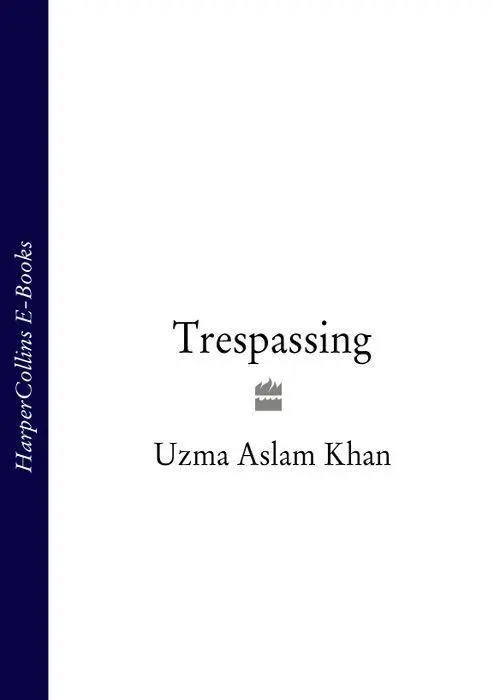
- Название:Trespassing
- Автор:
- Издательство:HarperCollins Publishers
- Жанр:
- Год:2011
- ISBN:9780007402427
- Рейтинг книги:4 / 5. Голосов: 1
-
Избранное:Добавить в избранное
- Отзывы:
-
Ваша оценка:
Trespassing: краткое содержание, описание и аннотация
Предлагаем к чтению аннотацию, описание, краткое содержание или предисловие (зависит от того, что написал сам автор книги «Trespassing»). Если вы не нашли необходимую информацию о книге — напишите в комментариях, мы постараемся отыскать её.
In this sweeping novel of modern Pakistan, Uzma Aslam Khan takes us from the stifling demands of tradition and family to the daily oppression of routine political violence, from the gorgeous sensual vistas of the silk farms to the teeming streets of Karachi — stinking, crumbling, and corrupt.
Trespassing — читать онлайн ознакомительный отрывок
Ниже представлен текст книги, разбитый по страницам. Система сохранения места последней прочитанной страницы, позволяет с удобством читать онлайн бесплатно книгу «Trespassing», без необходимости каждый раз заново искать на чём Вы остановились. Поставьте закладку, и сможете в любой момент перейти на страницу, на которой закончили чтение.
Интервал:
Закладка:
Hunkering in a corner of the library, he started taking notes from a few small American publications that defied the Pentagon’s gag order. One disclosed the use of weapons employed during the Vietnam War but since declared illegal by the UN and the US. It quoted a CIA agent saying the fuel-air explosives, used to clear out dense jungles in Vietnam, made no sense in the flat desert of the Middle East, and yet the bombs were being used on frontline Iraqi troops. About napalm, a US Marine officer admitted it had been used, just as in Vietnam, against both troops and civilians. So were cluster bombs. Another lamented that on television, one general called the air strikes ‘a party’.
Daanish noted all this in his journal, growing increasingly motivated. Here were a few courageous reporters. Surely it would be interesting to compare these reports with others?
He moved on to the popular press, struck by its sloppiness, its glaring inconsistencies. One magazine wrote that Iraq’s military was invincible but then bragged that the government could and would contain it. Another said officials persevered to avoid Iraqi civilian casualties, then quoted a general saying the number of civilians killed did not interest him. It was as if the reports were censored but not proofread.
Hours later, Daanish stepped outside. Walking aimlessly through the college grounds, he gradually made his way downtown, his neck sinking deep into the collar of his jacket. The wind had picked up during the afternoon. The darkness, at barely five o’clock, had set like cooling lacquer. He passed cafés piled with students and checked his pockets — not even two dollars left from his last paycheck, and the next would be cut. Stopping at a window, he looked inside. A woman carried a glossy black mug of steaming hot chocolate Daanish could almost smell. He pulled away.
The streets were still aglow with Christmas lights. Wreaths and colored balls hung from eaves. Ferns brightened almost every shop window. From one store blew the soft refrain of children singing carols. Ahead of him, beneath an orange street light, a group of friends met and exchanged tales of New Year’s parties. Becky hadn’t needed him to be her ethnic escort this time.
He passed a few shops with war stickers. One touted a cruise missile and read: This One’s For You, Saddam. Another showed a warhead detonating. It said: Say Hello to Allah.
Around him the air was cold and gay, verging on euphoric. He wanted something hot. He walked back to the café. He’d spend his last dollar after all.
But at the doorway, a heavyset man blocked his entrance. ‘We’re closing,’ he said. Daanish cast a quick look inside. No one seemed in a hurry to leave. Walking back down the street, he glanced around. The friends who’d met under the street light were entering the café.
In the following days, other Muslim students began relating similar incidents. One said someone had scribbled Go home, Towelhead on his door. He’d never worn a towel on his head, or a turban either. Graffiti was painted across the brick wall of a warehouse: Save America, Kill an Arab. A mosque was attacked, as was a Lebanese restaurant. And in the media, in place of war coverage, articles condemning Islam gained prominence. All the while, bombs dropped on Iraq every thirty seconds.
On average, it took Daanish twenty minutes to read each article. On average, the air raids killed twenty-five hundred Iraqis daily. Approximately thirty would lose their lives by the time he’d finished reading how much they hate us.
5
Khurram’s Counsel
JUNE 1992
The girl did not return. Not the next day, nor the following week. Daanish, pacing over the graying rug, was growing desperate for a way to fly out the wrought-iron grills of his bedroom window. He resolved to meet absolutely no more mourners.
Below, Khurram’s driver arrived with a pot of tea. Daanish called out to him.
The workers continued hauling and laying cement or else paused with the old man for tea.
‘Hey!’ Daanish called again, louder.
A young man balanced on top of the foundation wall a few feet lower than Daanish’s window, looked up. He nudged his chin questioningly. Daanish pointed to the driver. The man pointed too. Daanish nodded. ‘Call him.’
‘Did you talk to the President about my visa?’ asked the man.
‘What?’
‘The visa!’
‘Call him,’ Daanish again pointed to the driver.
The worker settled into a crouch. His toes curled around the unleveled edge of the wall. He began picking specks of dry mortar off his feet, preparing to sit under the window all day.
‘All right,’ Daanish hissed. ‘I’ll work on it. Now call him.’
The man hopped down, returning with the driver. The latter looked up, composed as always.
‘I’m going to give you a note for Khurram. Please wait,’ said Daanish.
The other man offered, ‘He’s deaf.’
‘What?’
The man muttered something and spat.
‘What do you mean he’s deaf?’ asked Daanish. ‘I’ve spoken to him before.’
‘You’ve talked in his right ear. Like this he’s deaf.’
‘Well,’ Daanish felt his temper rise. ‘Can you tell him, in his right ear, please, what I just said?’
‘When will I get the visa?’
‘Shit,’ growled Daanish. He stamped to his desk, not his desk — a small, blanched, wimpy thing Anu called a desk — and scribbled a note to Khurram: Can I borrow your car for the day? If you’re free, join me? I want to go to the beach. My mother would be less likely to object if I didn’t go alone, especially if you came to get me. Soon I hope, Daanish. He stuffed it in an envelope that he folded into a plane. He tossed this between the diamonds of the grill, down to the driver, who, happily, still waited. Unhappily, so did the other. It was he who caught the plane.
‘Have you talked into his right ear?’ Daanish asked dryly.
He nodded and passed the driver the paper. The driver walked to Khurram’s house.
‘And?’ said the man.
Daanish slammed the window shut.
He sat on his bed, waiting. Then he sprang up nervously, itching for something to do. At last he moved to the drawer with the cocoons. ‘I’ve decided to boil you, after all,’ he announced. ‘But only one. Which will it be?’ He stared at the trio of wooly pellets, picturing a thick white ribbon curled inside of each. While elbowing their way to shape, he was sure the creatures twitched their antennae, watching him.
Also in the closet was the lacquer box, with the photograph he’d not put in himself. Staring up at him was his young father, so young his hairline showed no sign of receding. His shoulders were bunched against the clouds. A maroon scarf lay stylishly over one shoulder. His jacket and trousers, though, were the same frayed ones he’d worn till his last winter. In the background rose a brown tower. The streets were swept, paved, orderly. His mouth was wide open in the hearty, leonine laugh Daanish heard in his dreams. A woman held his hand. Not his mother. She was spry, short-haired, boyish. Her brown skin was smooth and flushed, as if she’d been jogging. She too appeared cold and delighted.
What was the picture doing here?
What did Anu want, anyway?
He put the box away irritably.
An hour later, there was a loud knock. Daanish stumbled to unlock the door.
Khurram bustled inside. ‘Arre, you send message then go to sleep. It is nice for to see you again.’ He hugged him fervently.
Daanish hung limply in Khurram’s arms. He smiled. ‘Just give me five minutes.’
Once ready, he locked the door and led Khurram hurriedly out the kitchen, avoiding the relatives who called after him.
Читать дальшеИнтервал:
Закладка:
Похожие книги на «Trespassing»
Представляем Вашему вниманию похожие книги на «Trespassing» списком для выбора. Мы отобрали схожую по названию и смыслу литературу в надежде предоставить читателям больше вариантов отыскать новые, интересные, ещё непрочитанные произведения.











Обсуждение, отзывы о книге «Trespassing» и просто собственные мнения читателей. Оставьте ваши комментарии, напишите, что Вы думаете о произведении, его смысле или главных героях. Укажите что конкретно понравилось, а что нет, и почему Вы так считаете.