Dacia Maraini - Train to Budapest
Здесь есть возможность читать онлайн «Dacia Maraini - Train to Budapest» весь текст электронной книги совершенно бесплатно (целиком полную версию без сокращений). В некоторых случаях можно слушать аудио, скачать через торрент в формате fb2 и присутствует краткое содержание. Год выпуска: 2011, ISBN: 2011, Издательство: Arcadia Books, Жанр: Современная проза, на английском языке. Описание произведения, (предисловие) а так же отзывы посетителей доступны на портале библиотеки ЛибКат.
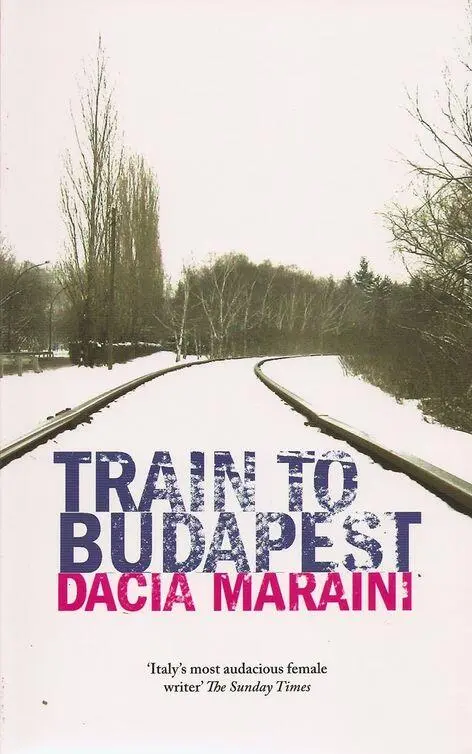
- Название:Train to Budapest
- Автор:
- Издательство:Arcadia Books
- Жанр:
- Год:2011
- ISBN:9781908129086
- Рейтинг книги:4 / 5. Голосов: 1
-
Избранное:Добавить в избранное
- Отзывы:
-
Ваша оценка:
Train to Budapest: краткое содержание, описание и аннотация
Предлагаем к чтению аннотацию, описание, краткое содержание или предисловие (зависит от того, что написал сам автор книги «Train to Budapest»). Если вы не нашли необходимую информацию о книге — напишите в комментариях, мы постараемся отыскать её.
Train to Budapest — читать онлайн бесплатно полную книгу (весь текст) целиком
Ниже представлен текст книги, разбитый по страницам. Система сохранения места последней прочитанной страницы, позволяет с удобством читать онлайн бесплатно книгу «Train to Budapest», без необходимости каждый раз заново искать на чём Вы остановились. Поставьте закладку, и сможете в любой момент перейти на страницу, на которой закончили чтение.
Интервал:
Закладка:
Amara smiles. ‘Was it really the cobbler who did it?’ she asks tenderly, remembering her father Amintore.
‘An uneducated but remarkably ingenious cobbler.’ There is something tender and happy in the voice of the man with the
‘Who told you this story?’
‘It’s an old legend. It’s more important to know how to tell stories than to know how to use your fists my mother used to say, and I know now she was right.’ He smiles with his lips together. His laugh is restrained and vigilant, the laugh of a man who has learned always to keep himself under control, both in joy and in pain.
An anonymous room, shabby little brown leatherette armchairs, a glass-topped table with some dog-eared magazines whose pages look as if they have been constantly turned by bored hands. A big dirty window. A cage-like structure with inside it a woman in uniform, her face soporific and gloomy. Why are police stations all over the world so similar, shabby and anonymous, never welcoming?
They have to wait, not because there’s a queue, but because various officials haven’t yet arrived. This the sleepy-looking official explains, indicating the little leatherette armchairs whose cushions carry the imprint of the backs and bottoms of all those who have passed hours waiting for a passport or a certificate or power of attorney.
Finally a door opens and it’s their turn. The man of the gazelles talks quietly, in sophisticated and perhaps rather literary Polish. The police officer fixes him with a blank look but is nonetheless politely serious and attentive. Hans repeats what Amara has told him: ‘This lady, an Italian from Florence called Maria Amara Sironi, is trying to trace a childhood friend of hers, a certain Emanuele Orenstein. We know that at one time he was living in Italy, but in 1939 the family returned to Vienna to live in a large building they owned on Schulerstrasse. In 1941 they were ejected from their apartment and sent to the Łódź ghetto. Early in 1943 something happened that Emanuele did not have time to enter in his diary. We don’t know what it was, but we can imagine. He must have been loaded onto a train to Auschwitz, or so it seems. After 1942, all Jews in the Łódź ghetto were sent to Auschwitz. No more has been heard of him.’
‘How do you know all this, Dr Wilkowsky?’ asks the policeman, perhaps growing a little more interested in the story, seduced by Hans’s beautiful voice.
‘The Signora Maria Amara Sironi here present had letters from Vienna and later from the Łódź ghetto before Emanuele vanished. His last letters are in the form of a diary written in pencil in a black exercise book hidden in a hole and discovered after the war. A simple schoolbook with pages ruled in squares for doing sums, which some charitable person, perhaps even Emanuele Orenstein himself, posted to this lady at an address written inside it. We presume he was deported to a concentration camp. The nearest was Auschwitz, so he probably ended up there. But although Signora Sironi has been to the camp and examined the archives, she could not find his name.’
‘And how do you think I can help you after thirteen years?’
‘At Auschwitz they told her that some of the camp documents have been transferred to police archives here. We would like permission to study them.’
‘Water under the bridge, Signora Sironi. The dead are dead; let sleeping dogs lie — you know the proverb?’ translates Hans reluctantly.
‘Out of more than a million Jews deported to Auschwitz, six thousand survived to be liberated. Emanuele could have been among them.’
‘They disposed of the children immediately. Please remind your Italian friend of that. It is unlikely any child survived.’
‘But Emanuele was fifteen and seemed older than his years, and he was strong too, used to running and climbing trees. They may have kept him alive to work.’
‘All things are possible. But unlikely.’
‘Do you really have these documents? The lady is not only here to look for this boy. She also has to write articles for her newspaper. May we show you her press card?’
‘Don’t bother. I know nothing,’ answers the policeman in an undertone, immediately translated by Hans who in this instance shows himself an excellent interpreter. Amara feels the policeman is lying. Why would he not want her to poke her nose into the archives of the SS? Were there secrets the authorities preferred not to reveal to the inquisitive? Or was it that they couldn’t accept her as a journalist, only as a woman looking for a man, or rather a child, who vanished many years ago?
‘Don’t you think if he’s alive he would have got in touch with you?’ asks the policeman in broken German.
‘That’s what the man with the gazelles believes too,’ says Amara and hastily corrects herself, ‘that’s what Dr Hans Wilkowsky also believes. If he were alive, he would have got in touch. But I believe he could be alive, but may not have tried to get in touch with me. He was a proud boy. And then … he may have assumed I’m married, as in fact I was, and that I wouldn’t want to see him. He was discreet. But I really do think he could be alive and holding back and keeping silent.’
‘He says go back to Auschwitz and take a closer look,’ translates Hans quickly. ‘Sometimes they changed their names. Or, he says, you could go to Vienna. You could find their house. And who knows, there might even be some trace of him in the ghetto at Łódź. There’s nothing here to help you.’
The police officer is dismissing them. He pronounces the last words on his feet, leaning on his desk with both hands and smiling impatiently. All they can do is go.
‘We should never have come near the milicja !’ says Hans seriously, ‘now we’ll be followed.’
‘But if we’d been spies we’d hardly have gone to them, would we? Try to be logical.’
‘Logic has nothing to do with the way they do things.’
‘But are we being logical?’
‘We think we are. But we’re just taking action. And being stupid. You by insisting on hunting for someone who vanished in ’43. And I by encouraging you.’
‘I never asked you to.’
‘I know. But Amara, you don’t understand what the cold war is. Above all it is a climate of mutual suspicion. Logic is irrelevant. What do you want to do now?’
‘Let’s start by taking shelter. It’s begun raining again.’
The man with the gazelles and the young Italian woman whose name is the opposite of sweet walk quickly, looking for a café. But they can’t find one. Hans points to some steps leading to a revolving glass door. They go up them and enter the Hotel Kazimierz. Not a soul in sight. An enormous hall, that must have known better days, welcomes them to its icy shadows. Long billiard tables are hidden under white cloths. Weak lamps hang from a high ceiling. Carpets perhaps soft and elegant in the thirties but now stained reveal their history. In one corner is an enormous piano with an abandoned air. Beyond an arch are some small round tables with egg-coloured cloths and small artificial gardenias with dusty corollas in melancholy little vases.
They sit down at a corner table and order beers. The hotel has no wine or aperitifs. Only beer and coffee. Would they like something to eat? Amara indicates no. But Hans nods. Perhaps he has had no breakfast. What would he like? The ancient waiter, dubious pinkish hair combed across his bald skull, bends over Hans as if using his hands to try and hide the brownish marks on an apron that has not been clean for a very long time. Hans asks what there is to eat. Scrambled eggs. Bread and butter. Will that do? Fine.
Not long after they have settled at their table someone sits down at the piano that dominates the area beyond the arch. Two surprisingly light and delicate hands play the theme from The Third Man , a film that has been filling cinemas all over the world.
Читать дальшеИнтервал:
Закладка:
Похожие книги на «Train to Budapest»
Представляем Вашему вниманию похожие книги на «Train to Budapest» списком для выбора. Мы отобрали схожую по названию и смыслу литературу в надежде предоставить читателям больше вариантов отыскать новые, интересные, ещё непрочитанные произведения.







Обсуждение, отзывы о книге «Train to Budapest» и просто собственные мнения читателей. Оставьте ваши комментарии, напишите, что Вы думаете о произведении, его смысле или главных героях. Укажите что конкретно понравилось, а что нет, и почему Вы так считаете.