Mavis Gallant - Paris Stories
Здесь есть возможность читать онлайн «Mavis Gallant - Paris Stories» весь текст электронной книги совершенно бесплатно (целиком полную версию без сокращений). В некоторых случаях можно слушать аудио, скачать через торрент в формате fb2 и присутствует краткое содержание. Год выпуска: 2002, Издательство: NYRB Classics, Жанр: Современная проза, на английском языке. Описание произведения, (предисловие) а так же отзывы посетителей доступны на портале библиотеки ЛибКат.
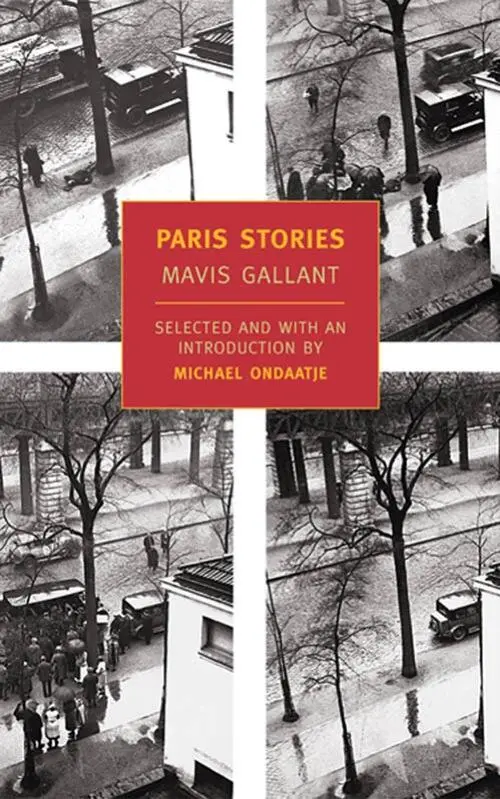
- Название:Paris Stories
- Автор:
- Издательство:NYRB Classics
- Жанр:
- Год:2002
- ISBN:нет данных
- Рейтинг книги:5 / 5. Голосов: 1
-
Избранное:Добавить в избранное
- Отзывы:
-
Ваша оценка:
Paris Stories: краткое содержание, описание и аннотация
Предлагаем к чтению аннотацию, описание, краткое содержание или предисловие (зависит от того, что написал сам автор книги «Paris Stories»). Если вы не нашли необходимую информацию о книге — напишите в комментариях, мы постараемся отыскать её.
Paris Stories — читать онлайн бесплатно полную книгу (весь текст) целиком
Ниже представлен текст книги, разбитый по страницам. Система сохранения места последней прочитанной страницы, позволяет с удобством читать онлайн бесплатно книгу «Paris Stories», без необходимости каждый раз заново искать на чём Вы остановились. Поставьте закладку, и сможете в любой момент перейти на страницу, на которой закончили чтение.
Интервал:
Закладка:
The mourners attending Mr. Cranefield's party reached the motor road and began to straggle across: It was a point of honor for members of the British colony to pay absolutely no attention to cars. The two widows had fallen back, either so that Barbara could make an entrance, or because the older woman believed it would not be dignified for her to exhibit haste. A strong west wind flattened the black dresses against their breasts and lifted their thick veils.
How will he hear me, Molly wondered. You could speak to someone in a normal grave, for earth is porous and seems to be life, of a kind. But how to speak across marble? Even if she were to place her hands flat on the marble slab, it would not absorb a fraction of human warmth. She had to tell him what she had done — how it was she, Molly, who had led the intruder home, let him in, causing Alec, always courteous, to remove himself first to the hospital, then farther on. Disaster, the usual daily development, had to have a beginning. She would go back to the cemetery, alone, and say it, whether or not he could hear. The disaster began with two sentences: “Mummy, this is Mr. Wilkinson. Mr. Wilkinson wants to tell you how he came to drive me home.”
Barbara descended the steps to Mr. Cranefield's arm in arm with her new friend, who was for the first time about to see the inside of an English house. “Look at that,” said the older widow. One of the peacocks had taken shelter from the wind in Mr. Cranefield's electric lift. A minute earlier Alec's sister had noticed, too, and had thought something that seemed irrefutable: No power on earth would ever induce her to eat a peacock.
Who is to say I never loved Alec, said Barbara, who loved Wilkinson. He was high-handed, yes, laying down the law as long as he was able, but he was always polite. Of course I loved him. I still do. He will have to be buried properly, where we can plant something — white roses. The mayor told me that every once in a while they turn one of the Russians out, to make room. There must be a waiting list. We could put Alec's name on it. Alec gave me three children. Eric gave me Lou Mas.
Entering Mr. Cranefield's, she removed her dark veil and hat and revealed her lovely head, like the sun rising. Because the wind had started blowing leaves and sand, Mr. Cranefield's party had to be moved indoors from the loggia. This change occasioned some confusion, in which Barbara did not take part; neither did Wilkinson, whose wrenched shoulder was making him feel ill. She noticed her children helping, carrying plates of small sandwiches and silver buckets of ice. She approved of this; they were obviously well brought up. The funeral had left Mr. Cranefield's guests feeling hungry and thirsty and rather lonely, anxious to hold on to a glass and to talk to someone. Presently their voices rose, overlapped, and created something like a thick woven fabric of blurred design, which Alec's sister (who was not used to large social gatherings) likened to a flying carpet. It was now, with Molly covertly watching her, that Barbara began in the most natural way in the world to live happily ever after. There was nothing willful about this: She was simply borne in a single direction, though she did keep seeing for a time her black glove on her widowed friend's black sleeve.
Escorting lame Mrs. Massie to a sofa, Mr. Cranefield said they might as well look on the bright side. (He was still speaking about the second half of the 1950s.) Wilkinson, sitting down because he felt sick, and thinking the remark was intended for him, assured Mr. Cranefield, truthfully, that he had never looked anywhere else. It then happened that every person in the room, at the same moment, spoke and thought of something other than Alec. This lapse, this inattention, lasting no longer than was needed to say “No, thank you” or “Oh, really?” or “Yes, I see,” was enough to create the dark gap marking the end of Alec's span. He ceased to be, and it made absolutely no difference after that whether or not he was forgotten.
GRIPPES AND POCHE
AT AN EARLY hour for the French man of letters Henri Grippes — it was a quarter to nine, on an April morning — he sat in a windowless, brown-painted cubicle, facing a slight, mop-headed young man with horn-rimmed glasses and dimples. The man wore a dark tie with a narrow knot and a buttoned-up blazer. His signature was “O. Poche”; his title, on the grubby, pulpy summons Grippes had read, sweating, was “Controller.” He must be freshly out of his civil-service training school, Grippes guessed. Even his aspect, of a priest hearing a confession a few yards from the guillotine, seemed newly acquired. Before him lay open a dun-colored folder with not much in it — a letter from Grippes, full of delaying tactics, and copies of his correspondence with a bank in California. It was not true that American banks protected a depositor's secrets; anyway, this one hadn't. Another reason Grippes thought O. Poche must be recent was the way he kept blushing. He was not nearly as pale or as case-hardened as Grippes.
At this time, President de Gaulle had been in power five years, two of which Grippes had spent in blithe writer-in-residenceship in California. Returning to Paris, he had left a bank account behind. It was forbidden, under the Fifth Republic, for a French citizen to have a foreign account. The government might not have cared so much about drachmas or zlotys, but dollars were supposed to be scraped in, converted to francs at bottom rate, and, of course, counted as personal income. Grippes's unwise and furtive moves with trifling sums, his somewhat paranoid disagreements with California over exchange, had finally caught the eye of the Bank of France, as a glistening minnow might attract a dozing whale. The whale swallowed Grippes, found him too small to matter, and spat him out, straight into the path of a water ox called Public Treasury, Direct Taxation, Personal Income. That was Poche.
What Poche had to discuss — a translation of Grippes's novel, the one about the French teacher at the American university and his doomed love affair with his student Karen-Sue — seemed to embarrass him. Observing Poche with some curiosity, Grippes saw, unreeling, scenes from the younger man's inhibited boyhood. He sensed, then discerned, the Catholic boarding school in bleakest Brittany: the unheated forty-bed dormitory, a nightly torment of unchaste dreams with astonishing partners, a daytime terror of real Hell with real fire.
“Human waywardness is hardly new,” said Grippes, feeling more secure now that he had tested Poche and found him provincial. “It no longer shocks anyone.”
It was not the moral content of the book he wished to talk over, said Poche, flaming. In any case, he was not qualified to do so: He had flubbed Philosophy and never taken Modern French Thought. (He must be new, Grippes decided. He was babbling.) Frankly, even though he had the figures in front of him, Poche found it hard to believe the American translation had earned its author so little. There must be another considerable sum, placed in some other bank. Perhaps M. Grippes could try to remember.
The figures were true. The translation had done poorly. Failure played to Grippes's advantage, reducing the hint of deliberate tax evasion to a simple oversight. Still, it hurt to have things put so plainly. He felt bound to tell Poche that American readers were no longer interested in the teacher-student imbroglio, though there had been some slight curiosity as to what a foreigner might wring out of the old sponge.
Poche gazed at Grippes. His eyes seemed to Grippes as helpless and eager as those of a gun dog waiting for a command in the right language. Encouraged, Grippes said more: In writing his novel, he had overlooked the essential development — the erring professor was supposed to come home at the end. He could be half dead, limping, on crutches, toothless, jobless, broke, impotent — it didn't matter. He had to be judged and shriven. As further modification, his wife during his foolish affair would have gone on to be a world-class cellist, under her maiden name. “Wife” had not entered Grippes's cast of characters, probably because, like Poche, he did not have one. (He had noticed Poche did not wear a wedding ring.) Grippes had just left his professor driving off to an airport in blessed weather, whistling a jaunty air.
Читать дальшеИнтервал:
Закладка:
Похожие книги на «Paris Stories»
Представляем Вашему вниманию похожие книги на «Paris Stories» списком для выбора. Мы отобрали схожую по названию и смыслу литературу в надежде предоставить читателям больше вариантов отыскать новые, интересные, ещё непрочитанные произведения.




Обсуждение, отзывы о книге «Paris Stories» и просто собственные мнения читателей. Оставьте ваши комментарии, напишите, что Вы думаете о произведении, его смысле или главных героях. Укажите что конкретно понравилось, а что нет, и почему Вы так считаете.