Robert Stone - A Flag for Sunrise
Здесь есть возможность читать онлайн «Robert Stone - A Flag for Sunrise» весь текст электронной книги совершенно бесплатно (целиком полную версию без сокращений). В некоторых случаях можно слушать аудио, скачать через торрент в формате fb2 и присутствует краткое содержание. Год выпуска: 2012, Издательство: Vintage, Жанр: Современная проза, на английском языке. Описание произведения, (предисловие) а так же отзывы посетителей доступны на портале библиотеки ЛибКат.
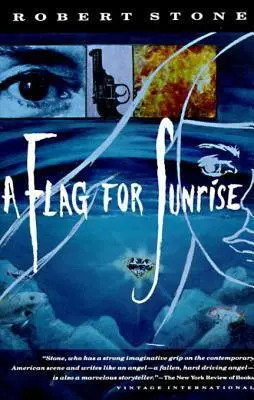
- Название:A Flag for Sunrise
- Автор:
- Издательство:Vintage
- Жанр:
- Год:2012
- ISBN:нет данных
- Рейтинг книги:4 / 5. Голосов: 1
-
Избранное:Добавить в избранное
- Отзывы:
-
Ваша оценка:
A Flag for Sunrise: краткое содержание, описание и аннотация
Предлагаем к чтению аннотацию, описание, краткое содержание или предисловие (зависит от того, что написал сам автор книги «A Flag for Sunrise»). Если вы не нашли необходимую информацию о книге — напишите в комментариях, мы постараемся отыскать её.
A Flag for Sunrise — читать онлайн бесплатно полную книгу (весь текст) целиком
Ниже представлен текст книги, разбитый по страницам. Система сохранения места последней прочитанной страницы, позволяет с удобством читать онлайн бесплатно книгу «A Flag for Sunrise», без необходимости каждый раз заново искать на чём Вы остановились. Поставьте закладку, и сможете в любой момент перейти на страницу, на которой закончили чтение.
Интервал:
Закладка:
“How are things going?”
“Oh,” she said, “not too bad.”
“Packing?”
“Yes,” she said. “Right.”
“How long have you been here now?”
“About six years.” She seemed to have to think about it. “Six it would be.”
“You’ll be sorry to leave then. Or will you?”
She pursed her lips as if she were trying unsuccessfully to smile.
“Yes, I’ll be sorry. I’ll be sorry to leave this way. To leave things as they are, when I might have helped more.”
“When you talk about things and how they are do you mean the country? The conditions?” He watched her then for a hint of suspiciousness; he was reminding himself of the secret policemen who started conversations with suspicious foreigners about the state of their countries. One found them all over.
“It’s a poor country.”
“With tourism coming down,” Holliwell said, “things might improve.”
“For some people they’ll improve.”
“Not for the campesinos? ”
“For a few of them. If they mind their manners and smile a lot.”
“You don’t read much in the papers about the politics here,” Holliwell said. “Not in the States.”
“I’m sure you don’t,” she said.
“You do read a few things though. Guerrilla stuff in the mountains. Makes you wonder who you ought to be for.”
“Good,” she said.
He laughed. “People like to tell you it’s the politics of bananas.”
“Sure,” she said, and her smile changed until it had a bitter turn to it. “It’s a banana republic. I’m sure that’s in the papers.”
“Strategic considerations aside,” Holliwell said, “bananas are worth fighting for. Any nutritionist can tell you that.”
“Really?”
Holliwell stood up, his eyes on hers. There was clear light there, when the film dissolved. The film of weariness or fear.
“If you don’t eat your bananas, you don’t get enough potassium. If you don’t get your potassium, you experience a sense of existential dread.”
“Now I’m a nurse,” she said, “and I never heard that.”
“You can look it up. One of the symptoms of potassium insufficiency is a sense of existential dread.”
“You’re the scientist. I’m supposed to believe what you tell me.”
“Certainly. And now you know why Tecan is vital to the United States.”
“The United States,” she told him, “may be in for a spell of existential dread.”
“What do you think will happen after you go?”
“There’ll be changes. I’m absolutely sure there will.”
“They say the more it changes here, the more it stays …”
She was shaking her head. “Changes,” she said.
“You mean … something like a socialist government?” It was a crude question and he was ashamed of it.
“The country is going to be overrun by its inhabitants. We may have to pay a little more for our potassium and our sense of cosmic certainty.”
“So,” Holliwell said, “we’re the bad guys again.”
“Look,” she told him, “they’re good people here. They suffer. Their kids die and they get pushed around and murdered. That’s all there is to the politics here — no more than that. Just people who need a break.”
“Will they get it?”
“If there’s any justice they will.”
“Is there any?”
“Yes,” she said. “Even here. Even Tecan isn’t beyond justice.”
“But it’s only a word. It’s just something in people’s heads.”
“That’s good enough,” she told him.
He had not been paying close attention to the things she said. There was no need for him to draw her out and sound her politics. Instead, he had been concentrating on the way she was, and in the time it took him to spin out his net of marginal civilities he had seen, or was persuaded he had seen, what fires were banked in her. Fires of the heart, of sensibility. There were plenty of engagés, he thought, plenty of them were honest and virtuous. She was different; she was heart, she was there, in there every minute feeling it. This kind of thing was not for him but he knew it when he saw it; he was not an anthropologist for nothing.
It’ll kill her, he thought, drive her crazy. Her eyes were already clouding with sorrow and loss. It was herself she was grieving and hoping for; for that reason she was the real thing. So he began to fall in love with her.
“Maybe it is good enough,” he said.
“Even here we have history. Things change. People want their rights.”
“Does history take care of people?”
“I wish I knew,” she said. “Maybe in the end. In the meantime people take care of themselves.”
“Yes,” Holliwell said.
Lady of sorrows, he thought, creature of marvel. It was enough for her that people took care of themselves. In the meantime.
I will show you, he thought, the war for us to die in, lady. Sully your kind suffering child’s eyes with it. Live burials beside slow rivers. A pile of ears for a pile of arms. The crisps of North Vietnamese drivers chained to their burned trucks.
He thought she was a unicorn to be speared, penned and adored. He was a drunk, middle-aged, sentimental. Foolish.
He wanted her white goodness, wanted a skin of it. He wanted to wash in it, to drink and drink and drink of it, salving the hangover thirst of his life, his war.
Why, he wondered, is she smiling at me? Then in a moment he thought he knew why, although he was sure that she did not. You did not have to be an anthropologist to know.
“I’ll see you tomorrow,” he said.
He would never bring it to that. He was more honorable than that, an honest man. But he was sure now and he did not feel ashamed for thinking it. Exalted rather and moved at her innocence in that regard, who was so wise.
The smile had left her face; she looked at him in slight confusion, raising a weary hand to her face.
“I’m supposed to have dinner,” Holliwell said, smiling. “I’m supposed to see the ruins.”
“Oh, my gosh,” she said. “I forgot.”
“Is it all right?”
She stammered, the hand touching her scarf.
“Not, not … for me. I mean I don’t think I can. But Father Egan will take you.”
“Good,” Holliwell said. “Well, I’ll see you anyway.”
“Yes,” she said. She had turned back in the direction from which she had come, she did not look at him again. “Take care. Take care of your leg.”
When she walked off he felt like crying. He stood up and walked the beach, hardly thinking of his leg. When he had been wandering around for a half hour, he found himself even with the ragged cabana where the Cuban and his friends were resting. It was their blender that attracted his eye. It was amazing how many people owned blenders in places like Tecan. Where there was electricity, even people with barely enough to eat seemed to have them. The Cuban was waving to him, motioning him over.
The man’s name, it turned out, was Miguel Soyer. He was tall and youthful with a square good-natured face, warm eyes under thick Celtic eyebrows. He did not much resemble his sister.
“You were diving with my brother-in-law, no?” Soyer asked as the three men with him watched politely from behind their dark glasses.
“Yes, indeed,” Holliwell said. He had been introduced to the others but had immediately lost their names. All of them had the sinister air that respectable businessmen so often projected in the South. Holliwell was not disturbed by it; it was an incongruity of appearance only, the result of a difference between Anglo and Latin expectations and masculine style.
“Twixt,” Soyer said. “Beautiful.”
“It was a fine day’s diving.”
Soyer turned and looked in the direction of the mission.
Читать дальшеИнтервал:
Закладка:
Похожие книги на «A Flag for Sunrise»
Представляем Вашему вниманию похожие книги на «A Flag for Sunrise» списком для выбора. Мы отобрали схожую по названию и смыслу литературу в надежде предоставить читателям больше вариантов отыскать новые, интересные, ещё непрочитанные произведения.






Обсуждение, отзывы о книге «A Flag for Sunrise» и просто собственные мнения читателей. Оставьте ваши комментарии, напишите, что Вы думаете о произведении, его смысле или главных героях. Укажите что конкретно понравилось, а что нет, и почему Вы так считаете.