Robert Stone - A Flag for Sunrise
Здесь есть возможность читать онлайн «Robert Stone - A Flag for Sunrise» весь текст электронной книги совершенно бесплатно (целиком полную версию без сокращений). В некоторых случаях можно слушать аудио, скачать через торрент в формате fb2 и присутствует краткое содержание. Год выпуска: 2012, Издательство: Vintage, Жанр: Современная проза, на английском языке. Описание произведения, (предисловие) а так же отзывы посетителей доступны на портале библиотеки ЛибКат.
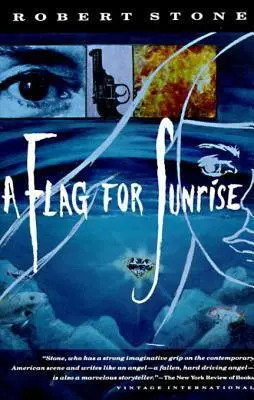
- Название:A Flag for Sunrise
- Автор:
- Издательство:Vintage
- Жанр:
- Год:2012
- ISBN:нет данных
- Рейтинг книги:4 / 5. Голосов: 1
-
Избранное:Добавить в избранное
- Отзывы:
-
Ваша оценка:
A Flag for Sunrise: краткое содержание, описание и аннотация
Предлагаем к чтению аннотацию, описание, краткое содержание или предисловие (зависит от того, что написал сам автор книги «A Flag for Sunrise»). Если вы не нашли необходимую информацию о книге — напишите в комментариях, мы постараемся отыскать её.
A Flag for Sunrise — читать онлайн бесплатно полную книгу (весь текст) целиком
Ниже представлен текст книги, разбитый по страницам. Система сохранения места последней прочитанной страницы, позволяет с удобством читать онлайн бесплатно книгу «A Flag for Sunrise», без необходимости каждый раз заново искать на чём Вы остановились. Поставьте закладку, и сможете в любой момент перейти на страницу, на которой закончили чтение.
Интервал:
Закладка:
“Hell, why not? I want him to feel he has a future with us.”
Negus laughed hoarsely.
“But watch him, Deedee. Watch him good. If he starts acting agitated like there’s too much on his mind, we want to know about it.”
“He always acts that way,” Deedee said. “So how will I know?”
“Intuit,” Callahan told her. “Intuit darkly, and get back with him. He shouldn’t be alone at all from this point.”
When she went out, Negus set the wheel to one-eight-zero and they settled back in their cockpit chairs. Negus lit his pipe.
“Jack, damnit,” he said after several minutes, “this here op … I wouldn’t give … well, I wouldn’t give you a Panamanian peso …”
“Do you have to?” Callahan asked, interrupting him. “Must you fucking say it again?”
Negus fell silent again. But only for a short time.
“That’s a damn fine woman, Jack. I hope you’re taking good care of her.”
“She takes care of me,” Callahan said. “She takes care of us all.”
In a clearing, three stelae stood in file, an even distance apart. Their bases were sunk in morning glory vines but some of the vines had been cut back to reveal the inscriptions and hieroglyphs.
The clearing had been part of a village plantation at different times; wax beans and wildly mutant gourds grew around the slight rise where the three standing stones were. It was bordered on three sides by tall ramon trees. A small stream, originating in the mountains, ran beside it toward the sea.
The place was an obsure joint property of the fruit company and the President’s family, adjoining the land donated to the mission. On certain maps it was marked as an archaeological site but — with the exception of the three stelae — it had been haphazardly denuded of its antiquities long before. A few adventurers hunted there still, at moderate risk. It was a forgotten place.
On the fourth side of the glade was what appeared to be a hill but was in fact a pyramid covered in jungle. It had been excavated forty years earlier, the apartment floors strained and sifted, the chacs removed and crated and sent to Philadelphia.
In the days before the arrival of antiquarians and smugglers, the people of the coast had buried their dead in the patch of salty, infertile soil that was closest to the plinths themselves. Some nameless ones were still interred there — the unknown and the Disappeared. Egan himself had come upon the corpse of an Indian child, somehow strayed from the Montana, and buried it beside the stream. A passer-by, following the path that led from the ocean to the falls at the head of the valley, might miss the stones and the buried pyramid entirely, in the filtered light and the many shapes and shades of green.
Now, Egan came up the path as the sunlight faded like mist from the forest, carrying a plastic briefcase and taking softly to himself. People were waiting for him at the stones. They were foreigners from the North, from South America and Europe. There were more than a dozen of them; their tents and hammocks were spread throughout the clearing. Young people of their sort, rarely seen before on that coast, had been turning up in increasing numbers, as though there were something for them there. Father Egan would come out and speak to them.
The easternmost stela, discolored from years of rubbings and centuries of weather, faintly showed the outline of a human figure, a man in a feathered headdress. The makings of a fire had been laid before it. As Egan took his place beside the stone marker, a slim young woman with a bandaged arm poured kerosene on the pile of sticks. The foreigners watched, reclining against their packs and ground cloths. Sitting apart from the rest was a hulking blond man with thick-browed elfin features and bright blue eyes.
When the fire was lit, Egan turned away from the group and leaned against the stone, eyes closed. It seemed to him he had a text. There was a cane fire in his brain. Wet-eyed, he rounded on them.
“Why seek ye,” he demanded, “the living among the dead?”
Someone giggled discreetly. Marijuana smoke floated on the still air.
“What are you doing here, children, a place like this?” He steadied himself, leaning on the stone. “You know when the Easter angel asked the woman at the tomb why she was crying she said: ‘Because they have taken away my Lord and I know not where they have laid him.’ ”
In the highest boughs, spider monkeys were singing out last reports, their sentries calling in from evening stand- to as the bands settled down for the night.
“Taken away,” Egan said. “Mislaid. No wonder she’s crying. Wouldn’t you? Don’t you?”
A few of the young people affirmed that they did.
“Of course you do. We all do. No matter how smart you are, some things are very hard to lose.”
A girl with a fever began to sing. She lay resting her head on her companion’s lap.
“This is a dead place,” Egan said. “It’s a boneyard, that’s why we’re here. It’s history,” he told them. “It’s the world.”
“Not my world,” said a man who was older than the others and drunk. “Not by a long shot.”
Egan ignored him.
“It’s another city on a hill, you see. An earthly historical city — very grand. Here we celebrate what dies. What fails. What is mislaid.”
“What about the bright side?” the man said. “Is there one?”
“Certainly,” Egan said. “But it has nothing to do with you. You’re not on it.”
Pablo and Deedee sat under the work lights aft of the ice hatches, mounted on upturned shrimp baskets, their backs against the lazaret. Over the open hatches the coiled net swung like a dun banner, anchored between the paired stabilizers and the chain drag line. The drag lay covered in a confetti of brightly colored chafing gear that was heaped over it; the pile looked like the wreckage of a carnival float. Before them, under the bright lights, was a living creeping jambalaya, a rapine of darkness and depth. In thousands, creatures of hallucination — shelled, hooded, fifty-legged and six-eyed — clawed, writhed, flapped or devoured their way through the mass of their fellow captives, the predators and the prey together, overthrown and blinded, scuttling after their lost accustomed world.
“Dig in, Pablo buddy,” Deedee said. “I guess you know a shrimp when you see one, right?”
Pablo stared silently into the mass of struggling life at his feet. Deedee stood up, walked carefully to the edge of the swarm and plucked from it in her gloved hand a two-foot barracuda. Grasping the struggling fish behind its row of teeth, she tossed it over the side.
“Poor baby,” she said. She worked with a joint between her lips. “Might be another one in there,” she told Pablo, sitting back down on the basket. “You want to watch where you stick your hands.”
Pablo leaned forward, picked up a shrimp and looked at it in his palm.
“There you go,” Deedee said, “that’s one right there. When you have a basket full of those little fellas you stick it down in the hold. If we were the honest folk we pretend to be we’d take their heads and legs off. But we’re not, so we won’t.”
He did not care for the way she watched him. She was smiling and high, but there was a guilty wariness beneath her chatter and high spirits. Pablo knew little about shrimping but he believed he knew rather a lot about female anxiety. How they looked when they were turning you around. How they smiled when they were scared.
He crushed the shrimp he was holding in his right fist and with the fingers of his left hand, pulled its head off. The gesture of petty violence seemed in no way to alarm her. She went on looking him happily in the eye but he knew she had seen and interpreted his vague threat. She was very tough, he thought, she was different from other women. And they were playing a game. The thought of games was hateful to him now, it savored of Naftali’s whisper.
Читать дальшеИнтервал:
Закладка:
Похожие книги на «A Flag for Sunrise»
Представляем Вашему вниманию похожие книги на «A Flag for Sunrise» списком для выбора. Мы отобрали схожую по названию и смыслу литературу в надежде предоставить читателям больше вариантов отыскать новые, интересные, ещё непрочитанные произведения.






Обсуждение, отзывы о книге «A Flag for Sunrise» и просто собственные мнения читателей. Оставьте ваши комментарии, напишите, что Вы думаете о произведении, его смысле или главных героях. Укажите что конкретно понравилось, а что нет, и почему Вы так считаете.