Robert Stone - A Flag for Sunrise
Здесь есть возможность читать онлайн «Robert Stone - A Flag for Sunrise» весь текст электронной книги совершенно бесплатно (целиком полную версию без сокращений). В некоторых случаях можно слушать аудио, скачать через торрент в формате fb2 и присутствует краткое содержание. Год выпуска: 2012, Издательство: Vintage, Жанр: Современная проза, на английском языке. Описание произведения, (предисловие) а так же отзывы посетителей доступны на портале библиотеки ЛибКат.
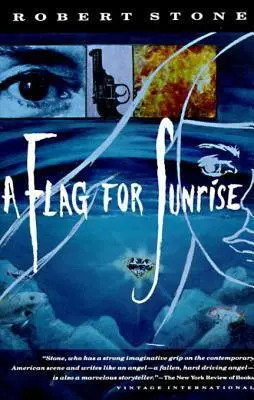
- Название:A Flag for Sunrise
- Автор:
- Издательство:Vintage
- Жанр:
- Год:2012
- ISBN:нет данных
- Рейтинг книги:4 / 5. Голосов: 1
-
Избранное:Добавить в избранное
- Отзывы:
-
Ваша оценка:
A Flag for Sunrise: краткое содержание, описание и аннотация
Предлагаем к чтению аннотацию, описание, краткое содержание или предисловие (зависит от того, что написал сам автор книги «A Flag for Sunrise»). Если вы не нашли необходимую информацию о книге — напишите в комментариях, мы постараемся отыскать её.
A Flag for Sunrise — читать онлайн бесплатно полную книгу (весь текст) целиком
Ниже представлен текст книги, разбитый по страницам. Система сохранения места последней прочитанной страницы, позволяет с удобством читать онлайн бесплатно книгу «A Flag for Sunrise», без необходимости каждый раз заново искать на чём Вы остановились. Поставьте закладку, и сможете в любой момент перейти на страницу, на которой закончили чтение.
Интервал:
Закладка:
“Wouldn’t that be great,” Marie said.
“I’m a fucking master of destiny,” Zecca said. “My family is related to Napoleon’s. I’m gonna get down with those Chinese.”
“Listen to him,” Marie said. “I hope you realize we’re all drunk here.”
“I realize it,” Holliwell said. “I wouldn’t have it any other way.”
“But, Jesus,” Marie went on a little sadly, “I wish we could trust you. I mean, we don’t even know who you are and here we’re talking about the Chinese.”
“You know who I am and you can trust me,” Holliwell said. “Personally, I enjoy talking about the Chinese.”
“Well, one day,” Zecca said, “this army will get me and the Chinese together and together we are gonna be the fucking Yellow Peril.”
“Include me in,” Holliwell told him. “As far as possible.”
“There have been Chinese for five million years, man,” the captain said. “I don’t know how long there’s been Zeccas but I know there’s one thing that Zeccas and Chinese have in common. We know how the world goes.” He took a little salt from the edge of his margarita glass and rubbed the grains between his fingers. “We know the price of salt. The Americans forget, if they ever knew. But Zeccas and Chinese will always know.”
Holliwell toasted the ancient wisdom of the Zeccas and the Chinese.
“Cole doesn’t know shit. Fat Frank doesn’t know shit. El General — well, he’s an ape. You, sir,” he said, addressing Holliwell, “I don’t know what you know. I won’t presume to speculate. But things don’t work the way people think.”
Holliwell shrugged. “I know that my redeemer liveth,” he said. The Zeccas stared at him. It was too Protestant a text.
After a moment, Tom laughed.
“We have a proverb, sir, in my grandfather’s country. In his island. I’m positive they have the same proverb in China. It goes ‘To trust is good. Not to trust is better.’ ”
“A salute ,” Marie said, and they drank the last of the margaritas.
“To Sicily,” Holliwell said.
Captain Zecca’s face seemed suddenly drained of good feeling. In the light from the living room, the shadow of his thick brows masked his eyes, high cheekbones and the arch of his nose covered the play of his thin lips.
“To the price of salt,” he said, “and the ten pains of death. Which is all we really know.”
Marie sighed. Holliwell held his seat until Captain Zecca rose from the table. He had seen such drinking parties in Vietnam and sometimes they ended badly. Zecca had begun to “sir” him rather a lot, a bad signal.
“Next month,” Captain Zecca said, as they all staggered off to show Holliwell to his quarters, “we have to have twenty barrels of green beer. The way things get done in this country we better get on it now.”
The room to which Holliwell was shown was small and comfortable, typical of the house; a touch of suburbia, a touch of Spanish formality. It had its own bath.
“Green beer!” Marie said. They shook hands all round.
“Good night, Doc,” the captain said. “Great ride.”
“Really,” Marie said.
Holliwell thanked them profusely, excessively.
Washing up in the small neat bathroom, he could hear them plainly when he turned off the tap. They were in the kitchen.
“St. Patrick’s Day,” Captain Zecca was telling his wife. “It’s in March.”
“Oh, you’re kidding,” Marie said.
“Like hell I’m kidding. I’ve got to locate this individual who can dye beer green without poisoning the whole station.”
“That’s too goddamn ridiculous,” she said.
Sitting on his bed, Holliwell could still hear them.
“Some Kraut, maybe. They’ve gotta have some Kraut over at the Germania brewery. Maybe he can do it.”
“He’ll think you’re crazy.”
“Fuck him.”
“Tom — in this town — they’ll dye it with old socks and deadly nightshade.”
“We’ll find a Kraut,” Captain Zecca said. “We’ll make him drink the first barrel.”
Marie was giggling as they went to bed.
“Green Tecanecan beer for St. Patrick’s Day. That’s the living end. Will anybody mind if I stick with agua mineral ?”
Holliwell heard them laughing together until he went to sleep.
Pablo woke to the goony birds. He had propped a chair against the doorknob; he was lying in a soiled mesh hammock in a bare evil-smelling room. Roaches in the size and quantity of delirium were scurrying across the slat floor, stripes of hard sunlight came in through the closed battered shutters. He struggled out of the hammock and took a Benzedrine at once. On the floor, he found an empty pack of the local cigarettes; he poured his remaining tablets into the packet and folded it away in his shirt pocket.
His clothes and his body were sweaty and rank and it had been days since he had been able to brush his teeth properly. This was a particular discomfort to a young man of Pablo’s fastidiousness.
Downstairs, Cecil was cooking refritos in a kitchen off the bar.
“Don’t you never sleep, Cecil?”
Without a word, Cecil came out of the kitchen and threw a plastic bag on the bar that contained Pablo’s passport and his turista card. Beside it he placed the blue duffel bag that Pablo had come south with.
“Twenty,” Cecil said. “Damn cheap at de price.”
Pablo paid him.
“De bus station — you know where it is. Take de bus to Palmas — make sure. In Palmas go on down to de quays and you see de Cloud. Das de name of her — de Cloud. Goin’ to be your new home.”
“See you, Cecil.”
“Hope so, mon. Hope you be doin’ all right. Find out de use of you, all like dat.”
“Shit,” Pablo said.
Cecil watched him walk out with his gear and went back to the beans.
The bus to Palmas ran past mile upon mile of banana plantation. One of them was enclosed by a chain link fence surmounted with barbed wire; at its gate was a Coca-Cola sign with its center board replaceable for the inclusion of the name of the establishment on whose behalf Coca-Cola was prepared to extend its welcoming logo. The sign read: “Coca-Cola — Bienvenidos a — LA COLONIA PENAL.”
The bus stopped often and it was crowded. There were a few women with children but most of the passengers were young plantation workers wearing machetes hung in leather sheaths from their belts. Listening to them speak together in a soft-edged Spanish of which he could pick up scarcely a word, Pablo fell victim to his wonted suspicions. That they were mocking him, taking counsel in avian trills and hisses to plot his undoing, seemed as obvious to him as the cloudless sky and the green mountains. Pablo was scornful of their ill intentions; he was armed, as was his custom, with a Dacor diver’s knife strapped to his calf and the automatic pistol bolstered against his armpit.
But the passengers in the bus aroused within Pablo another sensation and it was one on which he scarcely dared reflect. As his guarded glance swept the people pressed close around him, he felt that he could anticipate every smile and gesture that he saw. There was a secret self inside him that knew their rhythms and their stirrings, even knew their thoughts. In the hot cramped space he realized suddenly that he had some kinship of the blood with these dark stunted people whom he so despised — that they were, however distantly, his mother’s people and in that way, his own. It did not make him feel in the least warm toward them.
Palmas was a gas station at the end of a dirt street that led past mean wooden shacks to the ocean. Pablo climbed off the bus with his gear and walked the length of it. He paused at the dockside — there were a few shops and bodegas and the office of the captain of the port. Tied up at the two piers were two dozen local shrimp boats of seventy or eighty feet, their wheelhouses painted in bright tropical colors like the local buses. There was no craft in sight that looked as though it would be the Callahans’ powerboat. He put on his Macklin Chain Saw hat, took his sunglasses from the pocket of his shirt and looked from one quarter of the harbor to the other. Nothing but shrimpers. He walked out on the pier, set his bag down and leaned against a piling, cursing under his breath.
Читать дальшеИнтервал:
Закладка:
Похожие книги на «A Flag for Sunrise»
Представляем Вашему вниманию похожие книги на «A Flag for Sunrise» списком для выбора. Мы отобрали схожую по названию и смыслу литературу в надежде предоставить читателям больше вариантов отыскать новые, интересные, ещё непрочитанные произведения.





Обсуждение, отзывы о книге «A Flag for Sunrise» и просто собственные мнения читателей. Оставьте ваши комментарии, напишите, что Вы думаете о произведении, его смысле или главных героях. Укажите что конкретно понравилось, а что нет, и почему Вы так считаете.