Robert Stone - A Flag for Sunrise
Здесь есть возможность читать онлайн «Robert Stone - A Flag for Sunrise» весь текст электронной книги совершенно бесплатно (целиком полную версию без сокращений). В некоторых случаях можно слушать аудио, скачать через торрент в формате fb2 и присутствует краткое содержание. Год выпуска: 2012, Издательство: Vintage, Жанр: Современная проза, на английском языке. Описание произведения, (предисловие) а так же отзывы посетителей доступны на портале библиотеки ЛибКат.
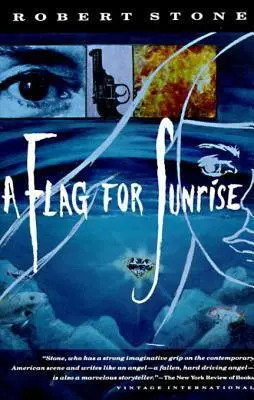
- Название:A Flag for Sunrise
- Автор:
- Издательство:Vintage
- Жанр:
- Год:2012
- ISBN:нет данных
- Рейтинг книги:4 / 5. Голосов: 1
-
Избранное:Добавить в избранное
- Отзывы:
-
Ваша оценка:
A Flag for Sunrise: краткое содержание, описание и аннотация
Предлагаем к чтению аннотацию, описание, краткое содержание или предисловие (зависит от того, что написал сам автор книги «A Flag for Sunrise»). Если вы не нашли необходимую информацию о книге — напишите в комментариях, мы постараемся отыскать её.
A Flag for Sunrise — читать онлайн бесплатно полную книгу (весь текст) целиком
Ниже представлен текст книги, разбитый по страницам. Система сохранения места последней прочитанной страницы, позволяет с удобством читать онлайн бесплатно книгу «A Flag for Sunrise», без необходимости каждый раз заново искать на чём Вы остановились. Поставьте закладку, и сможете в любой момент перейти на страницу, на которой закончили чтение.
Интервал:
Закладка:
On corners, vendors sold roasted maize from pushcarts, barefoot families made their way along the damp walls, ready to press back against them as cars passed. At the intersection where there was a little light, groups of young men in bright plastic shirts stood together drinking rum, listening or singing to someone’s guitar. There was much music to be heard — but these streets were not festive or lyrical. The mood was restless — febrile, Holliwell thought — furtive. The songs were short on melody, driven and mocking, calling forth from those who listened a hard humorless laughter. Holliwell could not understand a word of the shouted, perversely inflected Tecanecan Spanish that went back and forth in the darkening streets as they passed. He and Cole were tense and silent.
“Late at night,” Marie said, “these are bad streets.”
Holliwell caught a whiff of marijuana on the air, something he had never experienced before in a public place in a Spanish-American city. From a nearby street, he heard what seemed to be screaming.
“Pretty lively for this time of evening,” he said.
Zecca pulled his head back in and steered carefully round a turn.
“It’s always lively on this side of town. It’s one big bad party.”
Someone fired a water gun at Cole’s closed window. Cole looked at the dirty water streaking down the glass beside him.
“Hey, Cole,” Zecca said, “a lot of the people here are from Extremadura. You could find out a lot by checking it out over here, discreetly. In the daytime.”
“I think I’d do better out there, don’t you? I mean, I’d feel kind of heavy-footed around here. I’d be drawing crowds.”
“You’re gonna draw crowds anywhere,” Zecca said. It was uncertain whether he was speaking generally in reference to the country or of Cole.
Holliwell began to notice that there were a surprising number of cars in the narrow streets, most of them American cars only a few years old. They drove along a block of open arcaded shops and came on a cathedral square centered on a monumental obelisk. The rotary around it ran its course like a mechanized feeding frenzy, a riot of oversized cars in every condition, bad driving and ostrich optimism.
“Well, shit,” Zecca said, and drove the Honda into it. Marie clung to the back of her seat, her face on her arm. Cole and Holliwell held to the top of the car interior.
They went halfway around the rotary and up a wide, park-sided avenue that ran between the cathedral square and another plaza, visible in the distance, where there were neon signs and taller buildings — office buildings lit on every story.
To one side of the avenue along which they drove was a forest of low trees, divided from the broad clean sidewalk by a high barred fence. On the other side there was more greenery. There, only the tops of trees were visible because the thick wire fence along the street was backed with a wall of cactus.
“On your right here,” Tom Zecca said, “behind the wire and the cactus and the German shepherds is the palace of the President. Over there is the Central Park and the Zoo, famous for its three-legged cow.
“There are about ten thousand people bedding down in that park now. They’re a lot worse off than the people back there in Mamalago. But the nearest shack is more than a mortar’s distance away from the Palace. That’s a trick we taught the President. Anything closer is patrolled by the Guardia. The cracks in that obelisk back there came from the earthquake ten years ago. The people in Mamalago moved into the park and some of them never moved back. Then more folks came down from the hills and took over the houses in Mamalago. If you’re in Mamalago it’s rough, but it’s better than the park. Mamalago and the park are better than the shanty towns on the west slope. If it were still light, you’d have got a good look at the cathedral and you’d have seen the Palace of Culture beside it.”
“Where they have the midget wrestling,” Marie said.
“What’s the obelisk for?” Cole asked.
“Usual shit,” Zecca said. “Victory and independence and successful struggle. Tecan always wins. It won the Second World War.”
It was a dead-hot city, sea level and without hope or promise of an ocean breeze. As they drove along the ceremonial avenue, the day’s heat welled up from the earth; the mixed smell of the jungle plants and of cheap gasoline threatened to close off breath.
As they passed the palace gatehouse the smells, the sight of the sentry box in its well of light under the jacaranda, the brown sawed-off soldiers in MP’s helmets brought Holliwell such a Vietnam flash that he was certain that they must all be feeling it together. It awakened in him so potent a mixture of nostalgia and dread that in spite of the morning booze-up which was still fouling his blood, he began to feel like a drink.
No one said a thing.
When they made the turn into traffic at the end of the drive he half expected to see noodle restaurants beside the cinema with its cheap imported karate thriller — but there were record shops and farmacias instead and the street vendors sold roasted nuts and empanadas and the city smell was of cigars and pomade and dust instead of fish sauce and incense and bougainvillea.
Some things were the same though. The empty stares, the demented traffic — even the newly built bus station had about it something of the curving hand-me-down art deco of downtown Saigon. There were beggars clustered about its doors with little paper cartons full of cigarettes or chewing gum and fruit or sometimes only brown outstretched open palms. And the markets would be behind the bus station, where they always were, in Tecan as in Danang or Hue.
“As close to the bus station as you can get,” Bob Cole said, “will suit me fine.”
“You’re not trying for Extremadura tonight?” Marie protested. “You’ll get there in the wee hours. You’ll have no place to sleep.”
“My little red book says there’s a through bus in two hours,” Cole told her. “I’ll wander around town a little and get it.”
When they pulled up at the bus station both Tom and Marie turned around to check that their car was out of traffic.
“Stay the night with us,” Marie said. Tom, beside her, was nodding.
“No, thanks,” Cole told them. “Look,” he said to Tom Zecca, “maybe someone from the consular office should know I’m up there. If that’s the case, you tell them. O.K.?”
“You’re making a mistake,” Zecca said. “That’s the advice of the consular office. As conveyed by me.”
“Well, it doesn’t matter,” Cole said. He climbed out of the car and started into the crowds in front of the bus station. The beggars were on him at once.
“How do you like that?” Marie said. “He’s out of his mind.”
Carefully Zecca pulled the car into traffic again, and rounded the bus station block.
“He broke up with his wife,” Tom said. “I think I remember him telling me that.”
In the market behind the station the stalls were beginning to close. The streets at this end of the city were very like the streets at the lakeside with their mud roadways and high broken curbs. The same morose groups were gathered at corners.
“Shit, the guy’s crazy,” Zecca said. “He’ll get macheted up there. And he better not wander off from the bus station or he won’t even get that far. This is no town for midnight strolls.”
The Zeccas lived in a house high on the slope above the town, a street of middle-class houses with little stucco walls in front of them. At the end of their comfortable street, the shacks began, cut off from the bourgeois fortress by a barricade of barbed wire, rusted road signs and sheet metal: as they drove the Honda into their garage and began unloading their gear, a chorus of unseen dogs set up a cry from one end of the street to the other.
Читать дальшеИнтервал:
Закладка:
Похожие книги на «A Flag for Sunrise»
Представляем Вашему вниманию похожие книги на «A Flag for Sunrise» списком для выбора. Мы отобрали схожую по названию и смыслу литературу в надежде предоставить читателям больше вариантов отыскать новые, интересные, ещё непрочитанные произведения.




Обсуждение, отзывы о книге «A Flag for Sunrise» и просто собственные мнения читателей. Оставьте ваши комментарии, напишите, что Вы думаете о произведении, его смысле или главных героях. Укажите что конкретно понравилось, а что нет, и почему Вы так считаете.