John McGahern - The Pornographer
Здесь есть возможность читать онлайн «John McGahern - The Pornographer» весь текст электронной книги совершенно бесплатно (целиком полную версию без сокращений). В некоторых случаях можно слушать аудио, скачать через торрент в формате fb2 и присутствует краткое содержание. Год выпуска: 2009, Издательство: Faber & Faber, Жанр: Современная проза, на английском языке. Описание произведения, (предисловие) а так же отзывы посетителей доступны на портале библиотеки ЛибКат.
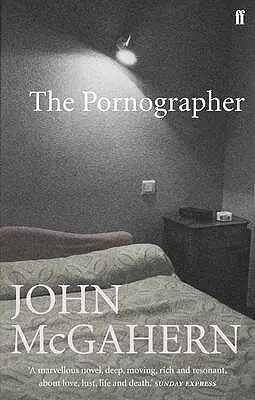
- Название:The Pornographer
- Автор:
- Издательство:Faber & Faber
- Жанр:
- Год:2009
- ISBN:нет данных
- Рейтинг книги:4 / 5. Голосов: 1
-
Избранное:Добавить в избранное
- Отзывы:
-
Ваша оценка:
The Pornographer: краткое содержание, описание и аннотация
Предлагаем к чтению аннотацию, описание, краткое содержание или предисловие (зависит от того, что написал сам автор книги «The Pornographer»). Если вы не нашли необходимую информацию о книге — напишите в комментариях, мы постараемся отыскать её.
The Pornographer — читать онлайн бесплатно полную книгу (весь текст) целиком
Ниже представлен текст книги, разбитый по страницам. Система сохранения места последней прочитанной страницы, позволяет с удобством читать онлайн бесплатно книгу «The Pornographer», без необходимости каждый раз заново искать на чём Вы остановились. Поставьте закладку, и сможете в любой момент перейти на страницу, на которой закончили чтение.
Интервал:
Закладка:
“I am,” I shouted back. “And you?” Before her wan smile could take on meaning, it drifted off into the noise and smoke and came back changed.
The summer air, the clean streetlights, their unreal clarity shook me when I stepped outside, and the harsh words, “You’re drunk.”
“I’m tipsy. How can a man know he’s drunk and still be drunk, know he’s a fool and still be a fool, be a thief. I must be drunk.”
“You’re tipsy, then. You’re far too tipsy to go back to the hotel. You can sleep the night in the flat. The short walk back there would even do you good.”
“I can’t,” I hiccuped, leaning against the outside wall of the pub, the car park and the forecourt crowded. Limited Plan Number One (not to go back to the flat) came floating silently to my aid, waving its delicate legs like a deep-sea diver approaching a submerged wreck.
“You wouldn’t have to sleep with me. I’ll sleep on the floor,” she said.
“I’d want to sleep with you. And it’s me that should sleep on the floor, but I can’t. I have to go to the hotel.”
“You can go in the morning.”
“No, I’m as well to go now. I’m well able to. I have to see if any message has come for me.”
“I’ll come with you, so,” she took me by the arm.
“I’ll be able to manage,” but she ignored it.
I stumbled on the stairs, but I was conscious enough on the journey to be grateful for the grace of complete avoidance of everything that my condition conferred, and at the hotel the note was waiting that I had arranged to be there. I gave her the note to read in the lobby. I had to go back the next day. It was not so urgent, I said, that I’d have to take a plane. I could go on the nightboat and train. That way we could have most of the day together. We kissed and I saw her to the door after she said she’d call for me at eleven the next morning. I got my key off the porter and I saw him take his eyes from whatever he was reading to watch my feet attempt the first few steps of the stairs.
I was awake but hardly daring to move with pain when she burst into the room the next morning. By the way she looked around I knew she’d been hurting herself with the fear that I might have some girl with me in the room.
“Is it eleven yet?”
“No. I’m early but when the man in the hall said you were in the room I thought I might as well come up rather than walk around till eleven.”
“That made sense. I feel horrible.”
“I don’t know what you wanted to go and drink so much for. Do you want me to go out and get you something for your head?”
“No. I might as well suffer it out now since I was so stupid. I’ll get up.”
Downstairs I paid for the room, and the man took in my bag behind the desk. The sun was out in Bloomsbury, the walls whitened with its light, and it hurt like hell. I was forced to laugh at the pain. We bought newspapers at the corner of Tottenham Court Road, crossed Oxford Street, and found an empty bench in Soho Square, and started to leaf in silence through the pages. Down in the bushes on the Greek Street side of the square a parliament of winos seemed to be in session. From time to time coins were collected on the grass, and one of their number left to return some minutes later with a quart of cider, which was passed around. To spin out this day like an invalid till the late train left Euston suited me well. When a person is both tired and ill they make few social mistakes. They make nothing.
“How do you feel now, love?” she leaned towards me after we’d been two hours or so on the bench and we kissed.
“Things are looking up. And you?”
“I feel a bit tired,” and she broke a long silence, “What are you thinking, love?”
“I was trying to figure out why those winos get all het up from time to time. And talk and jump about and wave. And they all just seem to sit down again.”
“Maybe that’s when something important comes up.”
“But what?”
“The price of cider? Who knows!”
After one o’clock we drifted down into a small pub that had flowers and bowls of nuts and a bald landlord leaned a shirt-sleeved arm on the counter. We had two drinks, stayed till it closed at two, and went back to the Italian restaurant we’d been to the day before. We teased out slow hours there with red wine and light dishes.
“It’s going to be a long, long winter. I should be in hospital by Christmas. The child is going to be a Christmas child. The worst will be the autumn. Some of my cousins will be in London for conferences. I’ll have to see them and it won’t be easy to hide my condition.”
“You can pretend you have to be out of town on some trumped-up business or other.”
“Not all the time. Tom, the engineer, the boy I used play with, has written with his dates already. He’ll be here in late October and staying at the Strand Palace. Boy, if I was out of town for that he’d not be long smelling a rat. He’d soon put two and three together.”
In the slow drip of her anxiety there was the temptation: let us get married, let us face out this horrible mess together, but a mere glimpse of the way she’d rise and warm to it was enough to kill it unspoken.
“You should have married Jonathan.”
“I should have done a lot of things and didn’t. There’s no use going over that now. I just couldn’t bring myself to do it.”
“Was Jonathan much hurt when you wouldn’t?”
“I suppose he was. I think he was in love with me for years. For years he’d been trying to get me to give up the job in the bank and come to London. We used often to talk about that, the irony of how it happened when it did happen, getting pregnant. I suppose his vanity was hurt too, but what was shocking was how businesslike he was about it. I saw him for the first time in his true colours then,” she said bitterly. “For all the champagne and tears and roses, people to him were just ciphers. He was brutal and domineering as well as sentimental but above all everything had a price.”
“Strange, out of all the ups and downs how starkly simple everything is now.”
“How?” she said sharply.
“You’ll have the child at Christmas. You’ll either keep it or adopt it.”
“It might be even simpler than that. I’m not that young for it to be all that simple, having a first child.”
I wanted to say, it’s not true that the old have shorter lives than the young. Many did not even get as far as us, no one has any rights in that line; but we had been in these waters before. They were choppy and disagreeable and led nowhere. It was almost five when we stepped out of the restaurant onto Old Compton Street.
“The train goes soon after eight. Will we break up here? I just have time to get my bag out of the hotel and make my way to Euston.”
“I’ll see you off,” she said. “Otherwise I’d just go back to the house and mope and cry. All I’d think of is that the train is leaving in such and such a time and every five minutes I’d check the clock.”
We sat in the late sun for half an hour in Soho Square. Some of the winos we had watched that morning were asleep, but others were still moving the bottle. One of the women dressed in a blue military overcoat seemed particularly angry. She muttered to herself and then took fits of shaking some of the men sleeping on the grass awake, talking to them in rapid bursts. All of them seemed to listen carefully to whatever she said and then to fall back to sleep.
After that we picked up the bag at the hotel and walked to Euston. We had an hour to wait and sat in the station bar.
“Can I give you money? I have plenty of money.”
“No. I’m even saving money. When I have to stop work I may need some and I’ll ask you then.”
“Whenever you want, but maybe you should take some now, just in case.”
Читать дальшеИнтервал:
Закладка:
Похожие книги на «The Pornographer»
Представляем Вашему вниманию похожие книги на «The Pornographer» списком для выбора. Мы отобрали схожую по названию и смыслу литературу в надежде предоставить читателям больше вариантов отыскать новые, интересные, ещё непрочитанные произведения.





Обсуждение, отзывы о книге «The Pornographer» и просто собственные мнения читателей. Оставьте ваши комментарии, напишите, что Вы думаете о произведении, его смысле или главных героях. Укажите что конкретно понравилось, а что нет, и почему Вы так считаете.