Hannah Kent - Burial Rites
Здесь есть возможность читать онлайн «Hannah Kent - Burial Rites» весь текст электронной книги совершенно бесплатно (целиком полную версию без сокращений). В некоторых случаях можно слушать аудио, скачать через торрент в формате fb2 и присутствует краткое содержание. Год выпуска: 2014, Издательство: Back Bay Books, Жанр: Современная проза, на английском языке. Описание произведения, (предисловие) а так же отзывы посетителей доступны на портале библиотеки ЛибКат.
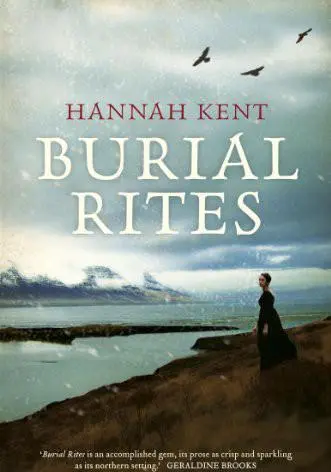
- Название:Burial Rites
- Автор:
- Издательство:Back Bay Books
- Жанр:
- Год:2014
- ISBN:нет данных
- Рейтинг книги:3 / 5. Голосов: 1
-
Избранное:Добавить в избранное
- Отзывы:
-
Ваша оценка:
Burial Rites: краткое содержание, описание и аннотация
Предлагаем к чтению аннотацию, описание, краткое содержание или предисловие (зависит от того, что написал сам автор книги «Burial Rites»). Если вы не нашли необходимую информацию о книге — напишите в комментариях, мы постараемся отыскать её.
Horrified at the prospect of housing a convicted murderer, the family at first avoids Agnes. Only Tóti, a priest Agnes has mysteriously chosen to be her spiritual guardian, seeks to understand her. But as Agnes's death looms, the farmer's wife and their daughters learn there is another side to the sensational story they've heard.
Riveting and rich with lyricism, BURIAL RITES evokes a dramatic existence in a distant time and place, and asks the question, how can one woman hope to endure when her life depends upon the stories told by others?
Burial Rites — читать онлайн бесплатно полную книгу (весь текст) целиком
Ниже представлен текст книги, разбитый по страницам. Система сохранения места последней прочитанной страницы, позволяет с удобством читать онлайн бесплатно книгу «Burial Rites», без необходимости каждый раз заново искать на чём Вы остановились. Поставьте закладку, и сможете в любой момент перейти на страницу, на которой закончили чтение.
Интервал:
Закладка:
‘I told Gudbjörg what Björn had said when I’d screamed that I wanted to die; that he had told me maybe I’d be next. Gudbjörg shushed me and said that Björn wasn’t himself, and didn’t mean it.
‘I told her how Björn had given me the baby to look after, and that I had held it tightly and that it had died in my arms, and I didn’t even notice.
‘Gudbjörg rocked me like I was a baby myself. She said that the child wasn’t meant for this earth, and that it wasn’t my fault it didn’t live. She told me that I was brave and that God would watch over me.’
‘Do you know where Gudbjörg is today?’ Tóti interrupted.
Agnes looked up from her knitting. ‘Dead,’ she said, unwaveringly. She pulled at the ball of wool to loose more thread.
‘When Ragnar, Kjartan and Björn returned from the barn, Rósa called Gudbjörg and me down from the loft and we all sat in the badstofa around the bed where Inga lay. She looked clean, but still. Eerie still, as when the wind drops and the grass doesn’t move, and you feel left behind.
‘Uncle Ragnar produced a flask of brandy and silently passed it around. That was the first time I tasted liquor, and I didn’t much care for it, but Jón had left on my foster-father’s horse to fetch the Reverend, and there was nothing to do but wait and drink. The hours creaked past, and I felt sick from the brandy and the bones in my legs grew stiff from sitting.
‘Jón didn’t return with the priest until late that night. I let them in. The Reverend forgot to knock the snow off his boots.
‘Gudbjörg, Aunt Rósa and I served the men food and they ate it off their laps, Inga on the bed in front of them. Aunt Rósa had lit a candle and placed it near Inga’s head, and I kept checking to see that it hadn’t fallen over; I was worried her hair would catch alight.
‘Once the men had eaten their food, the women took Kjartan and me to the kitchen while the Reverend spoke with the men. I tried to listen to what they were saying, but Aunt Rósa took my arm and pulled Kjartan onto her lap, and she started telling a story to distract us. She only stopped when Uncle Ragnar and Jón walked past the open doorway, carrying Inga’s body between them. They’d covered her face with a piece of cloth. I wanted to know where they were taking her and got up to follow, but Aunt Rósa tightened her grip around my arm and yanked me towards her. Gudbjörg quickly told me that the Reverend had said there was no chance of a burial until spring: the ground in the churchyard was frozen solid, and they were going to keep my poor foster-mother in the storehouse until the ground thawed and someone could dig a grave. We went to the doorway to watch them put Inga away.
‘The Reverend was following Björn down the corridor. I heard him say: “At least it leaves you plenty of time to make the coffins.” Then he suggested that they put her in the barn.
‘“Too warm,” my foster-father replied.
‘Uncle Ragnar and Jón laid Inga next to the dead baby in the storehouse. At first they put her down on a bag of salt, then Uncle Ragnar pointed out that the salt might be needed sooner than we could bury Inga, so they swapped the salt for dried fish, and I could hear the thin, dried bones of the cod snap in the sack, under the weight of her body.’
‘When did they bury her?’ Tóti asked. He suddenly felt claustrophobic sitting in the badstofa, surrounded by the muffled clicks of knitting needles and the rasp and squeak of wool.
‘Oh, not for a long time,’ Agnes said. ‘Inga and the baby were in the storehouse until the end of winter. Every time I had to fetch more lamp oil, or help Jón roll a barrel out to the pantry, I saw their bodies lying in the corner, bundled upon the sacks of dried fish.
‘Kjartan didn’t understand what had happened to his mamma. I suppose he forgot about the baby, but he always cried for Inga, sitting on the floor in the badstofa and howling like a dog. His pabbi ignored him, but when Uncle Ragnar visited, Kjartan received a cuff about the ears. He soon stopped crying.
‘Uncle Ragnar always seemed to be at Kornsá — talking with Björn in the badstofa, or bringing him brandy. Björn had grown more silent since the blizzard. When I served him his dinner he no longer thanked me, just picked up his spoon and began to eat.
‘And then one day I was told Björn didn’t want me any more. It must have been early spring, I was in a bad temper, and had refused to eat any dinner. My foster-father hadn’t said anything, not even a sharp word to tell me off for wasting food. He was spending all his time with the animals, which had begun to die from the cold, and I was frustrated that he loved them and Kjartan more than me.
‘Winter had turned and on this day there was a little light, so when I left the table I decided to go outside. No one stopped me. I stormed down the corridor and picked up the shovel that stood within the doorway, and began to dig out a path from the croft, relishing the feel of snow flecks upon my hot cheeks. Once I had cleared a way out, I threw the shovel aside and began to dig in the snow with my hands, taking huge armfuls and throwing them as far as I could. I worked until I had dug quite a large hole. When I paused to catch my breath, I looked up and noticed a black smudge in the distance: it was Uncle Ragnar on another of his visits. He greeted me and asked what I was doing covered in snow. I explained that I had begun to dig a grave for Mamma. Uncle Ragnar frowned and told me I shouldn’t call her Mamma, and wasn’t I ashamed of myself, thinking to bury her near the doorstep where everyone would tread on her, and not in the holy ground of a churchyard.
‘“Wouldn’t it be better to keep her warm in the storeroom until she can sleep in peace in consecrated ground?” he asked me.
‘I shook my head. “The storeroom is as cold as a witch’s tit,” I told him.
‘Uncle Ragnar said: “Watch your mouth, Agnes. Ugly words show an ugly mind.”
‘That night he told me that Björn was going to give up the lease for Kornsá and go to Reykjavík to work at the fishing stations. The winter had killed my foster-mother and her baby, as well as over half of Björn’s flock, and without a wife, and with nothing to pay the wages of another farmhand, Björn couldn’t afford to keep me. Kjartan went to live with his aunt and uncle, and when the weather warmed I was thrown on the mercy of the parish.’
‘And that is how you came to be an urchin,’ Tóti said.
Agnes nodded, pausing in her knitting to stretch her fingers. She rested the sock on her lap and looked up at him through the darkness. ‘That is how I came to be a pauper. Left to the mercy of others, whether they had any or no.’

I HAVE WOKEN EARLY, AND the badstofa is still heavy with shadows. I thought someone was bent low to my ear and whispering, Agnes, Agnes. The whisper severed me from my dreams, but there is no one here, and a cold dread suddenly drips through my heart.
I could have sworn someone was calling me.
I lie still and try to listen to the others breathe, so as to discern whether another is awake. Reverend Tóti is in the bed closest to me, having decided to sleep at Kornsá because of the lateness of the hour. But I know it wasn’t him who woke me. A priest would not wake a prisoner by whispering in her ear like a lover.
Minutes pass. Why is there so much darkness in the room? I can’t see my hands, although I hold them above my eyes. The gloom encroaches upon my mind, and my heart flutters like a bird held fast in a fist. Even when I force my eyes shut, the darkness is still there, and now, too, there are awful tremors of flickering light. Are my eyes open or shut? Perhaps it was a ghost who woke me — how can I explain these lights appearing in the murk before me? They’re like flames peeling off a wall, and Natan’s face is before me, his mouth wide in screaming, and his teeth bloody and shining, and his burning body dropping flakes of charred skin on my blankets. Everything smells of whale fat and Fridrik’s knife is deep in Natan’s belly, and a scream jerks from my chest as if it had been pulled from my gut by a rope.
Читать дальшеИнтервал:
Закладка:
Похожие книги на «Burial Rites»
Представляем Вашему вниманию похожие книги на «Burial Rites» списком для выбора. Мы отобрали схожую по названию и смыслу литературу в надежде предоставить читателям больше вариантов отыскать новые, интересные, ещё непрочитанные произведения.








Обсуждение, отзывы о книге «Burial Rites» и просто собственные мнения читателей. Оставьте ваши комментарии, напишите, что Вы думаете о произведении, его смысле или главных героях. Укажите что конкретно понравилось, а что нет, и почему Вы так считаете.