Jan Kjaerstad - The Discoverer
Здесь есть возможность читать онлайн «Jan Kjaerstad - The Discoverer» весь текст электронной книги совершенно бесплатно (целиком полную версию без сокращений). В некоторых случаях можно слушать аудио, скачать через торрент в формате fb2 и присутствует краткое содержание. Год выпуска: 2009, Издательство: Arcadia Books, Жанр: Современная проза, на английском языке. Описание произведения, (предисловие) а так же отзывы посетителей доступны на портале библиотеки ЛибКат.
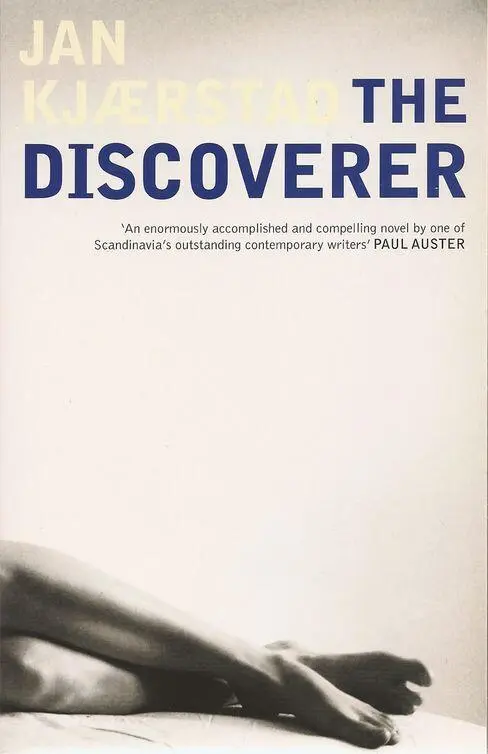
- Название:The Discoverer
- Автор:
- Издательство:Arcadia Books
- Жанр:
- Год:2009
- ISBN:нет данных
- Рейтинг книги:5 / 5. Голосов: 1
-
Избранное:Добавить в избранное
- Отзывы:
-
Ваша оценка:
The Discoverer: краткое содержание, описание и аннотация
Предлагаем к чтению аннотацию, описание, краткое содержание или предисловие (зависит от того, что написал сам автор книги «The Discoverer»). Если вы не нашли необходимую информацию о книге — напишите в комментариях, мы постараемся отыскать её.
The Discoverer — читать онлайн бесплатно полную книгу (весь текст) целиком
Ниже представлен текст книги, разбитый по страницам. Система сохранения места последней прочитанной страницы, позволяет с удобством читать онлайн бесплатно книгу «The Discoverer», без необходимости каждый раз заново искать на чём Вы остановились. Поставьте закладку, и сможете в любой момент перейти на страницу, на которой закончили чтение.
Интервал:
Закладка:
On the other hand, Jonas also had the definite impression that for Leonard the driving force was still wrath. That Leonard had rediscovered some of the Italian temperament from those evenings in the Red Room, a little of the bite of all those spicy sauces they had spooned over their pasta. The fiery grindings of the pepper mill. Either that or he had accomplished something which only very few ever manage: to preserve some of the indignation which we tend and nurture so carefully in our youth. Jonas could not help thinking that one should possibly take this as a lesson. Maybe everyone should have a little placard stuck to the fridge door of their settled, routine existences, a slip of paper saying: SAVE THE WRATH.
All the write-ups on Leonard Knutzen did, however, also lead Jonas to immerse himself in much more serious reflections. He was reminded of another time. He had, he recalled, not only been mad at the world. Once he had actually tried to open up the world. In junior high he had met a master, a schoolmaster, and before that Bo Wang Lee.
Uranus
In his youth Jonas Wergeland had the ability to follow several lines of thought at once. For long periods of time he also had the feeling that he was living parallel lives. While he may have spent some parts of the day in a basement, seething with rage, for other parts of the day he was, for example, at school — where he came across as a rather shy, polite and, not least, inquisitive young man.
The first time Jonas Wergeland saw the slogan ‘The real thing’ he thought, not of Coca-Cola, but of realskolen — junior high. For him, this truly was ‘real school’. It is not the case, as certain influential branches of psychology would have it, that our characters are formed by the time we are around seven. Things are not, I am glad to say, as dire as all that. Like the mighty banyan tree, human beings too can put down roots from branches high above. Jonas Wergeland received his ‘upbringing’, his most crucial stimuli, at junior high.
If it is true that from the cradle to the grave, from childhood games with stones to the puffing and blowing of old age, man lives out, as it were, the whole history of the species, then junior high was, for Jonas, a Renaissance, a revival of age-old learning, and particularly of the elementary knowledge instilled in him in ‘antiquity’, those three glorious first years at school. Not because he spent so much time with his chum Leonard, known as Leonardo, but because he came under the wing of a person, a teacher, who fully merited the epithet applied to individuals of exceptionally wide-ranging talent and cultivation: a Renaissance man.
Who was this person? Well it was certainly not the Iron Chancellor, who drummed the litany of German prepositions into their heads, nor was it Dr Jekyll, whom they had for English: on the surface a gentleman to his fingertips, dressed from top to toe in tweed and corduroy, but capable of exploding into the most pyrotechnical fits of rage, to which the snapping of a pointer was but the mildest prelude. Nor was it their enigmatic maths teacher, Miss Pi, who could stir a boy’s blood simply with the circular motions of her arms, or the Weed, their natural history teacher, who swooned at the very mention of the word ‘dissect’. And for any favour: forget PE teacher, Tamara Press. At an age when they positively oozed disrespect, only one person slipped through the needle’s eye of their tolerance. He was even exempt from the usual fiendish practical jokes, such as balancing the teacher’s lectern on the very edge of the dais or breaking off matchsticks in the lock of the classroom door. It is a mark of his standing that he did not even labour under a nickname. He was, quite simply, Mr Dehli. Jonas had him for Norwegian and history. In ancient myths and legends one often hears tell of inspired masters, the sort who teach the hero to fence or shoot with bow and arrow. Mr Dehli was such a master. Although the ‘e’ in his surname was actually sounded as ‘ay’ and the ‘l’ and the ‘h’ were the wrong way round, Jonas always pronounced it like that of the capital of India — for reasons which will later become apparent. ‘We’re not going to have Norwegian now,’ Jonas would think before his classes, ‘we’re going to have Indian .’
In all the heated debate which constantly rages around education reforms and books and buildings and grades, it is astonishing how people forget what a difference a teacher can make. You snore your way through years of deadly dull history lessons, then you have a reserve teacher for two periods and you’re hooked on the Thirty Years War or the books of Marguerite Yourcenar for life. Ask anybody — what they remember from school are the teachers. There is nothing to beat an inspiring teacher. There is no substitute — absolutely none — for the charisma of an enthusiast. And if anyone radiated infectious enthusiasm, it was Mr Dehli. He was never seen in the duster coats worn by some teachers in those days; he always came to school looking spruce and dapper in a white shirt, a jacket and a bow tie which was always hopelessly askew by the end of a zestful lesson, as if he had just been in a fight, or on a wild airplane ride. Jonas Wergeland said more than once that he had had only one real teacher in twelve years of schooling. It was also, and not unimportantly, Mr Dehli who introduced him to Maya.
It sometimes seemed to Jonas that it was not actually people who made him feel embarrassed. He was embarrassed by the world. Or for the world. Because of its alarming flatness. But thanks to Mr Dehli, after only a few months at junior high Jonas again began to discern a suggestion of depth, little glimpses of something behind the flatness. Through a fruitful process of repetition Mr Dehli also succeeded in reawakening the round-eyed joy of the first years at school; the delight of drawing a cow’s four stomachs, the pride in managing to construct a ninety-degree angle with the aid of compasses, the wonder aroused by a word like ‘accusative’. And suddenly Jonas understood the full magnitude of things: the purpose of the meridian concept, the consequences of Caesar’s statement when he crossed the Rubicon, the wealth of associations contained within a word like ‘stamen’. Mr Dehli got them to write whole stories in the pluperfect, or the past-future-perfect tense.
‘What is this?’ he asked during their first Norwegian period, writing a large H on the board so emphatically that chalk flew everywhere — Mr Dehli could pull a stick of chalk out of his jacket pocket quicker than any gunslinger. The whole class looked blank. ‘Take a good look,’ he said. ‘Can’t you see that it’s a ladder? Every letter in the alphabet is a ladder. Use them well and you’ll be able to climb wherever you please.’
Mr Dehli set out to elevate his pupils. Provide them with ladders to enable them to reach a higher plane. He never brought a pupil down. Instead, as an educator in the truest sense of that word, he drew out the best in them, drew from them things they did not even know they knew. He was not unlike a personage who would later appear on Norwegian television, the charismatic presenter of the musical quiz programme Counterpoint , Sten Broman who, like Mr Dehli, performed his duties dressed to the nines, in suits he designed himself, and had a knack for eliciting the correct answers from teams who, to begin with, seemed totally stumped; he seemed to take pride in bringing out the contestants’ subliminal knowledge.
Schoolmaster Dehli employed a number of unorthodox methods. When they were studying Ibsen, he turned up for class with a pocket mirror in one hand and his chest covered in medals. ‘It is impossible to understand Ibsen without also taking into account his vanity and his ambition,’ Mr Dehli declared. Who could forget something like that?
Читать дальшеИнтервал:
Закладка:
Похожие книги на «The Discoverer»
Представляем Вашему вниманию похожие книги на «The Discoverer» списком для выбора. Мы отобрали схожую по названию и смыслу литературу в надежде предоставить читателям больше вариантов отыскать новые, интересные, ещё непрочитанные произведения.


Обсуждение, отзывы о книге «The Discoverer» и просто собственные мнения читателей. Оставьте ваши комментарии, напишите, что Вы думаете о произведении, его смысле или главных героях. Укажите что конкретно понравилось, а что нет, и почему Вы так считаете.