Thomas Mcguane - Gallatin Canyon
Здесь есть возможность читать онлайн «Thomas Mcguane - Gallatin Canyon» весь текст электронной книги совершенно бесплатно (целиком полную версию без сокращений). В некоторых случаях можно слушать аудио, скачать через торрент в формате fb2 и присутствует краткое содержание. Год выпуска: 2007, Издательство: Vintage, Жанр: Современная проза, на английском языке. Описание произведения, (предисловие) а так же отзывы посетителей доступны на портале библиотеки ЛибКат.
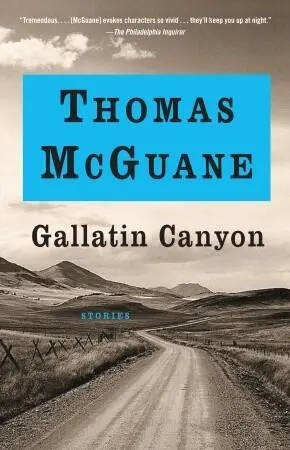
- Название:Gallatin Canyon
- Автор:
- Издательство:Vintage
- Жанр:
- Год:2007
- ISBN:нет данных
- Рейтинг книги:5 / 5. Голосов: 1
-
Избранное:Добавить в избранное
- Отзывы:
-
Ваша оценка:
Gallatin Canyon: краткое содержание, описание и аннотация
Предлагаем к чтению аннотацию, описание, краткое содержание или предисловие (зависит от того, что написал сам автор книги «Gallatin Canyon»). Если вы не нашли необходимую информацию о книге — напишите в комментариях, мы постараемся отыскать её.
are rich in the wit, compassion, and matchless language for which Thomas McGuane is celebrated.
Place exerts the power of destiny in these tales: a boy makes a surprising discovery skating at night on Lake Michigan; an Irish clan in Massachusetts gather around their dying matriarch; a battered survivor of the glory days of Key West washes up on other shores. Several of the stories unfold in Big Sky country: a father tries to buy his adult son’s way out of virginity; a convict turns cowhand on a ranch; a couple makes a fateful drive through a perilous gorge. McGuane's people are seekers, beguiled by the land's beauty and myth, compelled by the fantasy of what a locale can offer, forced to reconcile dream and truth.
Gallatin Canyon — читать онлайн бесплатно полную книгу (весь текст) целиком
Ниже представлен текст книги, разбитый по страницам. Система сохранения места последней прочитанной страницы, позволяет с удобством читать онлайн бесплатно книгу «Gallatin Canyon», без необходимости каждый раз заново искать на чём Вы остановились. Поставьте закладку, и сможете в любой момент перейти на страницу, на которой закончили чтение.
Интервал:
Закладка:
My mother had always seemed fearless; if she wasn’t, she concealed her fear with spontaneous belligerence. But she strove for obedient perfection under my grandmother’s eyes and when she fell short, usually in household matters like cooking or cleaning or religious matters like forgetting First Fridays, she responded to my grandmother’s well-concealed wrath like an educated dog, performing as directed but with the faint slink of force training. This behavior was disturbing and made me ambivalent about my grandmother, who treated me like a prince. Behind the geniality of this tiny woman, I saw the iron fist. I wasn’t sure I liked it.
Paul moved in and out of the house over the years, even had temperate spells. I remember some very pleasant times when my mother and I visited: he threw a baseball onto the complex of roofs for me to field with my Marty Marion infielder’s mitt and tried to instill in me his passionate Irish sentimentality and diasporic mythology. The rest of the family was feverishly American and did not care to celebrate the Irish connection; in fact, Uncle Walter on traveling to Ireland announced that the place was highly disorganized and insufficiently hygienic, and that the garrulity of the people was annoying, especially the sharp cracks that were mechanical and tiresome and always about other people.
But Paul had archaic Gaelic jigs on 78s that he played at tremendous volume from his room next to his mother’s, and, when drunk, he could roar along to various all-too-familiar ballads—“Mother Machree,” “The Wearing of the Green,” “When Irish Eyes Are Smiling,” and so on — giving me a whack when I accompanied the great John McCormack with such invented lyrics as “my vile Irish toes” or “God bless you, you pest, you, Mother Machree.”
Sometimes he tired of his old records and said it wasn’t the potato famine that had driven the Irish from the land; they had left to escape the music. It really depended on what the Bushmill’s was up to. He also used me to practice his insurance pitch. “Good morning, Wilbur,” he would begin — not my name — and it was always morning in these pitches even though he was incapable of rising early enough to make a morning pitch. Wilbur was an imaginary Yankee farmer, dull, credulous, yet wily. “Wilbur, we’ve known each other a good many years and, God willing, more to come with, let’s hope, much prosperity and happiness. I know you to be a man, Wilbur, whose family stands just below the saints in his esteem, a man who thinks of everything to protect them from. . from— Christ! — protect them from, uh— the unforeseen! Christ, of course! The unforeseen! —But ask yourself, Have you really thought of everything?” Here is where the other shoe was meant to drop, but, more often than not, Paul allowed himself an uncontrolled snort of hilarity before refilling his “martini.” This was never a martini; it was invariably a jolt of Bushmill’s, but he called it a martini, and the delicacy of the concept compelled him to hold the libation between thumb and forefinger, which uncertain grasp sometimes caused the drink to crash to the floor, a “tragedy.”
The fact that Paul and I got on so well would be remembered during my seventeenth year, when I was called upon to perform one more miracle. By my humoring him during his Irish spells, I had earned his faith. He’d taken me to see the Red Sox, Plymouth Rock, Bunker Hill, and Old Ironsides; he bought me lobster rolls at Al Mack’s diner, a Penn Senator surf-casting reel, coffee cabinets and vanilla Cokes by the hundred. He made me call a drinking fountain a “bubbler,” in the Rhode Island style.
Eventually, Paul moved back to his digs at Mohican House, evicted by Uncle Walter, who had replaced my grandfather for such duties. My grandmother was also a disciplinarian, but when it came to her youngest son she reverted to type and viewed him as troubled, broken by the war, while the rest of her offspring were expected to follow clear but inflexible rules. Irish tenors were replaced by radio broadcasts of ball games. For every holiday and the whole of summer, my mother continued to drag me from what she viewed as our place of exile in the Midwest to Brownell Street, which I might not have liked but for our almost daily trips to Horseneck Beach, where I had the occasional red-faced meeting with a girl in a bathing suit. I also made a new friend on Hood Street next to North Park, Brucie Blaylock, who could defend me against Meatball and his allies. Brucie was a tough athletic boy with scuffed knuckles and a perpetually runny nose whose beautiful eighteen-year-old sister had just married a policeman. The couple was still living in my friend’s home awaiting an apartment and, while snooping through their belongings, we discovered a gross of condoms which we counted, being unsure how many were in a gross. “This cop,” said my friend, gazing at the mountain of tiny packages, “is gonna stick it in my sister a hundred and forty-four times!” My mind spun not altogether unpleasantly at this carnal prospect, and my fear of bathing-suit girls at Horseneck Beach rose starkly. From time to time, we would re-count the condoms; by the time the number dropped below a hundred, my friend was suffering and I wandered around as if etherized by the information.
My aunts continued to adore and pamper me while reminding anyone who would listen of my capacity for working miracles. This would have been long forgotten but for the fact that their incentive came directly from their mother, especially my aunt Dorothy, who waitressed long hours at the Nonpareil diner downtown, and my aunt Constance, a substitute teacher who lived two houses away with her husband, a glazier. My uncle Gerry, who had joined the Boston mounted police solely to acquire a horse, was rarely around. Uncle Walter said the horse was all the family Gerry ever wanted. Dorothy’s husband, Bob, made himself scarce, too, finding the constant joking around my grandparents’ house exasperating. Theirs was a mixed marriage, the first in our family, as Bob was a jick, an English immigrant. It was customary for those of Irish extraction to mimic the accents of such people by singing out, “It’s not the ’eavy ’aulin that ’urts the ’osses’ ’ooves. It’s the ’ammer, ’ammer, ’ammer on the old ’ighway.” My grandmother outlawed this ditty out of deference to Bob, who, after all, might one day convert.
I seemed to have been forgotten during the early moments of the crisis, even by my mother. I seized on my brief obscurity to cook up reasons why I was now exempt from the miracle business: one, I was not the same boy who had stirred my grandmother to rise after the death of her husband; and two, it was not a miracle in the first place, except in the minds of my mother and her crazy sisters. I now sequestered myself in my room with Road & Track, Dave Brubeck Fantasy label 45s, and True West magazine. I was greatly absorbed by the events leading up to the gunfight at the OK Corral. No longer able to enchant me with accounts of the big baboon by the light of the moon combing his auburn hair, my mother tried upgrading my reading habits by offering me a dollar to read Penrod and Sam. I declined. But all this was distraction; I feared my call would come and I worked at facing it. I worried that by keeping to myself and playing the anchorite, I gave credence to my imputed saintlike powers; it behooved me to mingle with my relatives and strive to seem unexceptional, even casual. Being incapable of grasping the possible demise of my grandmother, I had no problem sauntering around the house seeing to everyone’s comfort. No one suspected the terror in my heart. At one point, as I suavely offered to make cocktails, my mother jerked me aside and asked me if I thought this was the Stork Club. Thereafter, my attempts to disappear consisted of idly scratching my head or patting my lips wearily as I gazed out upon Brownell Street, where every parking spot was taken by my relatives’ cars, all except Paul’s, which he called a “foreign” car. Anyone pointing out that it was a dilapidated Ford was told, “It is entirely foreign to me.” That car was not here, and if it was not over at the Mohican it could be as far afield as New Bedford or Somerset, whose watering holes provided what he called “acceptable consanguinity.” These were terrible stewpots mentioned in the paper from time to time in an unflattering light, the one in New Bedford being, according to Uncle Walter, a bucket of blood haunted by raving scallopers and their molls.
Читать дальшеИнтервал:
Закладка:
Похожие книги на «Gallatin Canyon»
Представляем Вашему вниманию похожие книги на «Gallatin Canyon» списком для выбора. Мы отобрали схожую по названию и смыслу литературу в надежде предоставить читателям больше вариантов отыскать новые, интересные, ещё непрочитанные произведения.






Обсуждение, отзывы о книге «Gallatin Canyon» и просто собственные мнения читателей. Оставьте ваши комментарии, напишите, что Вы думаете о произведении, его смысле или главных героях. Укажите что конкретно понравилось, а что нет, и почему Вы так считаете.