Alasdair Gray - Unlikely Stories Mostly
Здесь есть возможность читать онлайн «Alasdair Gray - Unlikely Stories Mostly» весь текст электронной книги совершенно бесплатно (целиком полную версию без сокращений). В некоторых случаях можно слушать аудио, скачать через торрент в формате fb2 и присутствует краткое содержание. Год выпуска: 2003, Издательство: Canongate U.S., Жанр: Современная проза, на английском языке. Описание произведения, (предисловие) а так же отзывы посетителей доступны на портале библиотеки ЛибКат.
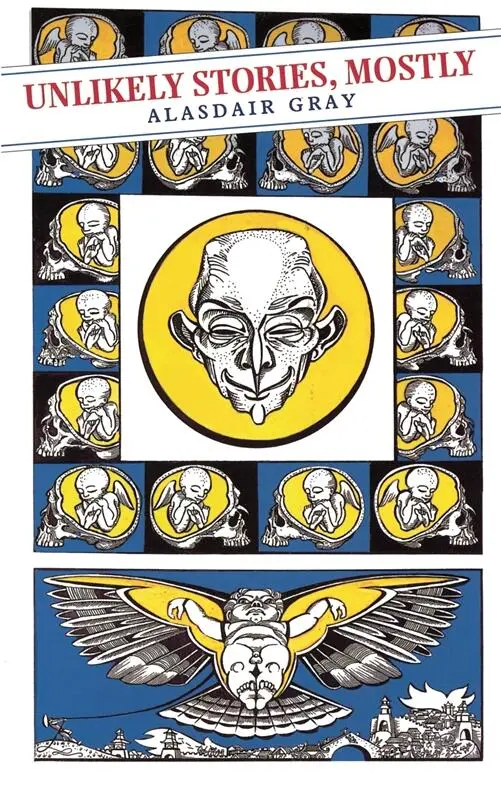
- Название:Unlikely Stories Mostly
- Автор:
- Издательство:Canongate U.S.
- Жанр:
- Год:2003
- ISBN:нет данных
- Рейтинг книги:4 / 5. Голосов: 1
-
Избранное:Добавить в избранное
- Отзывы:
-
Ваша оценка:
Unlikely Stories Mostly: краткое содержание, описание и аннотация
Предлагаем к чтению аннотацию, описание, краткое содержание или предисловие (зависит от того, что написал сам автор книги «Unlikely Stories Mostly»). Если вы не нашли необходимую информацию о книге — напишите в комментариях, мы постараемся отыскать её.
‘This anthology may be likened to a vast architectural folly imblending the idioms of the Greek, Gothic, Oriental, Baroque, Scottish Baronial and Bauhaus schools. Like one who, absently sauntering the streets of Barcelona, suddenly beholds the breathtaking grandeur of Gaudi’s Familia Sagrada, I am compelled to admire a display of power and intricacy whose precise purpose evades me. Is the structure haunted by a truth too exalted and ghostly to dwell in a plainer edifice? Perhaps. I wonder. I doubt.’ Lady Nicola Stewart, Countess of Dunfermline in The Celtic Needlewoman.
Alasdair Gray’s most playful book earned a place in this Classic Series by being in print since first published by Canongate in 1983. This completely amended edition has two new stories; also a postscript by the author and Douglas Gifford.
Unlikely Stories Mostly — читать онлайн бесплатно полную книгу (весь текст) целиком
Ниже представлен текст книги, разбитый по страницам. Система сохранения места последней прочитанной страницы, позволяет с удобством читать онлайн бесплатно книгу «Unlikely Stories Mostly», без необходимости каждый раз заново искать на чём Вы остановились. Поставьте закладку, и сможете в любой момент перейти на страницу, на которой закончили чтение.
Интервал:
Закладка:
“Yes!” I cried. “And in that it was like every other state in the history of mankind. But what made Athens different was the unusual freedom enjoyed by most men in it. When these men compared themselves with the inhabiters of the great surrounding empires (military Persia, priestridden Egypt, Carthage with its huge navy and stock-exchange) they were astonished by their freedom.”
She said, “Define freedom.”
I said, “It is the experience of active people who live by work they do best, are at ease with their neighbours, and responsible for their government.” She said, “You have just admitted that your free, active Athenians oppressed their neighbours and more than half their own people.”
I said, “Yes, and to that extent they were not free, and knew it. Their popular drama, the first plays which the common memory of mankind has seen fit to preserve, shows that warfare and slavery — especially sexual slavery — are horrible things, and at last destroy the winners and the empires who use them.”
“Which means,” cried my woman, looking more like a tragic heroine with every utterance, “that the Athenians were like our educated bourgeois of Western Europe and North America, who draw unearned income from the poor of their own and other countries, yet feel superior to the equivalent class in Russia, because we applaud writers who tell us we are corrupt.” After a silence I said, “Correct, madam. But do not be offended if I draw a little comfort from just one Athenian achievement: the tragic poem Prometheus Bound which was written by Aeschylus and is the world’s second oldest play. It shows Prometheus, creative foresight, being crucified and buried by the cunning lords of this world after they have seized power. But Prometheus prophesies that one day he will be released, and tyranny cast down, and men will see their future clear. Aeschylus wrote a sequel, Prometheus Unbound , describing that event. It was lost, and I can tell you why.
“The democracy of Athens, great as it was, flawed as it was, tried to become an empire, was defeated, and finally failed. All the great states which followed it were oligarchies. Some, like Florence and Holland, claimed to be republics, but all were oligarchies in which poets and dramatists were so attached to the prosperous classes that they came to despise, yes really despise, the commoners. They saw them as incurably inferior, deserving a tear and a charitable breadcrust in bad times, but potentially dangerous and at best merely comic, like the grave-diggers in Hamlet . No doubt the rulers of states thought Prometheus Unbound was seditious, but it must also have annoyed educated people by showing how slavish their best hopes had become. They could no longer imagine a good state where intelligence served everyone equally. In twenty-three centuries of human endurance and pain only one hero, Jesus of Nazareth, declared that a common man was the maker of all earthly good, and that by loving and sharing with him we would build the classless kingdom of heaven. And, madam,” I told her, “you know what the churches have made of that message. How cunning the winners are! How horrible!”
And I, who had not wept since I was a baby, shed passionate tears. I felt her grip my hand across the tabletop and though I had never before felt such pure grief for abused humanity, I have never felt such happiness and peace. It was a while before I could continue.
“But one day France, madam, yes our own France declared that democracy must return; that liberty, equality, fraternity are indivisible; that what the Athenians started, we will achieve. We have not achieved it yet, but the world will never know peace until we have done so. The main task of poetry today is to show the modern state the way to liberty and peace by remaking the lost verse-drama, Prometheus Unbound . I have completed half of it.”
She stared at me. I hoped she was fascinated. I described my play.
It starts with the supreme God (spelt with a capital G to separate him from lesser gods) standing on a mountaintop after the defeat of the titans. The sky behind him is a deep dark blue, his face and physique are as Michelangelo painted him, only younger — he looks about thirty. Round his feet flows a milky cloud and under the cloud, on a curving ridge, stands the committee of Olympus: Juno, Mars, Venus etcetera. These are the chorus. On two hills lower down sit Pan and Bacchus among the small agents of fertility and harvest: nymphs, fauns, satyrs and bacchantes with fiddles, drums, bagpipes and flutes. This orchestra makes music for the scene-changes. A dark vertical cleft divides the two hills. At the base of it is spread out a great tribe of common people who may as well be played by the audience. Their task is to enhance the play with their attention and applause until, at the end, the release of Prometheus releases them too. But at the start God’s gravely jubilant voice addresses the universe while the sky grows light behind him.
He speaks like any politician who has just come to power after a struggle. Together (he tells us) we have destroyed chaos and oppression. Prosperity and peace are dawning under new rules which will make everybody happy. Even the wildest districts are now well-governed. My brother Neptune commands the sea, storms and earthquake. My brother Pluto rules the dead. Let us praise the cyclops! The powers of reason would have been defeated without the weapons they made. They have been sent back to hell, but to an improved, useful hell managed by my son Vulcan. He is employing them to make the thunderbolts I need to coerce law-breakers. For alas, law-breakers exist, hot-heads who protest because my new state is not equally good to everyone. It is true that, just now, some must have very little so that, eventually, everyone has more; but those who rage at this are prolonging sufferings which I can only cure with the help of time … God is interrupted here by a voice from the ridge below him. Minerva-Athene, his minister of education, or else Cupid his popular clown, point out that the recent war was fought to destroy old time yet now God says he needs time to let him do good. Yes! (cries God) for time is no longer your tyrant, he is my slave. Time will eventually show how kind I am, how good my laws are, how well I have made everything.
Throughout this speech God’s nature is clearly changing. From sounding like the spokesman of a renewed people he has used the language of a lawmaker, dictator, and finally creator. At his last words the cloud under him divides and floats left and right uncovering the shining black face of the earthmother. It is calm and unlined, with slanting eyes under arched brows like a Buddha, and flat negro lips like the Sphinx. The white cloud is her hair, the ridge where the gods stand is her collarbone, the orchestra sits on her breasts, the audience in her lap. God, erect on top of her head, with one foot slightly advanced and arms firmly folded, looks slightly ridiculous but perfectly at home. When she parts her lips a soft voice fills the air with melodious grumbling. She knows that God’s claim to be a creator is false but she is endlessly tolerant and merely complains instead of shaking him off. Her grammar is difficult. She is twisting a huge statement into a question and does not divide what she knows into separate sentences and tenses.
EARTH
Who was before I am dark
without limbs, dancing, spinning
space without heat who
was before I am alight
without body, blazing, dividing
continents on rocking mud who
was before I am breathing
without eyes, floating, rooted
bloody with outcry who
was before I am a singing
ground, wormy-dark, alight
aloud with leaves, eyes and
gardeners, the last plants I grew who
Читать дальшеИнтервал:
Закладка:
Похожие книги на «Unlikely Stories Mostly»
Представляем Вашему вниманию похожие книги на «Unlikely Stories Mostly» списком для выбора. Мы отобрали схожую по названию и смыслу литературу в надежде предоставить читателям больше вариантов отыскать новые, интересные, ещё непрочитанные произведения.




Обсуждение, отзывы о книге «Unlikely Stories Mostly» и просто собственные мнения читателей. Оставьте ваши комментарии, напишите, что Вы думаете о произведении, его смысле или главных героях. Укажите что конкретно понравилось, а что нет, и почему Вы так считаете.