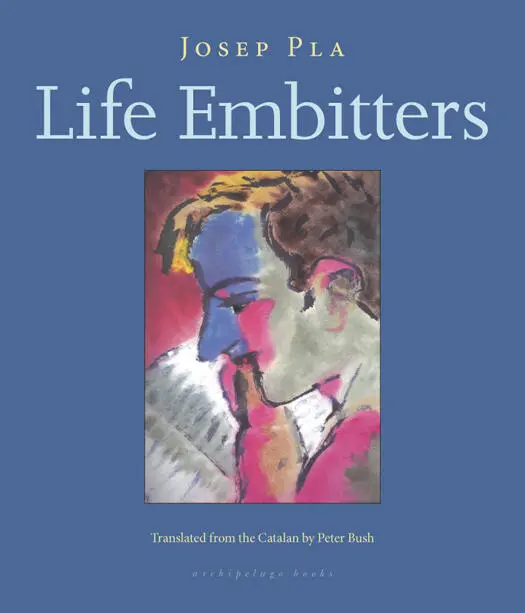
Josep Pla - Life Embitters
Здесь есть возможность читать онлайн «Josep Pla - Life Embitters» весь текст электронной книги совершенно бесплатно (целиком полную версию без сокращений). В некоторых случаях можно слушать аудио, скачать через торрент в формате fb2 и присутствует краткое содержание. Год выпуска: 2015, Издательство: Archipelago, Жанр: Современная проза, на английском языке. Описание произведения, (предисловие) а так же отзывы посетителей доступны на портале библиотеки ЛибКат.
- Название:Life Embitters
- Автор:
- Издательство:Archipelago
- Жанр:
- Год:2015
- ISBN:нет данных
- Рейтинг книги:4 / 5. Голосов: 1
-
Избранное:Добавить в избранное
- Отзывы:
-
Ваша оценка:
Life Embitters: краткое содержание, описание и аннотация
Предлагаем к чтению аннотацию, описание, краткое содержание или предисловие (зависит от того, что написал сам автор книги «Life Embitters»). Если вы не нашли необходимую информацию о книге — напишите в комментариях, мы постараемся отыскать её.
Life Embitters — читать онлайн бесплатно полную книгу (весь текст) целиком
Ниже представлен текст книги, разбитый по страницам. Система сохранения места последней прочитанной страницы, позволяет с удобством читать онлайн бесплатно книгу «Life Embitters», без необходимости каждый раз заново искать на чём Вы остановились. Поставьте закладку, и сможете в любой момент перейти на страницу, на которой закончили чтение.
Интервал:
Закладка:
I’m convinced Ràfols has always had a personal beggar, but something occurred with his Florentine beggar that became celebrated in the city’s intellectual circles and was so amusing it travelled the world. People still recount the anecdote though it dates back to 1921.
One early evening the architect left the church of Santa Croce and made for the band of beggars who had cornered the church’s front steps, to give the usual alms to his beggar. Ràfols was taken aback; he looked everywhere but the beggar was nowhere to be seen. Worried he might have suffered an upset, he spoke to a woman who belonged to the beggarly band and asked whether she knew what had happened to the absentee, namely, his beggar.
“ Il cieco sta bene, taro commendatore …” replied the woman in a rather sarcastic, tipsy tone. “ Il cieco sta benissimo, ma é uscito colla sua signora e sone andati al cinematografo .”
I hardly need add that, Llimona and Ràfols, like the Mexican and I, became wiser rather than richer in Florence, if I am candid. Our debates in the various cafés we visited and our endless conversations as we strolled along the prestigious banks of the Arno, were of an abundance and quality in inverse proportion to our meager fare. Our table was always bare, but our ideas and hopes had never flowed so effortlessly, boldly, or beautifully as they did then. We wouldn’t have been at all surprised to read in the newspaper one day that our Mexican painter had been appointed a minister or general in his country, because that man’s eagle eye justified the most optimistic of hypotheses. Nor would it have seemed at all peculiar if Lluís Llimona had made a fortune in commerce or painting, because his gifts as a painter were as evident as his talents as an entrepreneur. Nor that J.F. Ràfols, without shedding the luminous, palpable aura of grace that made him lighter than air, might have finally ended up having not one beggar in his charge but a whole army, for we’ve known greener fruit to ripen. None of that would be odd, but perfectly natural and possible. What would be odd, my beloved distant friends, would be for the scintillating ideas we floated on Florentine nights to resurface, for our ingenuousness to return or the pleasure with which we could stroll for an hour to read a text by Dante or a paragraph from Vasari on a stone house façade, or the enthusiasm that led us to one church after another, every day at any hour, even if we never attended mass. All that has gone never to return, however many years go by.
Ràfols was both the oldest and the tallest in the group. He was eclectic when it came to painting. His inclinations led him to seek out wistful eyes or a cheek able to inspire mystical tenderness and defend him from the morbid, erotic, digestive pomposity of the painters of the Bologna school. At the same time, nevertheless, he spoke of French impressionism and the humility of painters in that school so warmly, he revealed how far he had understood the state of grace which realism can attain — the fascinating beauty of reality.
In matters relating to life and politics the Mexican was an out-and-out revolutionary, but he had an academic taste in art that was fairly haphazard, if reasonably well grounded. He was no devotee of what he called academic prints and thus believed Rafael was cold and unfeeling. On the other hand, he was bowled over by Michelangelo. He liked to see art display the sweat and tautness produced by straining effort, tensed muscles and twisted mouths. He liked large symbolic figures, showy, dramatic foreshortening, and what he called social art. One of his idols was El Greco, not the familiar realist El Greco of the large portraits, but the restrained glow of El Greco suffused with purple incandescence. In any case, that gentleman reckoned that religion (what he called superstition) weighed too heavily in European art. He leant towards a lay, social Michelangelo.
Llimona and I always understood each other, although he is more Gothic and stylized and I’m more realist and plebeian. In Italy we always championed the champagne brut of the art of Umbria and Tuscany. When we arrived in Florence we immediately felt the connection and parallels that existed between our country’s past which peaked spiritually with the Gothic, and Tuscany’s culminating moment. When Barcelona and Florence reached their high point in art, they were two trading states able to give stone an unadorned, incisive elegance. So we were enthralled by the process we noted in the history of Italian painting: the process that Cimabue begins and Rafael d’Urbino concludes. We were fascinated by the initial stage, particularly as represented by the sequence of Cimabue, Giotto, Simone Martini, Paolo Uccello, Masaccio, Piero della Francesca, Benozzo Gozzoli, Ghirlandaio, and Sandro Botticelli. We set out to recreate in situ , in our turn, the path that leads from the primitives of Umbria, hovering between discreet mystic fervor and the heat of local, feudal passion, to Benozzo Gozzoli’s pink, springtime, gracious youthfulness and Botticelli’s supremely elegant luminous sensuality. We spent hour after unforgettable hour refining our understanding of the landscapes and figures we met in the course of our explorations.
We found the second part of that path, from Botticelli to Rafael, much less interesting. Initially, painting shifts from south to north, from Siena to Florence, to be precise. Then follows an opposite path: moves from north to south, from Florence, via Arezzo, Siena, Orvieto, Perugia, to Rome, where it enjoys its stellar moment, enjoys a radiant solstice in Rafael and, subsequently, goes into ineluctable decline. As painting shifts down the peninsula, it becomes more perfect, but at the same time grows cold and icy. Consider Siena’s position in this to and fro. In Siena the source of Italian art, one sees the ascendant phase, the wonders of the Tuscan primitives, especially Simone Martini, who is simply unforgettable. However, two centuries later, one can also observe the decline in the work of Pinturicchio, housed in the cathedral sacristy, a painter who is colder and stiffer than ice. That doesn’t mean we don’t champion Signorelli from Orvieto, El Perugino from Perugia and Rafael. But in the second part of this process one discerns elements of conscious, elective affinity, elements that must be contrived, because they have lost the fascination and grace of our discoveries on the first part of our explorations. We thus followed the basic itinerary in the history of Italian painting: an itinerary that marches towards perfection and that perfection — lethally — leads to burnout and is killed off in clever formalism. Such seems to be the fate of the works created by the human mind.
We were much less intensely drawn to things after Rafael. There is a significant drop in temperature. Two great branches spread out from Rafael: the schools of Lombardy and Bologna. Our eager, petulant, melancholy youthfulness made it impossible for us to grasp the voluptuous treasures abounding at the solstice of Italian painting. Voluptuousness requires a degree of mature experience. Later, the Venetians — Titian’s realism — seemed to bring us back to authenticity, to what our real tastes and inclinations favored.
When we first set foot in Rome, it was a huge disappointment. Our spirits sagged. We felt removed from genuine life and surrounded by a formal art full of grandiose but indifferent rhetorical exercises that lacked a warm pulse. Everything seemed too solemn, rich, and spectacular. We understood someone had to do what Michelangelo did to make the world complete. However, the baroque, with the ghastly Bernini, gave us a dose of unbearable sweetness — a kind of saturation on sickly pastries and sticky, insoluble saccharine. Youth can be shortsighted and dismissive, but time has changed nothing in this respect: I have never been able to stomach the baroque that I consider to be the essence of all that is superfluous and clichéd, pretentious, over-blown and over-stretched. Its fake passion exasperates me. Its theatricality exhausts me. Its emptiness depresses me. Its cardboard verismo provokes hilarity and sarcasm. The baroque is the only form of artistic exploration that is indifferent to human feeling. If the baroque hadn’t existed, Europe would be more substantial, more serious; its spirit would be lighter. The baroque was a wrong turning that helped to distort and mystify the svelte, genuine grace of Mediterranean humanity.
Читать дальшеИнтервал:
Закладка:
Похожие книги на «Life Embitters»
Представляем Вашему вниманию похожие книги на «Life Embitters» списком для выбора. Мы отобрали схожую по названию и смыслу литературу в надежде предоставить читателям больше вариантов отыскать новые, интересные, ещё непрочитанные произведения.



Обсуждение, отзывы о книге «Life Embitters» и просто собственные мнения читателей. Оставьте ваши комментарии, напишите, что Вы думаете о произведении, его смысле или главных героях. Укажите что конкретно понравилось, а что нет, и почему Вы так считаете.