Josep Pla - Life Embitters
Здесь есть возможность читать онлайн «Josep Pla - Life Embitters» весь текст электронной книги совершенно бесплатно (целиком полную версию без сокращений). В некоторых случаях можно слушать аудио, скачать через торрент в формате fb2 и присутствует краткое содержание. Год выпуска: 2015, Издательство: Archipelago, Жанр: Современная проза, на английском языке. Описание произведения, (предисловие) а так же отзывы посетителей доступны на портале библиотеки ЛибКат.
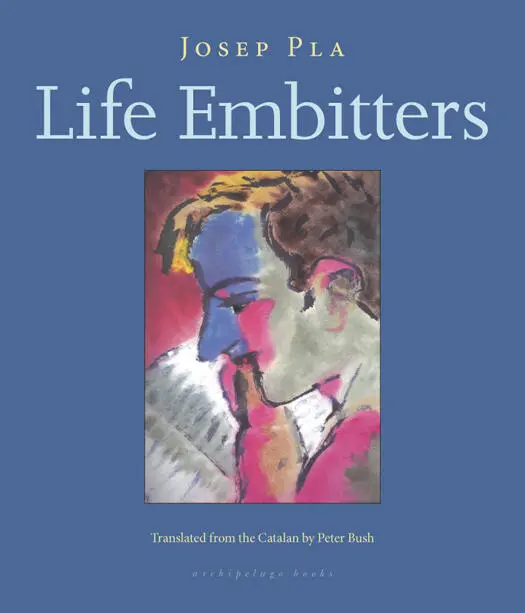
- Название:Life Embitters
- Автор:
- Издательство:Archipelago
- Жанр:
- Год:2015
- ISBN:нет данных
- Рейтинг книги:4 / 5. Голосов: 1
-
Избранное:Добавить в избранное
- Отзывы:
-
Ваша оценка:
Life Embitters: краткое содержание, описание и аннотация
Предлагаем к чтению аннотацию, описание, краткое содержание или предисловие (зависит от того, что написал сам автор книги «Life Embitters»). Если вы не нашли необходимую информацию о книге — напишите в комментариях, мы постараемся отыскать её.
Life Embitters — читать онлайн бесплатно полную книгу (весь текст) целиком
Ниже представлен текст книги, разбитый по страницам. Система сохранения места последней прочитанной страницы, позволяет с удобством читать онлайн бесплатно книгу «Life Embitters», без необходимости каждый раз заново искать на чём Вы остановились. Поставьте закладку, и сможете в любой момент перейти на страницу, на которой закончили чтение.
Интервал:
Закладка:
Once I’d realized that I was experiencing this sense of dislocation, I organized my life so it was relatively bearable. I created a series of defense mechanisms to avoid being tyrannized by that idola tribus mentioned by Lord Bacon. I saw that social life in my country was incredibly hard and that people spent their lives torturing others. I decided to leave for a while and have now lived among distant, unpredictable people for many a year. Within that profound solitude I’ve experienced some tolerable periods, to the extent that I can say that though I don’t much like our times they do offer the occasional delight.
My comments end here, and the more I reflect on them the more I can see how those last words precisely echo my state of mind at the time. No doubt about it: I was happy. I loved the city — Paris — because it was large enough to give me an ineffable feeling of solitude. The monotony of that life lulled me. I watched the masquerade parade by and longed for nothing: I was too close to things to want any of it. I waited on nobody and nobody waited on me. No man knew me, no woman either, and nobody felt charitable enough — hey, hey, can’t you shush — to enjoy my charms. I experienced freedom with lithe feline energy. Spring had just begun, the light wasn’t too bright and it drizzled endlessly. I so liked the weather I sometimes didn’t get up. The monotonous rain slowly numbed me, my body lost its boyish tendency to go on the attack; my imagination didn’t tempt me or demand things. The spring equinox was still cold, though I could feel the warm sap rising, and it seemed to draw me close to the essence of life and time went by in my hotel room on that lonely street with lime trees about to blossom and a faint, liquid light in my windows, within a warm, gentle haze.
This was the situation when I met Olga Johansen. I was thirty and my character was fully formed. My egotism was a fully crystallized, driving force. Olga was a gorgeous woman and younger than me; she was twenty-five, tall, blond, and buxom, with a subtle, silken firmness. It was the feeling of moral and material cleanliness that she radiated, rather than her golden flesh, that made her a pure delight. She was such a joy that she lived surrounded by a collection of wretched, adoring individuals. There’s nothing like exercising one’s vanity before people we appreciate. Olga had an entourage of sullen angels who looked at her with the eyes of beheaded calves.
Once we’d been introduced I was strangely surprised by the air of orderly pleasure and refined luxury emanating from her. Even so, when we first conversed, I made fun of the most hallowed and holy things. Initially, as I always saw her with that motley crowd, I thought she must be frivolous and incapable of lingering over any real pleasure or pain. I later realized that, even though she liked to soak up other people’s woes and catalogue strong feelings, she was able to focus calmly on a single thing, and that her fondness for listening to the woes of others was the sign of a soothing temperament. Perhaps she was the right woman for Martial’s epigram: ‘I don’t want her too easy or too difficult. I prefer them midpoint between the two extremes. I don’t want one who tortures or one who satiates.’ That summed up Olga: a soothing balm.
I don’t want to take up your time while I strain to recreate my states of mind then, because you were a benign witness to them. I thought that what people called love was simply a botched idealization of one of the most implacable, obscure drives of the human species. I believed there was only one thing that justified and explained marriage: the purely physical comfort and well-being the state of matrimony sometimes brings. From the spiritual point of view, that is, I decided it could resolve nothing in terms of helping one to escape from oneself. At best, the path of marriage is tantamount to a continuous liberating confessional, can numb and chloroform the pain brought on by consciousness, and for some can heal the scars of a life of failure. I saw Olga as the source of comfort in this world. That’s why I was so easily and imperceptibly suffused by her ineffable gentleness and concluded that marrying her would be a good deal. We launched into a copious correspondence, full of childish nonsense. For her part, Olga strung together things one might call decorous romanticism. I threw in the commonplaces of a cynical wit. Her letters were so sloppy they made me blush. Mine were incredibly uninspired. Olga’s billets doux were generally tedious. Mine were a mess, and if a chink of light ever broke through, it only exposed something idiotic …
She’d say: ‘You are a much better person than you think.’
I’d reply: ‘You are much worse than you say.’
We debated such questions enthusiastically for six months perhaps. Finally we both hinted simultaneously that we were probably wasting our time. Meanwhile, however, the likelihood of marriage had gained ground. Olga never asked for anything and this gave me a clear sense of how small scale I was. Don’t think for one minute that I found this unpleasant. Conversely, it would be wrong to say my character had changed. All in all, there is no real difference between freedom and being dominated by someone we feel we need. By her side I felt frail, anarchic, and insignificant and walked as if I were being led by the hand. Olga, for her part, gave everything and never haggled. She protested when I said she did things out of charity and when I threw her healing powers in her face. She replied that she was a woman like any other and did it out of love … I laughed and sometimes frightened myself. I couldn’t say if I have ever been completely sincere. However, if ever I was, it must have been when I tried to list the troublesome consequences marriage might bring if she became disillusioned for any reason. I remember how she burst into tears when we talked of such things, and became very nervous. I persisted. To shut me up she’d say that if what I was predicting actually happened, we could simply separate without making a fuss. Sometimes, man’s fate is so naturally absurd that anguish comes very politely. The fact is we decided to marry and did marry — probably with great enthusiasm.
Various tensions immediately surfaced. A number of respectable traits lurked under Olga’s rampant, often silly sentimentality. My hardened cynicism hid an appalling void. Olga was very familiar with my character, but she believed she could turn me into a proper, decent person by dint of her warmth and charm. I had entered matrimony with a clear head and didn’t expect it held anything special for me: at most I hoped to find the orderly pleasure, the benign sense of luxuriousness that Olga created. And that happened: Olga revealed a capacity for amazing self-denial in the smallest things. I lived two months of unforgettable delights.
However, Olga fell seriously ill and the doctors diagnosed an extremely severe attack of typhoid fever. So now is the time when I must speak loud and clear and tell the whole truth. My character reacted dreadfully to the wretched state Olga Johansen found herself in. I saw her as she was — a monstrous being. Her illness repelled me. I couldn’t jettison my lucidity. My withered, barren heart beat not once in sympathy for her. I was altogether horrified by her illness and my own appalling reaction and, overwhelmed by agonizing sorrow, I abandoned her. I hate to tell you that I decided to do so relatively naturally. It’s the truth and I’m spelling it out so you have an idea of what I’m really like.
Later, of course … I was obviously stricken with regret, but it was impossible to turn back. It was too late. We’ve not seen each other for fourteen years and I don’t know where she has ended up. And I am now a wandering dreamer, beset by perverse horrors, who would give his life to grasp a moment of tenderness, warmth, and peace of mind.”
Читать дальшеИнтервал:
Закладка:
Похожие книги на «Life Embitters»
Представляем Вашему вниманию похожие книги на «Life Embitters» списком для выбора. Мы отобрали схожую по названию и смыслу литературу в надежде предоставить читателям больше вариантов отыскать новые, интересные, ещё непрочитанные произведения.




Обсуждение, отзывы о книге «Life Embitters» и просто собственные мнения читателей. Оставьте ваши комментарии, напишите, что Вы думаете о произведении, его смысле или главных героях. Укажите что конкретно понравилось, а что нет, и почему Вы так считаете.