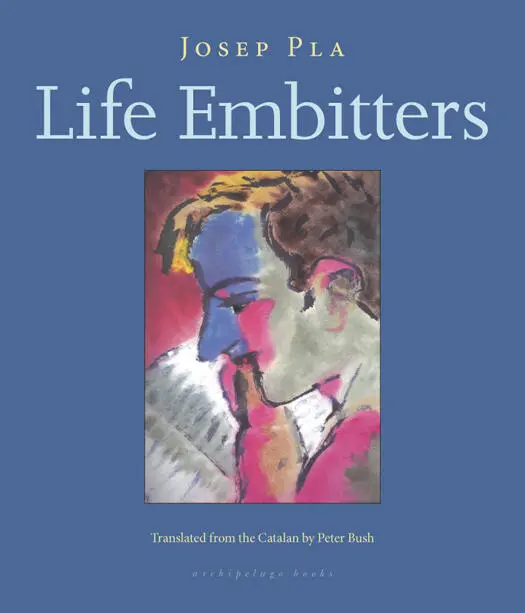
Josep Pla - Life Embitters
Здесь есть возможность читать онлайн «Josep Pla - Life Embitters» весь текст электронной книги совершенно бесплатно (целиком полную версию без сокращений). В некоторых случаях можно слушать аудио, скачать через торрент в формате fb2 и присутствует краткое содержание. Год выпуска: 2015, Издательство: Archipelago, Жанр: Современная проза, на английском языке. Описание произведения, (предисловие) а так же отзывы посетителей доступны на портале библиотеки ЛибКат.
- Название:Life Embitters
- Автор:
- Издательство:Archipelago
- Жанр:
- Год:2015
- ISBN:нет данных
- Рейтинг книги:4 / 5. Голосов: 1
-
Избранное:Добавить в избранное
- Отзывы:
-
Ваша оценка:
Life Embitters: краткое содержание, описание и аннотация
Предлагаем к чтению аннотацию, описание, краткое содержание или предисловие (зависит от того, что написал сам автор книги «Life Embitters»). Если вы не нашли необходимую информацию о книге — напишите в комментариях, мы постараемся отыскать её.
Life Embitters — читать онлайн бесплатно полную книгу (весь текст) целиком
Ниже представлен текст книги, разбитый по страницам. Система сохранения места последней прочитанной страницы, позволяет с удобством читать онлайн бесплатно книгу «Life Embitters», без необходимости каждый раз заново искать на чём Вы остановились. Поставьте закладку, и сможете в любой момент перейти на страницу, на которой закончили чтение.
Интервал:
Закладка:
At the moment my life , he wrote in 1921, is a sequence of crazy highs followed by descents into hypochondria. When I’m feeling high, I could easily ignore things that people consider unseemly and that I conventionally believe (perhaps mistakenly) to be contemptible. When I’m feeling depressed, I’d happily be thick with thieves … I argue for hours and hours about anything under the sun with anyone in sight until my nerve gives. As a rule I almost always never say what I am thinking — and quite effortlessly. In our country, duplicity — lies — runs in our blood. I like putting up smokescreens. The next day I can’t get out of bed. The day after that, I walk through parks and down streets feeling frail, and if I carried a walking stick, I’d be too weak to turn over the edges of fallen leaves. At dusk, I go into bookshops with a churning stomach and the taste of bitter almonds in my mouth. I’d prefer to forget the influence alcohol can have when one is in such a state of mind. It’s considerable .
This letter from Berlin is really peculiar: October was a delightful month. It rained a lot. Small rain drops whose plash-plashing sent you to sleep. The sky was very low and the streetlights melted into gray gauze. After ten o’clock the day began to stir from its torpor but never cleared entirely. It sometimes stopped raining and the weather dried out, seemed to stand still, creating the illusion of vaguely pleasant, tepid warmth. In the afternoon I often strolled in the Tiergarten or went to gawp at the animals in the zoo. I’d sometimes sit down on a bench under bare trees with geometrically straight branches. The park was a yellowish flame color. The boulevards, in the distance, faded into pink mist. The odd leaf still glided down, languidly, charmingly. The sparrows even nibbled the toes of my shoes. When it was dark I’d walk by the cafés on the Kurfürstendamm that were then filling up with marvelous, bronzed thirty-year-old bourgeois ladies, even if they dressed quirkily, rather too casually. In Rumpelmayer I liked to align the gilt of tea cups with the palest blue eyes. At night, from my hotel window, I’d sometimes observe the German moon — plump, swollen, a pale egg-yolk yellow, and rather foolish .
Once into the month of November, the weather breaks. Twilights became prolonged and sad. At dusk, the Berlin sky turned tart and cloudy like new wine. Its color made me lose all sense of living in a city. I would think I was living in uncharted territory, full of swamps and sandbanks, of foggy, desolate spaces. I watched twilight through a huge wood of lofty firs, across bare whitish soil, mottled by puddles of water and battered by wet gusts of wind. At that time of day the rain transported me to a silent, primeval lake district. Perhaps, by nightfall, I would be feeling nostalgic. But what I really felt in my inner self, especially when confronted by such a landscape, was that my principles were melting away like a wax candle, signaling that the inner axis of my upbringing was about to yield. However, this regrettable, individual process meant I succumbed to huge mental lethargy that drastically reduced my spirit of inquiry .
I don’t believe that all these symptoms , he wrote in the last paragraph of the letter, are those associated with the Romantic malady that is sparked by the unattainable evanescence of life. Romanticism is a mixture of truth and deceit transformed into something genuine. They are things that belong to my past — up to a point. The knowledge that my feelings are so insecure is what embitters me. You know how sociable and amenable I can be, particularly if my friends show understanding. However, I could never guarantee that my feelings will remain stable. Where does our sincerity begin and our play-acting end? Do we have it in us to draw a line between one and the other? Do I have it in me? Quite frankly, I don’t think I do. Events in life warp us; language betrays us; feelings deceive us; there are no rigid, one-sided characters: there are multiple truths. This constant instability holds me back, because I experience it in the presence of others and within myself. I am in danger of being sucked into swamps of brazen cynicism or the reverse, of being locked into heartless Puritanism, into the mindless adoration of order. ‘He who would act the angel acts the brute’ — Pascal’s observation is so true. However, I have something on my side: my lack of ambition. If I had any, the horrors aroused in me by ideas in general, the untamed nature of my instincts or my fascination with certain realities, would lead me quite unceremoniously along that path .
In another letter he wrote: There are arguments for the right and arguments for the left. On the other hand, not a single argument exists for staying in the center. But everyone, or almost everyone — I mean those who have no arguments at all — remain mired in this area of lukewarm mediocrity. It’s the one that gives the least headaches when times are calm. ‘In your opinion,’ I asked a Japanese man one day in Berlin, ‘what is man’s driving passion?’ ‘I don’t know,’ he replied. ‘My driving passion is breeding little birds in cages.’ I don’t think I’ll ever be that intelligent. I feel passionate about extremes. Gide’s statement. ‘I’m all about extremes,’ could have been mine. When you embrace an extreme you tend to think morality is a rhetorical exercise — however, despite everything, consolation is only to be found in extremes …
In the end Albert Santaniol spent long periods abroad. Here’s a curious confession I found in a letter dated from Prague: Ideally, I’d like to be a journalist, but not for the totally illusory way that profession confronts you with reality. However, I could never have subjected myself to the pressures of that commercial farce. I’d prefer a journalism that was entertaining, full of blood and guts, and agile enough to imitate reality. I learned a little about life, one summery night in Lyon, watching marionettes in the fair in Perrache . A gentleman in a morning coat, with a large white mustache and bushy, flowing beard — the father — was gazing ecstatically at the sun setting over the waters of the Rhône when his son appeared out of the blue, quietly, on tiptoe, with a wild look in his eyes and a financially desperate appearance, and bludgeoned him on the head with a club. The impact made by that sudden blow … As seen through a journalist’s eye, reality — politics and money are the two sides of reality that most stir their passions and imagination — reads like a train timetable or a minuet directed by a clean-shaven, little old dance teacher who is an old-fashioned fuddy-duddy. We know nothing about anything and yet we remain so stuck in the mud. In order to create good journalism one should be able to draw on the best people in each country — those who have managed to liberate themselves from conventional university thinking or the mediocre ways of the establishment. All journalists do with their apparently precise, restrained, mathematical reporting is to drown everyone in the gluey porridge of drawing-room comedy. The time will come when nobody will have a clear idea of the simplest, most immediate acts. And in a few years, the man who happens to tell it anything like it really is will be condemned out of hand, as if that was the right and proper thing to do. However, I suspect I may be rambling madly. My God, there’s still so much to see, health permitting …
In 1918, we find Santaniol in a pension on Calle Pérez Galdós, previously Colmillo (Tusker) in Madrid. In 1919, he is in Paris; in 1920, in London; in 1921, he’s roaming through the cities of central Europe with lengthy stays in Amsterdam, Berlin, and Prague. He is enchanted by Prague. In the summer, Prague , he wrote me on a postcard, is a golden city against the backdrop of the proudest, most hieratic trees the continental climate can sustain. The old Jewish cemetery is striking in its humble simplicity . In 1922 and ’23 he’s in Italy, first as a tourist, then as vice-consul. Those years saw a considerable reduction in the family income. He had no choice but to buckle down and spend a few hours a day pushing a pen. Then he died when a train went off the rails. It’s not easy to paint the usual superficial, clichéd portrait of him. His papers are scattered all over the place.
Читать дальшеИнтервал:
Закладка:
Похожие книги на «Life Embitters»
Представляем Вашему вниманию похожие книги на «Life Embitters» списком для выбора. Мы отобрали схожую по названию и смыслу литературу в надежде предоставить читателям больше вариантов отыскать новые, интересные, ещё непрочитанные произведения.


Обсуждение, отзывы о книге «Life Embitters» и просто собственные мнения читателей. Оставьте ваши комментарии, напишите, что Вы думаете о произведении, его смысле или главных героях. Укажите что конкретно понравилось, а что нет, и почему Вы так считаете.