Laila Lalami - Secret Son
Здесь есть возможность читать онлайн «Laila Lalami - Secret Son» весь текст электронной книги совершенно бесплатно (целиком полную версию без сокращений). В некоторых случаях можно слушать аудио, скачать через торрент в формате fb2 и присутствует краткое содержание. Год выпуска: 2010, Издательство: Algonquin Books, Жанр: Современная проза, на английском языке. Описание произведения, (предисловие) а так же отзывы посетителей доступны на портале библиотеки ЛибКат.
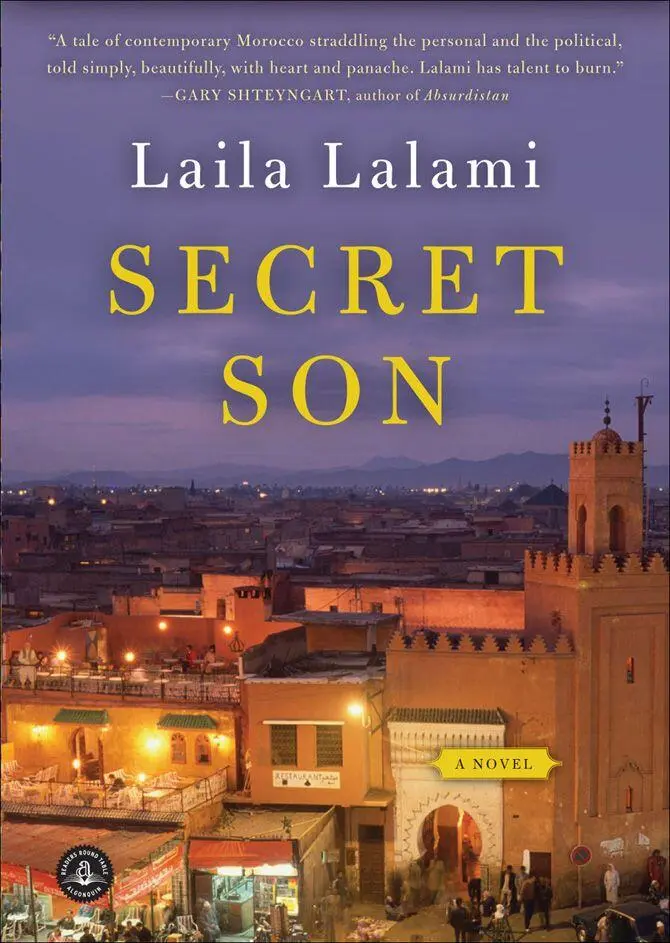
- Название:Secret Son
- Автор:
- Издательство:Algonquin Books
- Жанр:
- Год:2010
- ISBN:нет данных
- Рейтинг книги:5 / 5. Голосов: 1
-
Избранное:Добавить в избранное
- Отзывы:
-
Ваша оценка:
Secret Son: краткое содержание, описание и аннотация
Предлагаем к чтению аннотацию, описание, краткое содержание или предисловие (зависит от того, что написал сам автор книги «Secret Son»). Если вы не нашли необходимую информацию о книге — напишите в комментариях, мы постараемся отыскать её.
In the spirit of
and
, Laila Lalami’s debut novel looks at the struggle for identity, the need for love and family, and the desperation that grips ordinary lives in a world divided by class, politics, and religion.
Secret Son — читать онлайн бесплатно полную книгу (весь текст) целиком
Ниже представлен текст книги, разбитый по страницам. Система сохранения места последней прочитанной страницы, позволяет с удобством читать онлайн бесплатно книгу «Secret Son», без необходимости каждый раз заново искать на чём Вы остановились. Поставьте закладку, и сможете в любой момент перейти на страницу, на которой закончили чтение.
Интервал:
Закладка:
Amal headed back into the bedroom, Fernando following her. He picked up his jeans from the floor. “What is he doing here?” he whispered.
“I don’t know,” she replied. “I think they’re here for graduation.” She slipped on a black top and a pair of jeans, checking her reflection in the closet mirror. The color had gone from her face, and her brown eyes seemed bigger against her pale skin. She stood, staring at herself, then quickly rummaged through her drawer for a pair of earrings to wear. She went back to the living room.
“Mr. and Mrs. Amrani, would you like some coffee?” Fernando asked evenly.
“Yes, thank you,” Nabil said, barely glancing at him. “Aji tgelsi,” he told Amal, patting the space on the sofa between him and Malika. Ordinarily, Amal’s parents spoke French to each other and to her, using Darija Arabic only with the maid or the driver. (“Sounds like Russia in 1916,” Fernando had joked when Amal had told him about the language use.) But it was clear now that they did not want to risk being understood, in case Fernando spoke some French. Instead of sitting next to her father, she dropped into the armchair to the right, her arms hugging her knees.
“I know your mother’s been paying for your school,” Nabil began.
Malika crossed her long legs and shot him an angry look. “It’s my money, I can do with it whatever I want.”
Amal raised a surprised eyebrow at her mother’s tone.
“What I mean is,” Nabil said conciliatorily, “I knew Amal wouldn’t have lasted two years on her own if you hadn’t paid her tuition.”
The comment was directed at her mother, but it stung Amal more than she expected. “Is this why you’re here? To talk about money?”
Fernando walked in with the coffee tray. Malika did not touch her cup, but Nabil took a sip from his. “Hmm, this is very good,” he said in English, sounding surprised. “What kind of coffee is it?”
“Brazilian,” Fernando replied, sitting down on the second armchair, across from Amal.
“Oh,” Nabil said, staring at Fernando for a while, as though he had just realized some important fact. Again he spoke in Arabic. “And this is your … friend,” he said. “He is very dark.”
Amal knew a remark like this would come sooner or later, and yet she did not know what to say in response.
Malika jumped in. “His mother is from Brazil.”
“I thought you said he was American,” Nabil said to his wife.
“He is,” Amal replied. She glanced at Fernando. His eyes questioned her, wanting to know what was going on, but she could not begin to translate for him. What was there to report?
Nabil stared at his wife for a few seconds and then turned his attention back to Amal. “Anyway, look, I’m not here to talk about money or about him . I just meant that I know a lot more than you think. You think you can fool your father, but you can’t.”
“I’ve never pretended to fool you,” Amal said. “You’re the one who stopped talking to me.”
“We’re not here for this,” Malika said impatiently. “Lli ‘ta llah ‘tah.”
“You’re right,” Nabil said. “The past is dead. We’re here about the future.”
“My graduation is the future?”
“Of course,” Nabil said. And then, almost as an afterthought, he added, “We’re very proud.”
Sure, Amal thought, there are still appearances to keep up back home, brothers to convince that all was right with the world, cousins to brag to about the graduation of an only daughter, friends to invite to the biggest homecoming party anyone had ever seen, employees to tell about a new executive at AmraCo. In the Amrani family, this was how things worked. What would his friends say if, instead of the official line, they learned that she was getting ready to move in with this young man, who was too dark for her father’s taste?
“But there’s also something important that we have to discuss,” Nabil said.
Malika glanced at Fernando. “We can’t talk here.”
“Right,” Nabil said. “Why don’t we meet for dinner tonight? Do you remember where the Beverly Hilton is?”
Amal nodded. She had stayed there with her parents when they had come to help her move into her dorm room her freshman year. “What do you want to talk about?” she asked. Now she, too, glanced at Fernando, who surveyed the scene with a calmness that belied the feelings he must have had at being surrounded by people who talked about him but not to him.
Her father’s expression turned grave. “Something very important. Something about our family.” He took a card out of his wallet and handed it to her. “This is the hotel’s address and phone number, just in case.”
He stood up, and everyone else followed.
“Come at eight o’clock,” he said, starting to walk out. He turned around suddenly. “Where’s your car? I didn’t see it in the parking lot.”
“I sold it a long time ago.”
“I see. Then we’ll pick you up.”
“There’s no need,” Amal said. “Fernando can take me.”
“Come to dinner alone,” Malika said. “This is a family matter.”
“We’ll send a cab for you,” Nabil said.
“Fine,” Amal said. She opened the door for them, forgetting that Moroccans do not open doors for departing guests for fear of giving the impression that the guests are unwelcome. Months later, she would remember this moment and wonder whether this was the first sign of her having become a different person, or the last.
Nabil walked down the stairs to the street, but Malika lingered at the doorstep. She put her hand on her daughter’s cheek. “You look so grown-up now.” Her eyes watered; she blinked a few times. “It seems like only yesterday you were waving a stubby finger at me and telling me you wouldn’t come out from under the table.”
Amal chuckled. “I’m not a baby, Maman.”
They hugged. Nabil honked. He was behind the wheel of a rented black BMW, just like the one he had bought for her when she started school. It had gone to pay her rent for a few months, before she found her first job — teaching aerobics at the student center. That was followed by stints as a copy-shop clerk, a math tutor, a receptionist, and an intern at a medical research company.
Amal walked back inside the apartment, closed the door, and leaned against it.
“What was all that about?” Fernando asked.
Amal told him the little she knew.
“It must be some big news, then,” Fernando said, chewing his lip, “for them to have flown six thousand miles just to tell you. I wonder what it could be.”
She shrugged. “I’ve no idea. But it can’t be any good.”
Fernando put his arm around her shoulders. “Don’t worry. It’s not like he can take his money away twice.”
They showered and got dressed and went to see the apartment — all at Amal’s insistence. She wanted to go on with her day as if her parents had not shown up, but it was no use. Although the property manager left them alone for fifteen minutes while they walked through the rooms, opened closets and windows, and checked water taps, Amal wandered around the apartment without seeing it.
“So?” Fernando asked, after they stepped out.
“It’s nice,” she said.
“The south-facing bedroom doesn’t get enough light.”
“I guess so.”
“We wouldn’t be using it as a bedroom, anyway. So maybe it doesn’t matter.”
“I guess you’re right.”
“You don’t like it?”
“It’s fine.”
“Did you change your mind?”
“Of course not,” Amal said, slipping her hand in his and walking back toward the car. “We just have to keep looking. Let’s look again tomorrow. Maybe something better will come along.”
Читать дальшеИнтервал:
Закладка:
Похожие книги на «Secret Son»
Представляем Вашему вниманию похожие книги на «Secret Son» списком для выбора. Мы отобрали схожую по названию и смыслу литературу в надежде предоставить читателям больше вариантов отыскать новые, интересные, ещё непрочитанные произведения.










Обсуждение, отзывы о книге «Secret Son» и просто собственные мнения читателей. Оставьте ваши комментарии, напишите, что Вы думаете о произведении, его смысле или главных героях. Укажите что конкретно понравилось, а что нет, и почему Вы так считаете.