S. Agnon - Shira
Здесь есть возможность читать онлайн «S. Agnon - Shira» весь текст электронной книги совершенно бесплатно (целиком полную версию без сокращений). В некоторых случаях можно слушать аудио, скачать через торрент в формате fb2 и присутствует краткое содержание. Год выпуска: 2014, Издательство: Toby Press, Жанр: Современная проза, на английском языке. Описание произведения, (предисловие) а так же отзывы посетителей доступны на портале библиотеки ЛибКат.
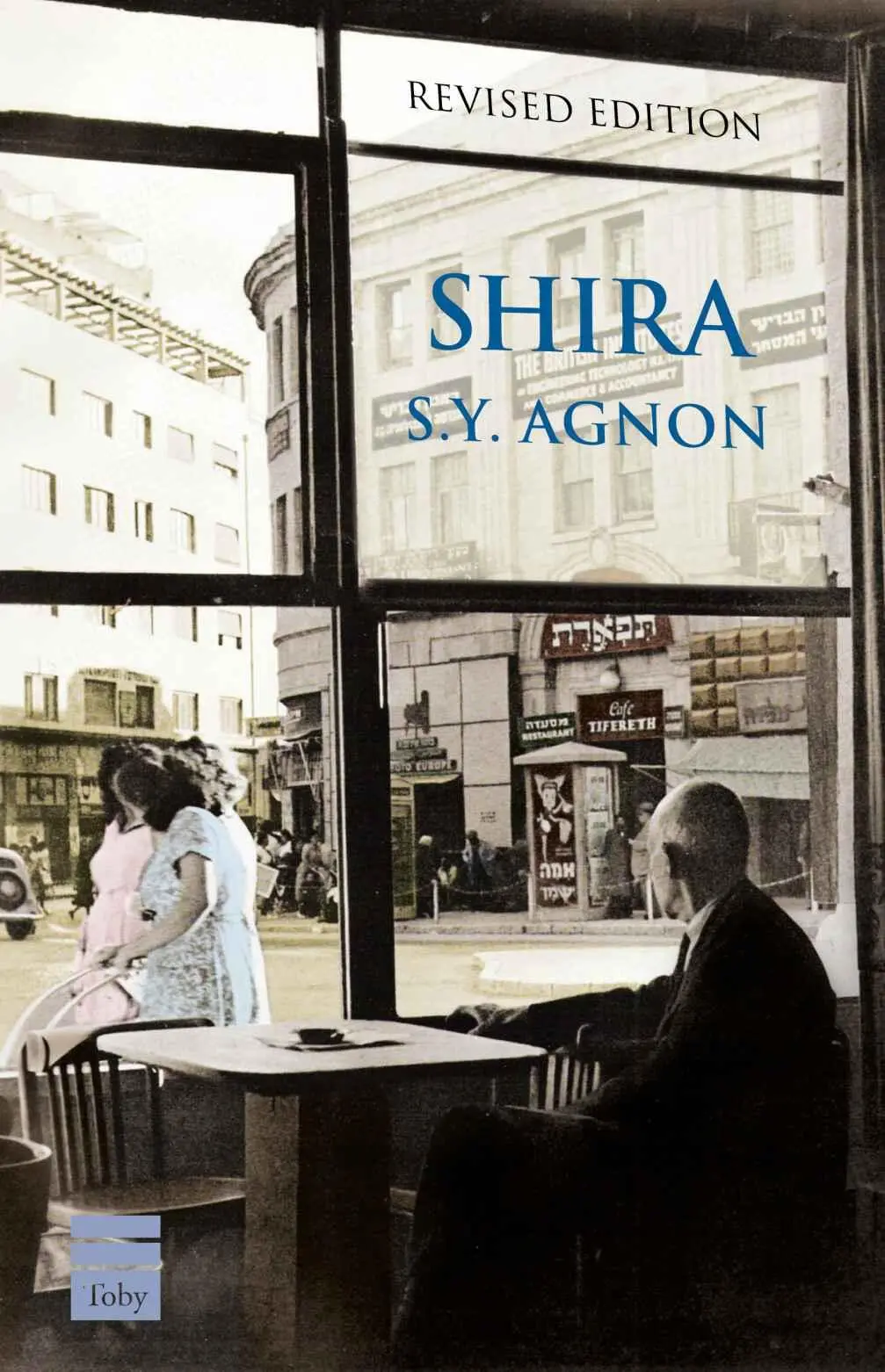
- Название:Shira
- Автор:
- Издательство:Toby Press
- Жанр:
- Год:2014
- ISBN:нет данных
- Рейтинг книги:5 / 5. Голосов: 1
-
Избранное:Добавить в избранное
- Отзывы:
-
Ваша оценка:
Shira: краткое содержание, описание и аннотация
Предлагаем к чтению аннотацию, описание, краткое содержание или предисловие (зависит от того, что написал сам автор книги «Shira»). Если вы не нашли необходимую информацию о книге — напишите в комментариях, мы постараемся отыскать её.
Shira — читать онлайн бесплатно полную книгу (весь текст) целиком
Ниже представлен текст книги, разбитый по страницам. Система сохранения места последней прочитанной страницы, позволяет с удобством читать онлайн бесплатно книгу «Shira», без необходимости каждый раз заново искать на чём Вы остановились. Поставьте закладку, и сможете в любой момент перейти на страницу, на которой закончили чтение.
Интервал:
Закладка:
Herbst and his daughter sat in the café. He had a cup of coffee, she had a dish of ice cream. She was leaning over him, and they were both reading the names of the victims and the brutal details of the murders. After reading the entire account, Herbst scanned the other items in the paper, one about an attempt to smuggle arms from Syria and one about an interview with a Jew imprisoned in Acre who had been sentenced to hang.
This is how Herbst and his daughter spent the time on the one occasion in their lives when they were together in a café. Herbst suddenly said, “Time to go. Mother might worry about us. You didn’t finish your ice cream. It’s all melted. I’ll order another. You don’t want it? Then let’s go.”
On the way, Tamara said to her father, “We didn’t even mention Alfreda Weltfremdt, who just got engaged.” “Engaged? To whom is she engaged?” “You didn’t see the notice? She’s engaged to someone whose name I forget.” Herbst said, “Mrs. Ernst Weltfremdt must be very happy.” Tamara said, “Why single her out?” Herbst said, “Because now she has something to write a poem or a play about. But we, who will be invited to hear her verses, are not to be envied.
Taglicht was always careful not to lie, because one lie leads to another, ad infinitum. There is no end to the pile of lies, and, even if there was no choice about the initial one, you end up with an appetite for lying. Now that he had told Herbst and Tamara that he had promised Julian Weltfremdt to stop in, he wished to sweeten the lie with a dose of truth.
Julian Weltfremdt was not used to having guests. Since the death of his little girl and the loss of his library, he no longer invited people to his home. If a guest did stop by, it was a red-letter day for Mimi. Apart from her piano and the pretense that she was a protector of the needy, she had nothing to be happy about.
That day, she had bought artichokes for supper. When she saw Taglicht in her house, she was elated and invited him to eat with them. Julian, who knew Taglicht would refuse, remained silent. He could see in her eyes how eager she was to share the pleasures of her table with a guest. He said to Taglicht, “I know you pharisees don’t give an inch on ritual, even when it’s a matter of pleasing someone. But, if I promise to make sure Mimi doesn’t feed you anything unkosher, will you perhaps indulge her and eat with us? What can a kosher Jew eat in the home of an infidel such as me? Mimi, what did your grandmother feed that merchant from Galicia, the one your grandfather used to deal with? Pickled fish and whiskey. We don’t have any pickled fish and whiskey, but we have sardines and some superb cognac. But I don’t know if it’s kosher — it was a gift from an Englishman I rescued from an Arab shepherd who was about to thrust a knife in his back.”
Taglicht knew it would be right for him to accommodate these two solitary people and eat with them. Since the day their daughter died, they had lived together like two mutes. But he had promised Herbst and Tamara that he would come there for supper, so he couldn’t do the decent thing; he did what was required to keep his promise. Mimi gazed at him, her lovely eyes veiled by a film of grief. Julian, like most men who cause their wives sorrow without knowing it, noticed this and was annoyed at Taglicht, a gentle man who had suddenly become harsh. Taglicht stammered a bit and took leave of them.
When he left, Julian followed him out and said, “Wait, and I’ll show you a shortcut.” Taglicht said to him, “When did you last see Herbst? I wanted to talk to you about him. I don’t know anything specific. I know only what I see on his face. He looks tormented. If you see him, pay attention.”
Chapter nineteen
When Taglicht left the Weltfremdts’, he was haunted by the bleakness that prevailed there, even though it was overshadowed by the happy face of the lady of the house when a guest arrived at her long-forsaken door. Taglicht, true to character, tried to ignore what he had seen, to avoid thinking about his friends, but he didn’t succeed. He found himself reflecting on these two solitary people, who had suffered a double blow. After their furnishings and books were lost, their daughter died. When the child was alive, she had sweetened their plight and linked their souls. When she died, the link was severed and their souls became separate. They live together now, like the piano she brought with her from her father’s house and the crumbling box of books, the remains of his collection. Julian has no use for the tunes, and Mimi has no use for the books. What connects Julian and Mimi? Fear of change, habit, compassion, and sadness. Mimi’s sadness adds to her charm; Julian’s sadness makes him angry. They are alike in one respect: they are both kind. But they are different in that he communicates through reproaches, whereas she uses her lovely voice. Taglicht was feeling more and more troubled, until his thoughts shifted back to the Mount Carmel victims. They had been in his mind from the time he left Herbst until he entered the Weltfremdt house. There was no end to the murder, no limit to the massacre. Jews were killed in other countries; Jews were killed in this country too. Before a boy could distinguish between death and murder, he heard about Jews being killed. Taglicht himself remembered that one day he went to school and saw the city weeping. He learned that a Jew, a milkman, had been murdered. After a while, the culprit was found, and he told how he had killed the milkman. They were both early risers. The milkman used to get up early to cart milk from the country to the city, while he used to get up early to cut firewood and bring it to the city. That day the Gentile said to the milkman, “Jew, give me your head, so I can test out my axe.” The Jew laughed. The Gentile swung his axe and chopped off the milkman’s head. Everyone was still in shock about the milkman when another incident occurred. A Jewish midwife was called to some village by a local gentlewoman and didn’t return. The area was searched, but she wasn’t found. After a while, the gentlewoman got married. She hired workers to renovate her palace. One day they went to check something in the cellar. They noticed a barrel filled with honey, opened the barrel, and found the body of a woman, the missing midwife. While everyone was still in shock about the midwife, another incident occurred, involving a family of nine, all of whom were murdered. In each of these cases, Jews had been murdered secretly, and everyone — Jew and Gentile alike — was upset by the bloodshed. Suddenly, the events of Kishinev occurred: Jews were killed openly. From then on, it seemed to be acceptable to spill Jewish blood, and pogroms became common.
The massacre continues, and there is no end to the horrors that have transpired in the world, with Jews the principal victims. A Jew seeking refuge from trouble is pursued by trouble wherever he goes. Even here, there is no respite. What can one do to avoid being murdered? Some of what has to be done is being done by the Haganah, teaching us to defend ourselves, to protect our property, to prevent our enemies from destroying us. Taglicht doesn’t want revenge; he wants to contain the trouble. He enlisted in the Haganah as soon as he arrived in the Land of Israel. He goes where he is sent, without concern for his own safety, never avoiding danger. But the Haganah’s approach has to be scrutinized, because it protects and defends but never attacks, and, as long as you don’t attack, the enemy has the upper hand. If he kills, he kills; and if he fails to kill, what has he lost? He is merely driven off, unharmed. This subverts the Haganah. If we were to show the enemy that we can be like them, they wouldn’t be so eager for our blood, and we could prevent the murder of countless Jews. Until it becomes clear to the Arabs that Jewish blood does not come cheap, we have to act on the talmudic principle: “When someone comes to kill you, beat him to the draw.”
Читать дальшеИнтервал:
Закладка:
Похожие книги на «Shira»
Представляем Вашему вниманию похожие книги на «Shira» списком для выбора. Мы отобрали схожую по названию и смыслу литературу в надежде предоставить читателям больше вариантов отыскать новые, интересные, ещё непрочитанные произведения.









Обсуждение, отзывы о книге «Shira» и просто собственные мнения читателей. Оставьте ваши комментарии, напишите, что Вы думаете о произведении, его смысле или главных героях. Укажите что конкретно понравилось, а что нет, и почему Вы так считаете.