S. Agnon - Shira
Здесь есть возможность читать онлайн «S. Agnon - Shira» весь текст электронной книги совершенно бесплатно (целиком полную версию без сокращений). В некоторых случаях можно слушать аудио, скачать через торрент в формате fb2 и присутствует краткое содержание. Год выпуска: 2014, Издательство: Toby Press, Жанр: Современная проза, на английском языке. Описание произведения, (предисловие) а так же отзывы посетителей доступны на портале библиотеки ЛибКат.
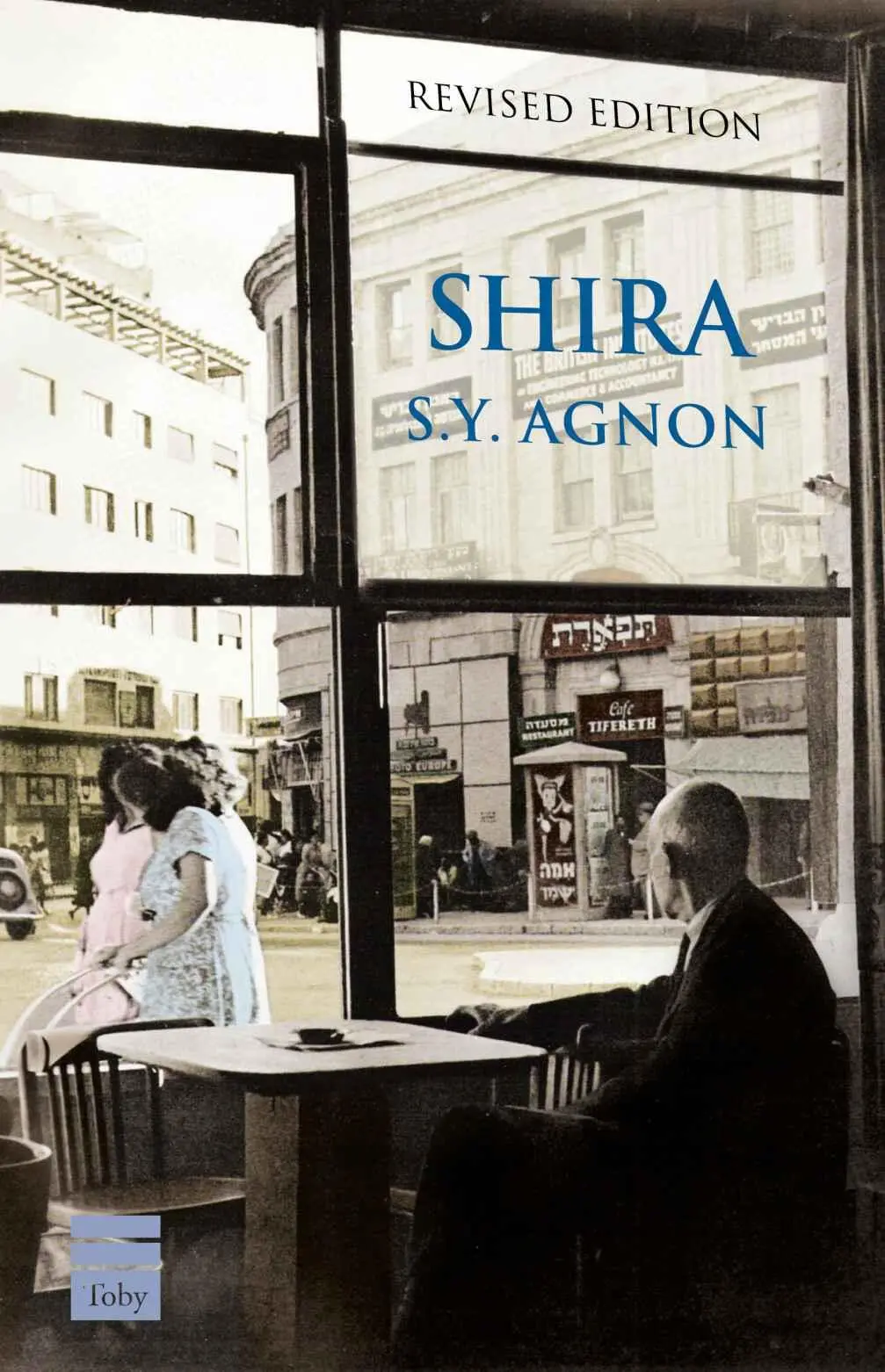
- Название:Shira
- Автор:
- Издательство:Toby Press
- Жанр:
- Год:2014
- ISBN:нет данных
- Рейтинг книги:5 / 5. Голосов: 1
-
Избранное:Добавить в избранное
- Отзывы:
-
Ваша оценка:
Shira: краткое содержание, описание и аннотация
Предлагаем к чтению аннотацию, описание, краткое содержание или предисловие (зависит от того, что написал сам автор книги «Shira»). Если вы не нашли необходимую информацию о книге — напишите в комментариях, мы постараемся отыскать её.
Shira — читать онлайн бесплатно полную книгу (весь текст) целиком
Ниже представлен текст книги, разбитый по страницам. Система сохранения места последней прочитанной страницы, позволяет с удобством читать онлайн бесплатно книгу «Shira», без необходимости каждый раз заново искать на чём Вы остановились. Поставьте закладку, и сможете в любой момент перейти на страницу, на которой закончили чтение.
Интервал:
Закладка:
Gradually, the storm in his heart, which had been stirred up by Shira — by the thought that she might have transmitted some disease to him and from him to his wife and daughters — began to subside. You can’t imagine the scale of his terror. He leaped up repeatedly, alarmed for no reason. When a spoon or fork fell, for example; when the door was opened. After he began to calm down, Herbst felt as if he had a wound that was bandaged too tightly. When the bandage was removed, the pain vanished and he felt normal again. Herbst felt like someone who went out for a walk but was unable to move his legs. When he opened his coat and took off his hat, his feet felt light. Herbst had many metaphors for his soul. I have included two of them, relatively simple ones, for in that period his imagination was vivid, and his images were odd and remote. In one realm, there was no change — the realm of impending disease, which sometimes remained vague to him, formless or nameless. At other times, each disease assumed its classic form, its characteristic symptoms. He considered himself the primary source; the rest of humanity, both a source and an outcome. Before long, all the victims, including himself, were forgotten, along with their diseases, except for his wife, who succumbed to an illness the doctors were unable to diagnose or cure. He, too, forgot the source of her disease and no longer tormented himself with the fact that he could have shed light on its nature and thus its cure. All the fantasies that at first led him to rage, to self-torture, were transformed into pity for this innocent woman assaulted by so many ills. Because he pitied his wife, he tried to please her. There wasn’t a single good thing it was in his power to do that he didn’t try to do. Which wasn’t easy, at this particular time. Because Zahara was about to give birth, Henrietta was unusually nervous. She forgot about serving meals on time; she forgot to do his laundry; and, when the mailman gave her a letter for him, she forgot to pass it on. It happened once that an urgent letter arrived and was left in the kitchen, among the pots. If Manfred hadn’t needed a match for his cigarette, the letter would still be there. Luckily, it was a silly letter, an invitation to a testimonial dinner, one of many such events that take place in Jerusalem every day, honoring some guest who is passing through. Tables are set up for cakes, cookies, pastries, and wines and other beverages, and prominent men and women are invited. But not every prominent person is the master of his own time, and many of them have other invitations for that very hour. In such cases, a moderately prominent person — the lecturer Herbst, for example — is invited and introduced to the guest of honor as a professor at the Hebrew University. Being a well-mannered person, he remains silent and doesn’t say, “No, I’m not really a professor.” Fortunately, it was a silly letter, and, if he had never received it, he would have lost nothing. But the same thing could have happened with an important letter. Nevertheless, he did not scold his wife. On the contrary, he made an effort to reassure her. And this is how he behaved whenever possible.
This effort purified his soul and allayed some of his anguish. But it left its mark on his face, and the strain was quite obvious to the world.
It is the way of the world to see one’s own worries reflected in a friend’s. A man with a miserable wife blames his friend’s sorrow on his friend’s wife, a man who is having trouble with his children blames his friend’s trouble on his children, and so on. Taglicht was a bachelor and childless. What troubled him at that time were those factions that split off from the Haganah to act on their own, contrary to the policy of restraint adopted by the moderates in the yishuv , by the Jewish Agency, by the bi-nationalists, by the best of the English. When Taglicht heard that Tamara Herbst belonged to one of these factions and was involved in terrorist activity, he surmised that her father was worried about her. It didn’t occur to him that Herbst knew very little about Tamara’s activities, that, like most parents, he was not well informed about his children’s lives. Especially in matters such as these, which are carefully guarded and concealed lest they reach the wrong ears.
Taglicht was nineteen years older than Tamara. She therefore thought of him as a member of her father’s generation. Until Tamara went to study in Tel Aviv, he used to address her as if he were an old man talking to a child. That was how he behaved until the day Zahara came from the kvutza , bringing Avraham-and-a-half with her, at which point Taglicht began to treat Tamara as an adult. Henrietta took note of this and said, “Dr. Taglicht, why do you make an old lady out of Tamara? Why, you knew her when she was in the cradle.” Taglicht answered, “One of these days I’ll have to treat her as a grownup, so I might as well begin now.” Since Tamara remained silent, he said no more. After this exchange, Tamara tried to justify his new attitude and was careful not to respond to Taglicht in her usual frivolous way. When Taglicht saw Herbst’s worried face, he understood that he was distressed because of Tamara, because she belonged to that faction, and because she was involved in terrorist activities. He decided to seek her out in order to talk things over with her, to convince her to reconsider. At first, he had intended to revert to his original manner, to approach her as he used to when she was a child, so she would see she was still young and immature. After further consideration, he realized that she would be more likely to acknowledge the implications of her actions if he approached her seriously.
It was easy for Taglicht to go to Herbst’s house but difficult to find Tamara there, for she would fly off as soon as she finished breakfast. Where to, who knows? Still, he found her. He addressed her seriously, without reproach, speaking not as someone with a monopoly on the truth, but as someone whose heart is filled with concern. He talked on and on, until he came to the subject of politics. He began explaining English diplomacy and the strategy of the Colonial Office, which were designed to defeat Zionism and abrogate the Balfour Declaration. Terrorist actions that disrupted the policy of self-restraint were thus welcomed as a step toward the destruction of the yishuv. Tamara stood and listened. She gazed at Taglicht as if she did not know to whom his words were directed. She let him talk and assumed a bewildered expression, as though what was being said had nothing to do with her. Then her expression became questioning, as if to say, What are you after? and these two expressions alternated with a coy one: Though I don’t understand what you are saying, I’m willing to listen. When he paused to give her a chance to respond, she looked disappointed and said, “I thought you were going to say something nice. That you are in love with me, for example. Instead, you talk politics. Tell me, dear doctor, why haven’t you fallen in love with me? I can provide endless evidence that you won’t find another girl like me.” Taglicht looked at her and said, “I admit, Tamara, that I was denied a clowning tongue. Not that the subject can’t be treated lightly, but I was denied the talent bestowed on you in such profusion.”
As he was leaving, she called after him, “I was sure you would look back, that our eyes would meet and disturb you. But you went off without looking back. I didn’t turn to watch you go either. If you like, we could stop at that café on the corner. I hear they have all kinds of ice cream. If you don’t eat ice cream, because you believe the old doctors who say it chills the stomach, then you can have a warm drink. I’m surprised at you, Dr. Taglicht, for listening to every old wives’ tale. Those old doctors have weak stomachs, so of course they catch cold from ice cream. That’s no reason to deprive yourself. You renounce enough things for religious reasons.” Taglicht said, “You think it’s my idea to renounce them? The Torah requires this of me and of all Jews.” Tamara smiled, as she tended to do whenever she felt she had the upper hand, and said, “The Torah doesn’t require anything of me.” Taglicht said, “Why do you exclude yourself from the general public?” Tamara said, “I assume you know as well as I do that the rules you invoke are no longer generally accepted. They are upheld by stubborn individuals who refuse to relinquish the authority enjoyed by their ancestors in medieval times. Like the clerics, they want to exercise power over everyone. I admit that some of them are tolerant; even though they cling to superannuated notions, they don’t hold us in contempt, and they even mix with us.” Taglicht said, “Me, for example?” He was obviously pleased with his question. Tamara said, “Actually, I had in mind a young man you don’t know.” Tamara was about to mention his name but had second thoughts, as he was suspected of a terrorist act in which she had also been involved. Taglicht said, “Didn’t you want to tell me something about…about the fellow who — how did you put it? — ‘clings to superannuated notions’ and is an acquaintance of yours?” Tamara realized from his question that he knew to whom she was referring. She laughed inwardly at the phrasing of the question, at her attempt to conceal, which was, in fact, revealing. She affected innocence, pretending to be unaware of the gravity of the issue. Tamara said, “Last Hanukkah I was invited to a latke party. There was a man there who wouldn’t eat, because the pancakes were fried in the fat of a goose that hadn’t been slaughtered by one of those fellows. You know whom I mean — a fellow with a chin braid and a braid over each jaw, which the Orthodox call earlocks and a beard. There was a doctor there, a native of the Caucasus, descended from mountain Jews who had always been armed like free men and never known the yoke of the Diaspora. The doctor asked that man, ‘Why aren’t you eating latkes? Aren’t they good?’ He wasn’t ashamed to say, ‘Because they were fried in the fat of an improperly slaughtered goose.’ The doctor said, ‘The entire Diaspora is the outcome of those dietary laws. If Jews didn’t designate someone special, a shohet , to slaughter animals, they would have to do it for themselves. They wouldn’t be intimidated by a drop of blood. They would defend themselves, and Gentiles wouldn’t dare to attack them. But Jews are so afraid to spill blood that they deliver themselves to be slaughtered. They would rather let their blood be spilled than spill the blood of their enemies. Why? Because they’re not in the habit of slaughtering anything, not even a pigeon.’“
Читать дальшеИнтервал:
Закладка:
Похожие книги на «Shira»
Представляем Вашему вниманию похожие книги на «Shira» списком для выбора. Мы отобрали схожую по названию и смыслу литературу в надежде предоставить читателям больше вариантов отыскать новые, интересные, ещё непрочитанные произведения.






Обсуждение, отзывы о книге «Shira» и просто собственные мнения читателей. Оставьте ваши комментарии, напишите, что Вы думаете о произведении, его смысле или главных героях. Укажите что конкретно понравилось, а что нет, и почему Вы так считаете.