S. Agnon - Shira
Здесь есть возможность читать онлайн «S. Agnon - Shira» весь текст электронной книги совершенно бесплатно (целиком полную версию без сокращений). В некоторых случаях можно слушать аудио, скачать через торрент в формате fb2 и присутствует краткое содержание. Год выпуска: 2014, Издательство: Toby Press, Жанр: Современная проза, на английском языке. Описание произведения, (предисловие) а так же отзывы посетителей доступны на портале библиотеки ЛибКат.
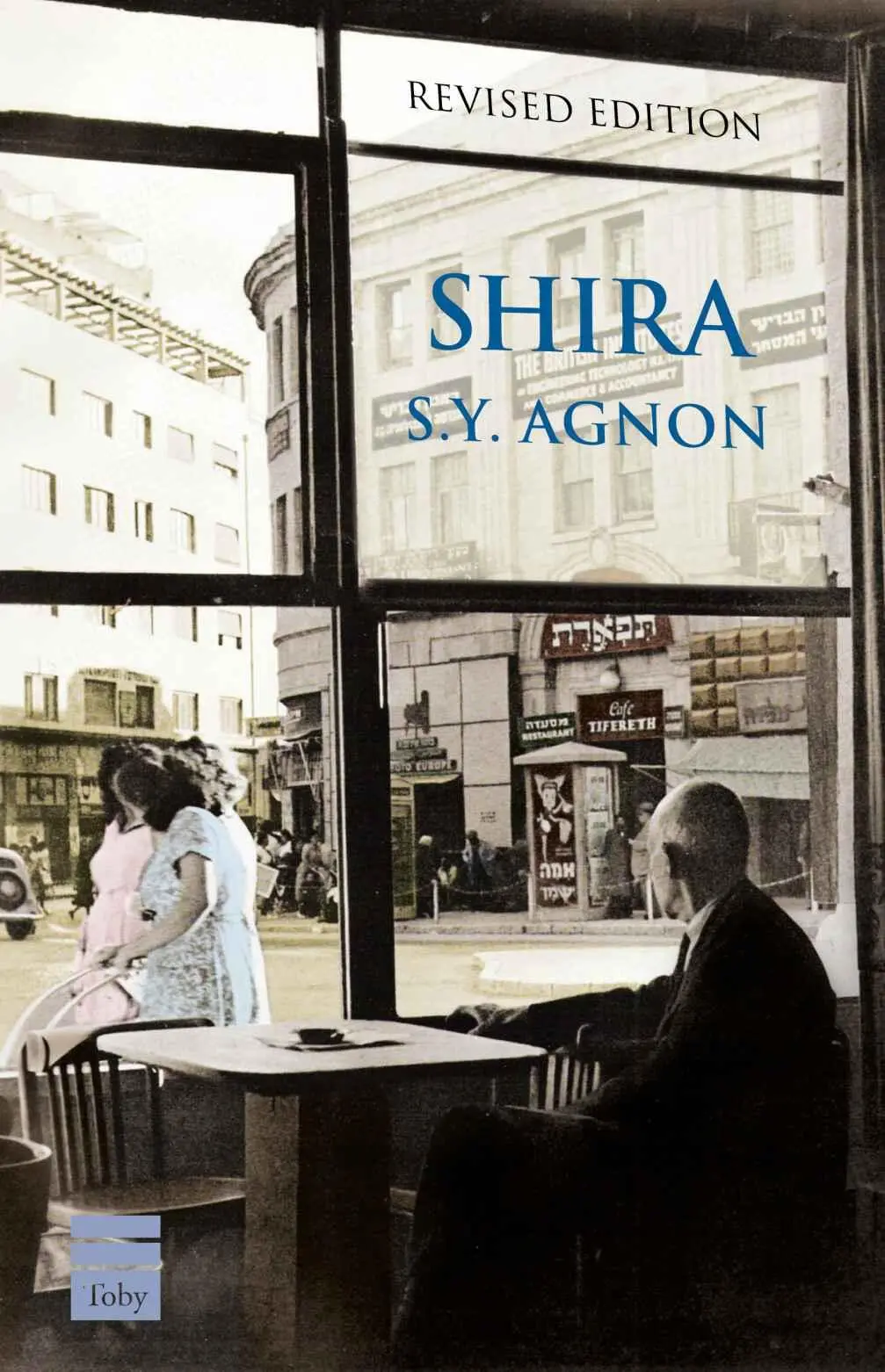
- Название:Shira
- Автор:
- Издательство:Toby Press
- Жанр:
- Год:2014
- ISBN:нет данных
- Рейтинг книги:5 / 5. Голосов: 1
-
Избранное:Добавить в избранное
- Отзывы:
-
Ваша оценка:
Shira: краткое содержание, описание и аннотация
Предлагаем к чтению аннотацию, описание, краткое содержание или предисловие (зависит от того, что написал сам автор книги «Shira»). Если вы не нашли необходимую информацию о книге — напишите в комментариях, мы постараемся отыскать её.
Shira — читать онлайн бесплатно полную книгу (весь текст) целиком
Ниже представлен текст книги, разбитый по страницам. Система сохранения места последней прочитанной страницы, позволяет с удобством читать онлайн бесплатно книгу «Shira», без необходимости каждый раз заново искать на чём Вы остановились. Поставьте закладку, и сможете в любой момент перейти на страницу, на которой закончили чтение.
Интервал:
Закладка:
Herbst was at a loss for words. His tongue set itself in motion, uttering nothing. Herbst knew that at some point he would challenge her, but there was no way to eradicate her opinions. Your metaphors are certainly crude, Miss Shira, Herbst thought to himself. “Good night,” Shira said, her key in hand. “Good night,” Herbst answered. Shira said, “I should have stopped by the pharmacy.” Herbst said, “Then let’s go back.” Shira said, “I can’t.” “Why?” “Why? Because I’m too tired.” Herbst said, “Say the word and I’ll go.” Shira said, “My dear doctor, I’ll forgo the pharmacy and you’ll forgo the good deed.”
Chapter fifteen
As always when coming from Shira’s, he made his way on foot. Although the roads were desolate because of Arab shells, and Herbst was not without imagination, it didn’t occur to him that the perils that menaced others menaced him as well.
The bus was still running. In fact, service was more frequent, so those in outlying districts who had to congratulate a friend on some joyous occasion and couldn’t call on him on Shabbat because of the distance could go in the evening. But Herbst, as always, was on foot. His mind was brimming with the day’s events, and he didn’t want to be distracted by the crowd on the bus.
Sacharson attached himself to Herbst. Before he could hide from him, there he was. Enraged, Herbst lowered his eyelids and reflected: Only the devil could calculate the precise moment when just about anyone would be unwelcome and then proceed to inflict this nut on me. But he said, “I’m glad I ran into you, Mr. Sacharson. My daughter Tamara went to Greece, and her mother would like to trace her route. If you’re done with the Baedeker and no longer need it, I would like to have it back. Right now, if possible.” Hell, he was annoyed with himself. That nut deserves to be scolded for not returning my book, and I pamper him with words as if I’m asking a favor.
Sacharson smiled abjectly, which was how he responded when he saw someone stumble, and scratched his mouth to camouflage the smile, as he always did at such times. While scratching his lip, his fingers found their way into his mouth, and he began to gnaw at his nails. It was a dark night, and one couldn’t really distinguish his fingernails from his skin, so it wasn’t necessary to camouflage the smile. But, out of habit, he scratched his lip and gnawed at his nails. After spitting out some bits of nail, he coughed to clear his throat and threw out a word, as if adding to what had already been said. It was Sacharson’s style to begin in the middle, as if he were adding to a previous statement. After he had talked for a while, Herbst perked up and said, “You mentioned Norway. What does Norway have to do with us?”
Sacharson’s smile could be seen again, and then it was gone. He said, “I was recounting some of what happened to me a few years back, when I still bore the yoke of the commandments accepted by our people. I say ‘our people’; yes, our people, my dear Mr. Herbst. I still consider myself absolutely Jewish — more so than those who are regarded as proper Jews, more than ever since I associated myself with the new covenant between God and Our Savior, and even more so now that I have the privilege of considering myself faithful to God and His people Israel.” Herbst fixed his eyes on an approaching bus, hoping to be able to flee homeward on it and get rid of Sacharson. But it was headed elsewhere, and Sacharson tagged along behind him, walking and talking. Herbst looked back at him and said hastily, “So, Mr. Sacharson, what were you going to say?”
Sacharson draped his cane over his arm and said, “I see, Dr. Herbst, that your ears didn’t accommodate you by taking in my words. I’m not offended, and I don’t want to appear offended. That’s how people are: some talk, others don’t hear. It’s often better not to hear than to hear what wasn’t said. No need to show signs of displeasure. I don’t intend to offer clever aphorisms. I’ll get right back to the beginning of the story, and you’ll hear what you missed before.” Herbst said, “Tell me, Mr. Sacharson, do tell me. This time I will pay attention.”
Sacharson cleared his throat because of the stiff collar that pinched him, because of the bits of fingernail that were caught in his throat, because of the story he was about to tell. He jerked his thumb at Herbst and said, “It happened during the war between Russia and Japan.” Herbst said, “Then it’s an old story.” Sacharson said, “What I mean to tell is not a war story.” Herbst said, “If it’s not a war story, then what do you mean to tell? Whatever it is, tell it, Mr. Sacharson. Tell it. So, it occurred during the Russo-Japanese War. I don’t think you said what the story is about yet. Or am I mistaken? Anyway, no need to go back to the beginning. So, it happened during the Russo-Japanese War.” Sacharson said, “Yes, during the Russo-Japanese War.” Herbst said, “An unnecessary comment, Mr. Sacharson. I remember every word you said. If you like, I can repeat it. Now then…”
Sacharson repeated, “So, I was on my way to America. I was escaping, Mr. Herbst. Escaping from Russia, like many of my people who had no wish to risk their lives for the brutal czar. You people from the liberal countries can’t imagine the pain of young Jews in Russia. Denied all civil rights, members of a battered and trampled people burdened with harsh rules that were becoming worse with every passing day, all of a sudden we were told: ‘Rise up and join hands with your persecutors to fight a nation you don’t know, that has done you no wrong.’ Anyone who could, escaped this war, as I did. I won’t subject you to the entire story. Imagine it for yourself: fellow Jews, brothers in misery, who ought to stand by each other in time of distress — not only did they not stand by me, but they treated me like merchandise, an object to exploit. They stole my last penny, leaving me with nothing. I’m not here to accuse them, nor do I mean to suggest that Jews have no compassion. But compassion is one thing, and avarice is another. Those Jews who are willing to skin a poor man for a price are the same ones who contribute to charitable causes and, of course, to anything holy. In the great synagogue in my town, there is a Torah scroll donated by a renowned philanthropist. Who was he? A man who used to snatch poor orphans and hand them over to Nicholas’s soldiers in place of the sons of the rich. And the rich men — those same rich men — were God-fearing, performed all of the rituals and commandments, and contributed to every cause. Some built synagogues and seminaries or funded schools. Others supported assorted charities, especially those with a sacred purpose. Jews are attracted to that sort of thing. Remember the Kishinev pogrom? When it was over, a fund was set up for the victims, who were without food or clothing. A famous rabbi — one of the most famous in your country — was among those who responded. How? By sending them a very large supply of tefillin. ” Herbst said, “Please, Mr. Sacharson, tell me, how are tefillin related to Norway?” Sacharson said, “You’re joking, doctor. Wait and you’ll see that it’s all one subject — tefillin and Norway, or Norway without tefillin. As you see, Dr. Herbst, Sacharson can joke too when he wants to.” Herbst said, “Excuse me, Mr. Sacharson. I wasn’t joking. I merely asked a question. Since you began with Norway, I was reminding you about Norway.” Sacharson said, “I’m not fussy. Still, let me remind you that I didn’t begin with Norway. Before I said anything about Norway, we were discussing something else: the Russo-Japanese War and the escape of poor Sacharson, who is now privileged to join you on your walk, a short walk as befits a short tale. Now I’m coming to Norway in my story. After many difficulties, I reached Norway. I arrived with swollen feet and torn shoes; hardest of all, empty-handed. The money my mother had given me for expenses was extorted by our Jewish brothers who were supposed to smuggle me across the border. Actually, those swindlers didn’t get rich on me. My mother was poor. She plucked feathers for a living. How did she have money to give me? She skimped on meals, filling the gap with fast days. If I told you how much she gave me, you would laugh. But all I ask of you is that you hear my story without making fun of me. I ask one further thing: a bit of patience. I’m getting back to the heart of the matter. So I arrived in Norway empty-handed. My paltry sum of money had been stolen at the border. I was allowed to keep my other possessions: three faded shirts, an old set of tefillin , and a frayed prayerbook inherited from my father, whose merit must have worked in my favor. You can’t imagine my misfortune. Empty hands, empty stomach, aching legs. Still, I did not despair. My physical anguish didn’t allow me to indulge in a spiritual response such as despair, but it nonetheless glared forth from my eyes. Some fellow from Norway noticed and said, ‘Come with me.’ He was a merchant who had dealt with Russian Jews and had learned some Yiddish. I went with him. He took me to a hotel and ordered a meal for me on his account. Even if you were never in Scandinavia, you have probably heard that it is the custom in most of the big hotels to offer a great assortment of food for breakfast, twenty or thirty varieties at a time, mostly meat and fish. I couldn’t eat meat, because it wasn’t kosher; nor could I eat fish, because it could have been cooked with shellfish. The sardines had been preserved in wine, so I avoided them too, for fear the wine was un-kosher. I took some of those thin crackers called Norwegian bread and ate until my throat felt scratchy. I was still hungry. My benefactor, who had invited me to eat, was confident that a starving man about to faint from hunger would eat whatever he was offered and didn’t notice what I was eating and what I was rejecting. But the waiter noticed and reported to the kitchen. The cook came and asked, ‘Why aren’t you eating any of the good things we’re providing for your pleasure?’ I told him they were forbidden by our religion, et cetera, et cetera. He listened, astonished. Finally, he glared at me, outraged, and this is what he said: ‘Who are you, and what sort of religion is it that forbids you to enjoy the good food any decent person enjoys?’ At the end, my dear Mr. Herbst, at the end, if you will excuse me, he spat in my face. Those northern people are very fine, but there is something in the Jewish religion that enrages even the best Gentile. And rage, my dear Mr. Herbst, leads to ugly deeds, such as spitting in someone’s face.”
Читать дальшеИнтервал:
Закладка:
Похожие книги на «Shira»
Представляем Вашему вниманию похожие книги на «Shira» списком для выбора. Мы отобрали схожую по названию и смыслу литературу в надежде предоставить читателям больше вариантов отыскать новые, интересные, ещё непрочитанные произведения.









Обсуждение, отзывы о книге «Shira» и просто собственные мнения читателей. Оставьте ваши комментарии, напишите, что Вы думаете о произведении, его смысле или главных героях. Укажите что конкретно понравилось, а что нет, и почему Вы так считаете.