S. Agnon - Shira
Здесь есть возможность читать онлайн «S. Agnon - Shira» весь текст электронной книги совершенно бесплатно (целиком полную версию без сокращений). В некоторых случаях можно слушать аудио, скачать через торрент в формате fb2 и присутствует краткое содержание. Год выпуска: 2014, Издательство: Toby Press, Жанр: Современная проза, на английском языке. Описание произведения, (предисловие) а так же отзывы посетителей доступны на портале библиотеки ЛибКат.
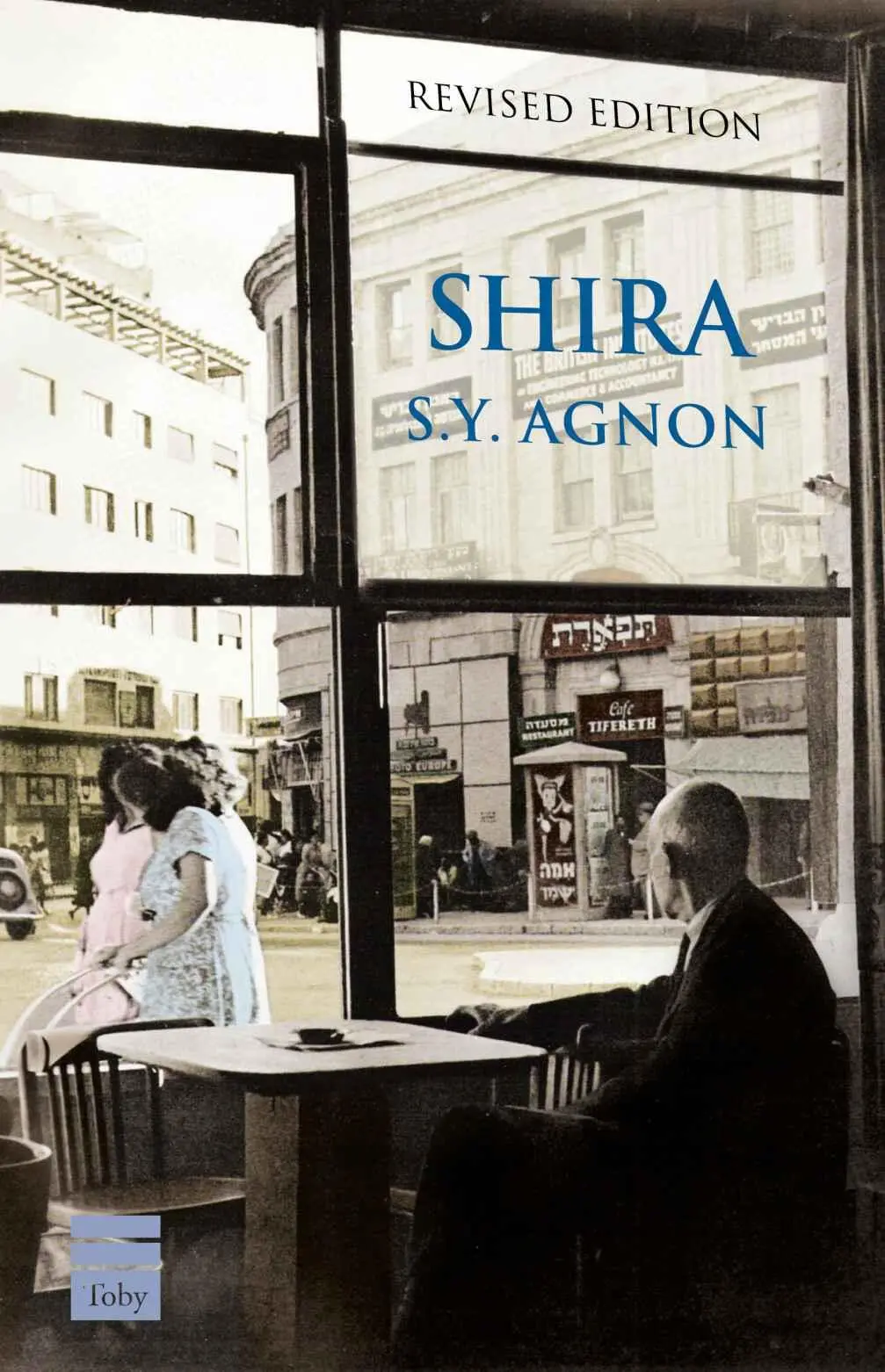
- Название:Shira
- Автор:
- Издательство:Toby Press
- Жанр:
- Год:2014
- ISBN:нет данных
- Рейтинг книги:5 / 5. Голосов: 1
-
Избранное:Добавить в избранное
- Отзывы:
-
Ваша оценка:
Shira: краткое содержание, описание и аннотация
Предлагаем к чтению аннотацию, описание, краткое содержание или предисловие (зависит от того, что написал сам автор книги «Shira»). Если вы не нашли необходимую информацию о книге — напишите в комментариях, мы постараемся отыскать её.
Shira — читать онлайн бесплатно полную книгу (весь текст) целиком
Ниже представлен текст книги, разбитый по страницам. Система сохранения места последней прочитанной страницы, позволяет с удобством читать онлайн бесплатно книгу «Shira», без необходимости каждый раз заново искать на чём Вы остановились. Поставьте закладку, и сможете в любой момент перейти на страницу, на которой закончили чтение.
Интервал:
Закладка:
Herbst lowered his head and reached across the table, touched a dish, withdrew his hand, touched it again, withdrew again. He studied his empty hand, muttering, “Anyone with credit can afford to turn to whomever he wants.” The tall, thin student laughed and said, “The author of the Midrash certainly didn’t lack the means to cover his words. This is probably equally true of our teacher Moses, to whom these words were attributed. He probably didn’t have to look for credit elsewhere.” To which his friend added, “Surely both Moses and the author of the Midrash said only what their credit would support.” The tall, thin student interrupted. “Since we were talking about language earlier, let me say something on that subject. It seems likely to me that those ancient languages that are no longer spoken, the ones we call Semitic, were pronounced without vowels, exactly as they appear in the early inscriptions. SDNM, for example, should be read as it stands, without adding vowels to make SiDoNiM.” Herbst, who was uncomfortable with theories and didn’t enjoy speculating in a field that was not his, smoked in silence, putting out one cigarette and smoking another, dropping the ashes everywhere except in the ashtray. Once or twice he looked in the direction of Shira’s table. Shira wasn’t there. Could she have gone off and left him without saying a word? Then she reappeared. He wanted to leave his students and go to her; he also wanted to invite his students to come sit with him and Shira. These two thoughts were accompanied by a third thought: I have provided more witnesses who could testify that they saw me with Shira.
He got up, went over to Shira, and said, “Come, Shira, let’s sit with those two young men. They’re intelligent people who express their ideas in vigorous language. I know that you’ll enjoy their conversation. This day has been dedicated to literature. On the way here, we discussed hasidic tales; at Anita Brik’s, we discussed poetry. Now, what are these two fellows discussing? Poetics.” Shira said, “Go back to them. I’m too tired to join you.” Herbst said, “Then I’ll call the waiter. I’ll pay, and we can go.” Shira said, “I’ve already paid. Go back and say goodbye to your students, or, if you like, you can sit with them and I’ll find my way home alone.” Herbst said, “I dragged you out of the house, and I’ll return you to it.” Shira said, “Whatever you like.” Herbst said, “If it’s entirely up to me, I choose to go home with you and stay awhile.” Shira said, “I already told you I don’t feel well today.”
Herbst ignored her words. Since the day he met her, he had considered her totally dependent on him, in every aspect of her being, as if she lived through him alone. And, as long as she pleased him, all was well with her. It was merely her obstinacy speaking now, an obstinacy he wished to break. His soul suddenly began to sway, and he was on the verge of falling. He dragged behind her, feebly, accompanied by the memory of her affection, which took several forms. “What’s the matter?” Shira asked. He was overcome with rage. She asks what’s the matter; can’t she see, can’t she tell? He suppressed his anger and asked, “What did you say?” She answered, “I was asking you if anything is the matter.” Herbst glared at her in astonishment and said, “Why do you ask?” Shira said, “You seem to be having trouble walking.” “Yes,” Herbst answered angrily. “My shoelace is loose.” “Your shoelace is loose?” “It’s loose, and it broke off.” “It broke off?” “Not really. Since it was loose, I thought it was broken.” “But it didn’t break?” “It didn’t break, and it isn’t loose. Tell me, Shira, has that never happened to you?” Shira said, “Neither that nor anything similar.” Herbst repeated her words and said, “Please, Shira, explain that to me.” Shira said, “I always tie a knot.” Herbst said, “Even when the shoe has a strap? What sort of shoes are you wearing now?” Shira said, “Do you know what I’d like to say to you?” “What?” Herbst cried, excited. Shira said, “No more questions.” “Why?” “Because they bore me.” Herbst said, “Believe it or not, I see great things in my questions.” Shira said, “In that case, enjoy them yourself; in fact, don’t bother putting them into words.” Herbst said, “It’s not just my thoughts that I want to enjoy, I want — “ Shira interrupted him and said, “I thought a scholar’s chief joy was his thoughts.” Herbst said, “And what about the rest of humanity?” Shira said, “As for the rest of humanity, everyone has his own idea of enjoyment.” Herbst said, “See, Shira, in this respect I’m like the rest of humanity; I’m not satisfied with fantasy.” Shira said, “In that case, you have my blessing. I hope you find what satisfies you.” Herbst said, “Actions speak louder than blessings.” Shira looked at him with open displeasure. Herbst said, “I’ll explain myself.” Shira said, “Don’t be angry with me, Herbst. My head hurts, and my brain won’t tolerate complicated explanations. I’m almost home. The road has never been so long as it is now.” Herbst said, “Is my company so oppressive?” Shira said, “Herbst, let me tell you this: not everything in the world depends on you. There are disruptive factors other than your company. Please, spare me further explanations. Every word I say is fraught with pain.” Herbst said, “It’s that bad?” Shira said, “Please, don’t bother to act surprised. Just give me a chance to recover. I’m glad to be so near home.”
Herbst was in the midst of a vexing muddle. He had already given up on the gratification implicit in staying with Shira. Now all he wanted was to talk. He had nothing specific to say to her, but it was hard for him to let her go. He wanted to engage her in conversation in order to hold on to her, another hour, another half an hour. He remembered Anita Brik and was about to make her a topic of conversation. Before he had a chance to set his tongue in motion, she was forgotten. He recalled Shira’s disdainful remarks about the Hasidim, among them the statement that no one had ever accused her of neglecting them in the hospital, and was going to bring up the subject of sympathies and antipathies — how they don’t always govern our actions. Before he said a word, he forgot what was in his mind. Various other matters muddled his thoughts. Before being transformed into words, they were lost in a muddle. He remembered his students: that he had invited her to sit with them and listen to their talk about language and poetry, and she had refused to join them. He said to her, “Do you ever read essays or articles about authors and books?” Shira said, “Why all of a sudden?” Herbst said, “It’s not so sudden. I’m asking because you rejected the opportunity to hear a discussion of poetry.” Shira said, “I was tired, and I’m still tired.” Herbst said, “Yes, Shira, you are tired. Still, you could answer my question.” Shira said, “What did you ask?” Herbst said, “When a good book about poetry or poets comes your way, do you read it?” Shira said, “Why read books about books?” Herbst said, “A good essay can sharpen a reader’s perception of a poem.” Shira said, “If I can read the poems themselves, why bother with the critics’ opinions? If I can master something with my own mind, why do I need other people’s?” Herbst said, “True, but they might reveal meanings you wouldn’t be aware of on your own.” Shira shrugged her shoulders and said, “You know something, Manfred? Since my teeth grew in, I’ve been in the habit of chewing my own food. Dear doctor, I see that metaphor seems crude to you, so I won’t speak in metaphor. From the day I learned to read, I read without inviting critics and essayists to chew the words of storytellers or poets beforehand and thrust the results into my mouth.” Herbst said, “You don’t admit that there are some things essayists and critics can elucidate for us?” Shira said, “My dear Manfred, when I was in nursing school and my fellow students used to sit around discussing the professors, the doctors, and the head nurses, I paid no attention. I haven’t changed in this respect, even now that I’m a licensed nurse. Their chatter and opinions had no effect on the doctors’ behavior. What they had in common was the fact that they all went right on doing what they did, and, since the nurses were so used to the doctors, they went right on making them the subject of their conversation.”
Читать дальшеИнтервал:
Закладка:
Похожие книги на «Shira»
Представляем Вашему вниманию похожие книги на «Shira» списком для выбора. Мы отобрали схожую по названию и смыслу литературу в надежде предоставить читателям больше вариантов отыскать новые, интересные, ещё непрочитанные произведения.









Обсуждение, отзывы о книге «Shira» и просто собственные мнения читателей. Оставьте ваши комментарии, напишите, что Вы думаете о произведении, его смысле или главных героях. Укажите что конкретно понравилось, а что нет, и почему Вы так считаете.