Gail Hareven - Lies, First Person
Здесь есть возможность читать онлайн «Gail Hareven - Lies, First Person» весь текст электронной книги совершенно бесплатно (целиком полную версию без сокращений). В некоторых случаях можно слушать аудио, скачать через торрент в формате fb2 и присутствует краткое содержание. Год выпуска: 2015, Издательство: Open Letter, Жанр: Современная проза, на английском языке. Описание произведения, (предисловие) а так же отзывы посетителей доступны на портале библиотеки ЛибКат.
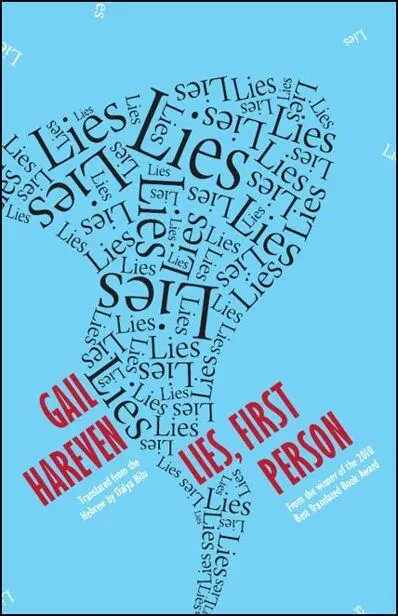
- Название:Lies, First Person
- Автор:
- Издательство:Open Letter
- Жанр:
- Год:2015
- ISBN:нет данных
- Рейтинг книги:3 / 5. Голосов: 1
-
Избранное:Добавить в избранное
- Отзывы:
-
Ваша оценка:
Lies, First Person: краткое содержание, описание и аннотация
Предлагаем к чтению аннотацию, описание, краткое содержание или предисловие (зависит от того, что написал сам автор книги «Lies, First Person»). Если вы не нашли необходимую информацию о книге — напишите в комментариях, мы постараемся отыскать её.
Elinor's comfortable life — popular newspaper column, stable marriage, well-adjusted kids — is totally upended when she finds out that her estranged uncle is coming to Jerusalem to give a speech asking forgiveness for his decades-old book,
.
A shocking novel that galvanized the Jewish diaspora,
was Aaron Gotthilf's attempt to understand — and explain — what it would have been like to be Hitler. As if that wasn't disturbing enough, while writing this controversial novel, Gotthilf stayed in Elinor's parent's house and sexually assaulted her "slow" sister.
In the time leading up to Gotthilf's visit, Elinor will relive the reprehensible events of that time so long ago, over and over, compulsively, while building up the courage — and plan — to avenge her sister in the most conclusive way possible: by murdering Gotthilf, her own personal Hilter.
Along the way to the inevitable confrontation, Gail Hareven uses an obsessive, circular writing style to raise questions about Elinor's mental state, which in turn makes the reader question the veracity of the supposed memoir that they're reading. Is it possible that Elinor is following in her uncle's writerly footpaths, using a first-person narrative to manipulate the reader into forgiving a horrific crime?
Lies, First Person — читать онлайн бесплатно полную книгу (весь текст) целиком
Ниже представлен текст книги, разбитый по страницам. Система сохранения места последней прочитанной страницы, позволяет с удобством читать онлайн бесплатно книгу «Lies, First Person», без необходимости каждый раз заново искать на чём Вы остановились. Поставьте закладку, и сможете в любой момент перейти на страницу, на которой закончили чтение.
Интервал:
Закладка:
The mouth coughed, First Person withdrew a little from the lectern to cough, he straightened his reading glasses on his nose. He moved at his will and uttered whatever sounds came into his head, and I saw every movement and heard every sound. The pounding in my ears died down, and no fire alarm or invitation to the most delightful pleasure imaginable would have uprooted me from my seat: more than anything in the world I needed to see and hear.
He spoke about others who had preceded him in the attempt to solve the dark riddle of Hitler, right from the beginning of the Führer’s career. Any library worthy of the name possessed books on the subject. Some of the explanations they provided were cheap and sensational, not worth commenting on, others gave food for thought, but he would not dwell even now on the serious attempts to come to grips with the subject. There were thousands of such texts in existence, he had not read them all, but let’s say he had read quite a few, and some of them he had even had the opportunity to teach.
After years of studying and teaching, after all the explanations, he felt that we were left with a black hole, with an unsolved riddle, and that all the explanations, even the most profound, were only words, words, words. . that every explanation and every theory collapsed into a black hole of surpassing evil, supreme evil, pure and distilled.
This awareness, this growing despair with words, gave rise to the idea that in order to crack Hitler a completely different way of thinking was required. And this led to the conclusion that what was required in order to plumb the depths of the abyss was not the rational vision of a man of science and theory, but the vision of an artist, the intuitions of an artist, and the courage of an artist.
The speaker bowed his head for a moment in silence, and massaged his cheek with his index finger, as if to pause for reflection before he continued:
When he embarked on this ambitious — today he would not hesitate to use the word “presumptuous”—project of writing about Hitler in the first person, he sincerely believed that only art had the power to plumb the depths of the most evil of souls, and investigate its contents. Scholars and scientists could tell us about Hitler, but only art could make Hitler present to us.
Various accusations had been hurled at him with regard to the book. He agreed with most of his critics, and he was even prepared to add self-criticism of his own to their criticism of him. But of one sin he stood accused of, at least, he was innocent: he had not taken the heavy burden of writing the novel upon himself lightly, and not out of any lust for fame or provocation. Since he had come to confess his error, he would say frankly that from the outset it was clear to him that some people would not understand, and some people would be hurt. In this sense at least he embarked on his project with his eyes open: in the clear knowledge that both art and truth were ruthless.
As far as the criticism of the book was concerned, he was his own harshest critic. As we could see for ourselves, he was no longer young, and he had devoted the last years of his life to the single purpose of exposing the error of his work. He had made a grave mistake in the assumptions he had made, but one thing he could say for certain and in all honesty was that the author had undertaken the writing of the book as a sacred task. The author believed with all his heart that if there was ever anything worth doing, it was writing Hitler, First Person .
His voice. I should describe the elusive quality of his voice, without which this report would be lacking. I have already mentioned the unidentifiable accent, but an accent is not a voice. His voice aspired to pathos when he spoke of art, but at the same time it held a note of parody, as if he were presenting us with an imitation. He sounded like a kind of clown mimicking himself — a clown mimicking a clown imitating an imitation, an imposter pretending to be an imposter — until the listener felt lost and foolish, because he had no idea what was at the bottom of the voice and what it intended. One minute he sounded sincere, and the next he seemed to be mocking the very notion of sincerity. I remembered well the effect of this voice of his, but this time I no longer waited uncertainly for his next sentence in the hope that it would reveal his intention to me. I already knew who he was. And I already knew better than to expect any meaning.
The passing of the years, or perhaps the fact that he was standing on a stage, had intensified the ambivalence of his tone to the point it actually jarred, and I could sense an undercurrent of unease in the audience. On my left, Oded kept rubbing his wrist against the arm of the chair, as if absent-mindedly scratching an insect bite.
The voice dropped to a tone almost of complaint when he went on to review two of the writers who had crossed the line before him. Richard Lourie, a professor of literature, had written a novel called The Autobiography of Joseph Stalin which, as the name implies, tells the story of the Soviet Czar in the first person. If we judge the degree of evil by the number of the tyrant’s victims, then Stalin was even worse than Hitler, but nobody accused Professor Lourie, who was a candidate for the Pulitzer Prize for another of his novels, of doing anything outrageous, and nobody identified him with the subject of his novel or called him “Stalin.”
George Steiner, an outstanding scholar and intellectual, gave Hitler the right to speak and argue in his provocative novella The Portage to San Cristobal of A. H. Steiner came in for a ton of criticism — he himself thought the text very courageous — but in his humble opinion, Steiner didn’t go far enough in looking into the abyss. Steiner’s Hitler was a polemical Hitler, not a personality in the full sense of the word, but rather a collection of bold claims regarding the role of the Jews in history, the author’s argument with himself and his identity.
In writing Hitler, First Person the author strove to advance beyond what Steiner, for whom he had the greatest admiration, had done. He aimed at plumbing the depths of Hitler’s soul, his soul and not his arguments. He wanted to present Hitler not as a series of arguments, and not as a case study under a psychiatric label of one kind or another, but as a human being who experienced reality in his own unique way.
How did this human being experience reality? asked the voice, and his finger rose to massage his cheekbone again.
What conflicts created his stormy stream of consciousness? What did he dream about in his sleep? What images were seared into his mind as a child? These were the questions that would not let him be, and his need for answers, his prayer for answers, he addressed to the muse of literature. More and more he came to believe that only there, only in the realms of art, only under the trance-like inspiration of Mnemosyne, might he come to understand.
In a little while we were about to watch the movie The Fall . What had made us leave home in the heat of thirty eight degrees Celsius, and come here? A purely academic interest in the last days of the Third Reich? Curiosity about the way in which contemporary Germans tell the story of those days? Let us be honest with ourselves. We came here because secretly, in our hearts, we wanted to see Hitler. We came to see Hitler, and we need not feel ashamed of it, because the dark riddle of Hitler still holds us spellbound after all this time; it calls to us and will not let us be until we succeed in solving it.
Steiner’s novella was made into a play. A very talented English actor played Hitler. A no less talented actor plays the Führer in the film we are about to see. We should consider the immense spiritual resources these good people had to bring to bear in order to get under the skin of the character and to understand it. In his opinion, regardless of what we thought of the play or the film, we should respect these two artists for the spiritual sacrifice they were called to make in order to bring Satan before us. Let us consider the possibility that by means of their art and through the personal sacrifice they made — and under the mysterious trance of the muse — these two actors came closer to solving the Hitlerian riddle than a thousand professors with their theories.
Читать дальшеИнтервал:
Закладка:
Похожие книги на «Lies, First Person»
Представляем Вашему вниманию похожие книги на «Lies, First Person» списком для выбора. Мы отобрали схожую по названию и смыслу литературу в надежде предоставить читателям больше вариантов отыскать новые, интересные, ещё непрочитанные произведения.







Обсуждение, отзывы о книге «Lies, First Person» и просто собственные мнения читателей. Оставьте ваши комментарии, напишите, что Вы думаете о произведении, его смысле или главных героях. Укажите что конкретно понравилось, а что нет, и почему Вы так считаете.