Jack O'Connell - The Skin Palace
Здесь есть возможность читать онлайн «Jack O'Connell - The Skin Palace» весь текст электронной книги совершенно бесплатно (целиком полную версию без сокращений). В некоторых случаях можно слушать аудио, скачать через торрент в формате fb2 и присутствует краткое содержание. Год выпуска: 2011, Издательство: MysteriousPress.com/Open Road, Жанр: Современная проза, Триллер, на английском языке. Описание произведения, (предисловие) а так же отзывы посетителей доступны на портале библиотеки ЛибКат.
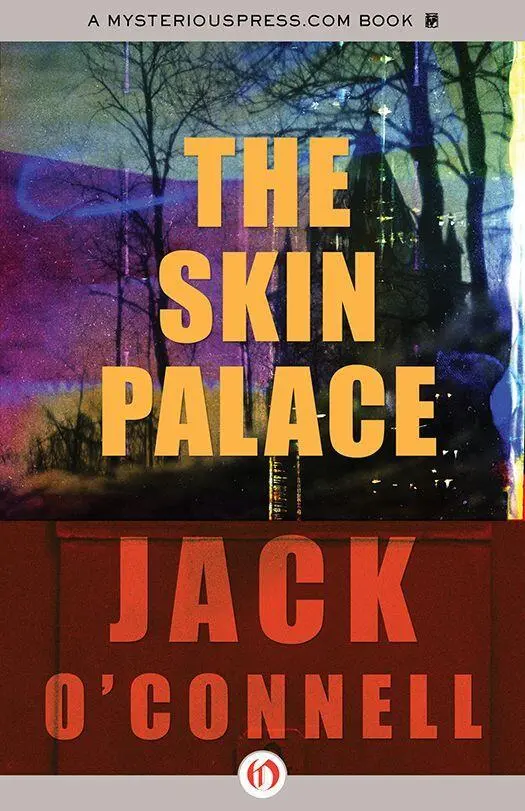
- Название:The Skin Palace
- Автор:
- Издательство:MysteriousPress.com/Open Road
- Жанр:
- Год:2011
- ISBN:нет данных
- Рейтинг книги:3 / 5. Голосов: 1
-
Избранное:Добавить в избранное
- Отзывы:
-
Ваша оценка:
The Skin Palace: краткое содержание, описание и аннотация
Предлагаем к чтению аннотацию, описание, краткое содержание или предисловие (зависит от того, что написал сам автор книги «The Skin Palace»). Если вы не нашли необходимую информацию о книге — напишите в комментариях, мы постараемся отыскать её.
The Skin Palace — читать онлайн бесплатно полную книгу (весь текст) целиком
Ниже представлен текст книги, разбитый по страницам. Система сохранения места последней прочитанной страницы, позволяет с удобством читать онлайн бесплатно книгу «The Skin Palace», без необходимости каждый раз заново искать на чём Вы остановились. Поставьте закладку, и сможете в любой момент перейти на страницу, на которой закончили чтение.
Интервал:
Закладка:
“Not hungry tonight, son?”
He slaps the notebook closed and looks up at Hugo, not knowing what to say, feeling like he’s been caught doing something embarrassing if not necessarily wrong.
Hugo slides into the first seat on the opposite aisle and says, “Neither am I,” then he tilts his head back and rubs his eyes for a time, opens them and stares up at the enormous white of the screen.
“This is church for people like us, Jakob,” Hugo says. “I find the blank screen relaxing. It eases the mind. It slows down the images.”
Jakob’s not sure if he should answer. He’s a little uneasy, worried that Hugo will try to pump him about Papa’s motives and methods.
Hugo takes a handkerchief from his coat pocket and pats at the top of his head.
“It’s shocking,” he says.
“Sir?”
“How well you know your way around. You’d think you grew up on a soundstage.”
Jakob shakes his head. “If only,” he says.
“Clearly,” Hugo says, “you have the passion. And the talent. This is to be your life’s calling, I take it?”
“I just love movies, Mr. Schick,” Jakob says. “I always have. I’ve never wanted to do anything else.”
“It frightens me a bit,” Hugo says. “How common that is, I mean. Cinema has taken over in a way I never quite thought it would.”
Jakob stays quiet but nods.
“Did your mother love the movies?”
“I never knew my mother, Mr. Schick. She died soon after I was born.”
“I’m very sorry, Jakob. Your father then. Did he instill the passion for film?”
Jakob’s laugh fills the room.
“My father never went to the movies. He was busy. Working. It was very difficult in Maisel.”
“So I’ve heard.”
“I had a,” the boy pauses for just a second, “governess. A kind of nanny. She took me every day and night. The Kierling Theatre. A beautiful building, even in its decay. Most of the movies were in English. Subtitled. We went until I began to learn the language. Then we kept going.”
“Is she still back in Maisel? The nanny?”
“She’s dead also,” Jakob says. “Maisel has a very high mortality rate.”
“Apparently,” Hugo says, repocketing his handkerchief.
There’s a few minutes of silence until Jakob gathers the nerve to say, “Ms. Persons says you worked with Fritz Lang?”
“Ms. Persons,” Hugo repeats. “How precious of you.”
“Is it true?”
“What do you think?”
“Coco says you were second-unit camera for von Stroheim.”
Schick likes this one.
“My children,” he says, “love to tease.”
“Miss Wiene says you ghostwrote part of Citizen Kane.”
“This one I had not heard.”
“And Leni—”
“Yes?” Hugo says, grimacing a bit. “What does Ms. Pauline say?”
“She says you did surveillance work for some government man named Mr. Cohn. She says you secretly filmed some meetings.”
“One day, Jakob, I will kill that woman.”
Jakob wants to bite his own tongue out of his mouth. Hugo senses the explosion of regret and says, “Relax, son, Schick is only joking.”
Jakob mutters, “She’s amazing.”
Hugo nods and says, “Unfortunately, she is,” then he gets up out of his seat and walks to the right, climbs the stairs to the stage and comes to the lip in front of Jakob. “But never forget, son, she is just another actor. My good friend Hitch called them all cattle. But I think they are more like a common venereal disease. You can always pick one up without very much effort. So sad really, that this is who will carry on my gospel once I’ve exited the stage.”
He stares down at the boy, expressionless, hands clasped behind his back, his safari jacket straining over his belly. He leans his head forward a bit, smiles slightly, and says, “So, when are you going to show it to me?”
“Show it to you, sir?”
Hugo nods.
Jakob tried to think what he could mean and comes up empty.
“I’m afraid I don’t—”
“The script,” Hugo explodes, his voice booming through the cavern of the theatre and echoing back.
“The script,” Jakob repeats.
Hugo sighs, arches his back, says to the ceiling, “You know, at some point, coyness becomes an insult.”
“I’m sorry, Mr. Schick, I don’t—”
“Are you trying to tell me you don’t have a screenplay, son? Is this what you would ask an old man to believe? Please, Jakob, think about how long I’ve been around this industry. I’ve seen the prodigies come and go and end up schlepping industrial training strips in Newark. Please, don’t presume to tell Hugo that you haven’t written a script. That you don’t think it is the greatest thing since Chinatown. That you never for a moment considered using your father’s influence to foist it on me.”
“My father,” Jakob yells, coming to his feet, “has nothing to do with my screenplay.”
A huge, smug smile fades into Hugo’s face. He folds his arms across his chest and says, “So there is a screenplay.”
Jakob wants to leave, wants to be back upstairs trying to find a tape measure for Udolpho Phist.
“Would you at least tell me the title?” Hugo asks, now sounding apologetic.
Jakob looks down at his feet, sniffles, mumbles, “It’s called Little Girl Lost.”
“I like it,” Hugo says.
“That’s just a working title for now.”
“Of course,” Hugo says.
They both let a minute pass.
“I never intended to give it to you,” Jakob says, knowing how false this will sound before the words leave his lips.
“I would be delighted,” Hugo says, “no, honored. I would be honored to read this Little Girl Lost.”
“It’s not really done yet.”
“They’re never done, Jakob.”
Jakob shakes his head.
“I swear to you, Mr. Schick, my father doesn’t even know I’ve written a film.”
“Jakob, relax, please, Hermann is my banker now. If he wants us to make your movie, I’m sure we can find—”
“My father,” Jakob yells, “doesn’t know I wrote a movie.”
Hugo is taken back. He sits down on the stage between the break in the gold railing and lets his legs hang toward the floor.
“All right, calm now,” he says. “There’s no need to be angry.”
“I do not need nor want,” Jakob says, “my father’s help to make my film.”
“This is good, Jakob. This is wonderful. You surprise and delight me. Upon this rock, eh son? You have the talent and you have the passion. And now I know you have the anger. No one realizes how much anger you need to make a picture. You treasure that anger, my boy. You nourish it until you can channel it into the camera.”
Jakob doesn’t want to hear any more. He steps into the aisle and Hugo says, “Sit down, boy.”
Jakob freezes.
“You still work for me. Now sit down.”
There’s no threat to Hugo’s voice, but a palpable seriousness. Jakob slides back into the seat.
“Now, you tell Schick, who is it you emulate?”
Jakob looks up, confused.
“Who is it you want to be? Tell me. Is it Lang? You mentioned Lang, yes? Kurosawa? Bergman? Reifenstahl, perhaps?”
“I don’t—”
“No, of course not. You love the Americans. It’s obvious. It’s how you learned the language, as you say. Yes, it’s got to be Joseph H. Lewis? Or F. E. Feist? Maybe Phil Karlson? Tony Mann? Sam Fuller? Fuller was a local boy, you know.”
“Stop,” Jakob says. “I don’t want to be any of them.”
“Who am I missing?” Hugo asks.
“I want to be Kinsky. I want to be an original.”
Hugo takes a long and deep breath and manages to suppress the laughter.
Читать дальшеИнтервал:
Закладка:
Похожие книги на «The Skin Palace»
Представляем Вашему вниманию похожие книги на «The Skin Palace» списком для выбора. Мы отобрали схожую по названию и смыслу литературу в надежде предоставить читателям больше вариантов отыскать новые, интересные, ещё непрочитанные произведения.




Обсуждение, отзывы о книге «The Skin Palace» и просто собственные мнения читателей. Оставьте ваши комментарии, напишите, что Вы думаете о произведении, его смысле или главных героях. Укажите что конкретно понравилось, а что нет, и почему Вы так считаете.