Jack O'Connell - The Skin Palace
Здесь есть возможность читать онлайн «Jack O'Connell - The Skin Palace» весь текст электронной книги совершенно бесплатно (целиком полную версию без сокращений). В некоторых случаях можно слушать аудио, скачать через торрент в формате fb2 и присутствует краткое содержание. Год выпуска: 2011, Издательство: MysteriousPress.com/Open Road, Жанр: Современная проза, Триллер, на английском языке. Описание произведения, (предисловие) а так же отзывы посетителей доступны на портале библиотеки ЛибКат.
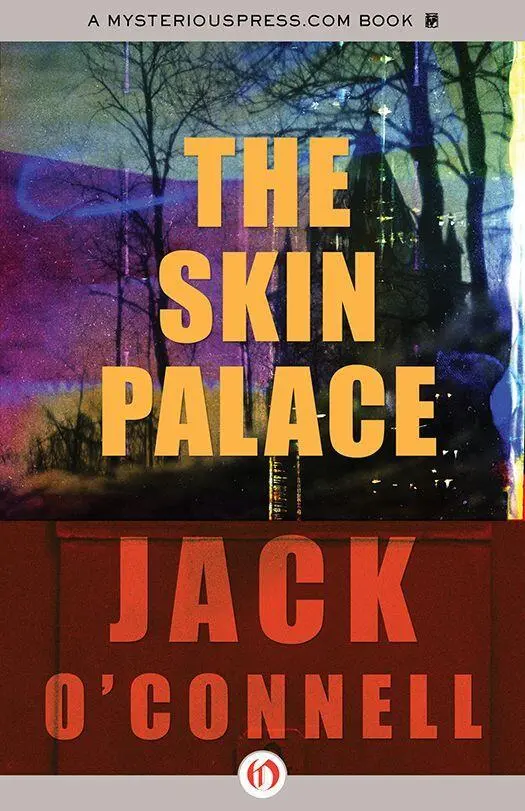
- Название:The Skin Palace
- Автор:
- Издательство:MysteriousPress.com/Open Road
- Жанр:
- Год:2011
- ISBN:нет данных
- Рейтинг книги:3 / 5. Голосов: 1
-
Избранное:Добавить в избранное
- Отзывы:
-
Ваша оценка:
The Skin Palace: краткое содержание, описание и аннотация
Предлагаем к чтению аннотацию, описание, краткое содержание или предисловие (зависит от того, что написал сам автор книги «The Skin Palace»). Если вы не нашли необходимую информацию о книге — напишите в комментариях, мы постараемся отыскать её.
The Skin Palace — читать онлайн бесплатно полную книгу (весь текст) целиком
Ниже представлен текст книги, разбитый по страницам. Система сохранения места последней прочитанной страницы, позволяет с удобством читать онлайн бесплатно книгу «The Skin Palace», без необходимости каждый раз заново искать на чём Вы остановились. Поставьте закладку, и сможете в любой момент перейти на страницу, на которой закончили чтение.
Интервал:
Закладка:
She nods.
“What do you think?” he asks.
And she decides, at that moment, not to mention the seven prints she developed.
“I have no idea,” she says. “On Monday I walked into a camera store and brought home a camera. The store owner told me it was a consignment sale. He mentioned your name. He says you were losing your eyesight—”
He doesn’t raise his voice but he cuts her off and says, “That’s a lie, Sylvia. Jack Derry never mentioned my name.”
“Oh,” she says, “you know Mr. Deny? I could’ve sworn he mentioned your name. Would you know where he might be? I still owe him some money.”
“Deny never mentioned my name,” he repeats.
“I guess I’ve got it wrong then.”
He’s frustrated. He shifts in his seat and says, “Have you taken a look at the camera?”
“Not really. Been so damn busy—”
His head falls back, bumps the Naugahyde. He says, “Please, Sylvia. Don’t be this way.”
She shakes her head. “Look, I don’t know what you expect from me, but you’ve got a hell of a lot of nerve. You want something from me, fine. It’s possible I can help you, I don’t know. But stop jerking me around—”
“That’s not what I’m trying to do, Sylvia—”
“Good. Great. Then just start telling me how you know so much about me. How you know where I’ve been and what’s happened to me. Why you were watching me at the dance back therè—”
“Damn good thing I was—”
“You’re a hero, Propp,” she says, now furious. “So noble of you to stop a goddamn rape. How do I know that son of a bitch Zorro wasn’t working for you? Beautiful way to get me down here—”
He pounds down on the table. Her cup falls over and coffee spills and he yells, “I don’t believe this. I don’t believe you just said that.”
He slides out of the booth and exits the diner without looking back and Sylvia slumps and realizes she’s made a mistake. She lets a second go by for both of them to calm down, then she slides out and goes after him.
But he’s nowhere to be seen. She walks a full circle around St. Benedict’s but he’s not in the cavern. And then a thought hits her and before she even looks back inside through the windows, she knows it’s true — her camera is nowhere to be seen on the tabletop. Propp has taken it.
She stands still and listens but can’t hear any footsteps, any noise at all beyond the soft hum of the generator back inside. And the impact of where she is and the fact that she has no idea how to leave suddenly hits her and she wants to run but keeps herself from moving, stands still and calls for Propp.
But there’s no answer.
21
Sylvia retraces her steps. She moves through the opening to the diner’s cavern, squeezes down the narrow path. She starts down the gravel embankment, slips and slides to the rail bed on her behind. She’s back in the dark except for the red lantern glow that barely makes it around the bend of the tunnel. She knows the way back to the Zone is left, in the direction of the red light. She knows if she just follows the tracks, eventually she’ll come to the hatchway that leads up into the Canal cellars.
She also knows that if Propp was telling the truth, turning right and following the tracks that lead away from the Zone will bring her up into the remains of Gompers Station.
She stands in the middle of the rail bed for a second, trying to think. They took so many turns on the way down here that it’s doubtful she could remember them all. On the other hand, Gompers Station, with its packs of wild dogs and junkies and drunks and gangboys is not someplace you want to stroll through at night, especially when you’re wearing a shredded nightgown.
But she can find her way home from Gompers, so she turns right and starts walking. Within five minutes the track bed starts to incline upward and she climbs toward an arc of moonlight and emerges in a huge pavilion. The roof of the station is almost nonexistent and enough light is getting through to give her some bearings. She’s only been inside Gompers once and that was over a dozen years ago. She’d stayed too late at the Girls’ Club one Saturday and, afraid of missing the bus home, she took a shortcut through the station. It had already been closed down for a good ten years and natural erosion combined with perpetual vandalism had made some awful headway by then. She ran through this blighted, bombed-out temple as fast as she could, but the image of the place stayed with her for weeks.
And now, looking around in this weak moonlight, in these dim, soft beams of light that reveal all the dust and grit just hovering in the air, it’s like her childhood memory has come to life. But it’s more vivid and decayed than anything her imagination could have estimated and provided for. All she can think of is grainy black-and-white landscape shots she’s studied, the aftermath of world war bombings, pictures of places like Berlin and Dresden, the ground just a jumble of various-sized craters and mounds of earth and brick and stone, buildings half-slouched into each other, their walls knocked down, windowless, chimneys toppled into useless heaps, and everywhere these in-discriminate tangles of something like wire and iron and scraps of cloth and metallic shards, just clumps of recombinant junk whose origin is unknown, plunked down like a shower of meteorites from space and now sitting mute and useless like clusters of industrial weed.
This is the remains of Gompers Station. This is what’s left of one of the most stunning architectural wonders in New England. It’s now a monument to entropy, an embarrassing hulk whose only purpose is to admonish the ego of a community. It’s an arc of cracked and ash-caked vaulting walls, grand stairways that degenerate halfway to their destination into simple mountains of hacked-up bedrock, Greco-Roman columns that lie sideways in cinder beds and are covered with neon gang graffiti and now serve only as marble bull’s-eyes for the spray of dogs and forgotten reprobates.
Sylvia thinks there’s something wrong with her for looking on all this decay and thinking only I wish I had my camera.
Maybe that’s why she came this way. Because she thought Propp would come this way. And Propp has her camera.
She looks around the perimeter of the pavilion for movement, for some sign of another presence. She should be looking for exits, ways out to the street and out of downtown. But what her eyes settle on, across the hall, for some reason bathed in a brighter, more direct shower of moonlight, is what at first looks like a huge, white-ish boulder. As she moves across the hall toward it she realizes it’s the bottom half of a massive support column that’s been knocked down and broken at its base. The odd thing is that the main shaft of the column, the bulk of its mass, is gone, is nowhere in the vicinity. Someone must have hauled it away and she can’t begin to imagine how much the thing could have weighed. What’s left here is the base, about three feet tall and maybe three feet in diameter, this ribbed pillar that looks like solid marble, a creamy white-gone-yellow but shot through with dark veins that in a better light she’d take to be scarlet.
And as she comes to stop in front of it and puts her hand out to touch it, to take in the coldness that she imagines it retains, Sylvia is instantly struck by the fact, by her absolute surety of the fact, that she’s seen this broken column before, that this is the specific pedestal that the Madonna and her infant are posed on in the seven photographs she developed.
This is where Terrence Propp shot the series. This is the precise point where the shadowy mother with the achingly tender shoulder and her half-shrouded infant with its hungry mouth sat and were exposed, at least seven times, to the open eye of the camera.
Читать дальшеИнтервал:
Закладка:
Похожие книги на «The Skin Palace»
Представляем Вашему вниманию похожие книги на «The Skin Palace» списком для выбора. Мы отобрали схожую по названию и смыслу литературу в надежде предоставить читателям больше вариантов отыскать новые, интересные, ещё непрочитанные произведения.








Обсуждение, отзывы о книге «The Skin Palace» и просто собственные мнения читателей. Оставьте ваши комментарии, напишите, что Вы думаете о произведении, его смысле или главных героях. Укажите что конкретно понравилось, а что нет, и почему Вы так считаете.