Jack O'Connell - The Skin Palace
Здесь есть возможность читать онлайн «Jack O'Connell - The Skin Palace» весь текст электронной книги совершенно бесплатно (целиком полную версию без сокращений). В некоторых случаях можно слушать аудио, скачать через торрент в формате fb2 и присутствует краткое содержание. Год выпуска: 2011, Издательство: MysteriousPress.com/Open Road, Жанр: Современная проза, Триллер, на английском языке. Описание произведения, (предисловие) а так же отзывы посетителей доступны на портале библиотеки ЛибКат.
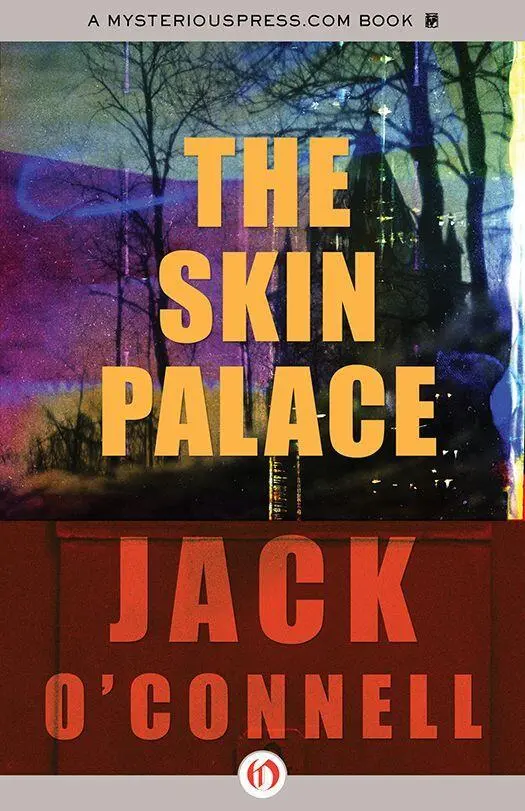
- Название:The Skin Palace
- Автор:
- Издательство:MysteriousPress.com/Open Road
- Жанр:
- Год:2011
- ISBN:нет данных
- Рейтинг книги:3 / 5. Голосов: 1
-
Избранное:Добавить в избранное
- Отзывы:
-
Ваша оценка:
The Skin Palace: краткое содержание, описание и аннотация
Предлагаем к чтению аннотацию, описание, краткое содержание или предисловие (зависит от того, что написал сам автор книги «The Skin Palace»). Если вы не нашли необходимую информацию о книге — напишите в комментариях, мы постараемся отыскать её.
The Skin Palace — читать онлайн бесплатно полную книгу (весь текст) целиком
Ниже представлен текст книги, разбитый по страницам. Система сохранения места последней прочитанной страницы, позволяет с удобством читать онлайн бесплатно книгу «The Skin Palace», без необходимости каждый раз заново искать на чём Вы остановились. Поставьте закладку, и сможете в любой момент перейти на страницу, на которой закончили чтение.
Интервал:
Закладка:
“An original, is that right?” he says. “And what does this original want to do?”
Jakob knows he’s shown too much of his hand. He can’t believe he’s done this. It’s always been so easy to keep the film-talk inside. He must have inhaled some of the amyl nitrite floating through the studio. He must still be punchdrunk with the sight of Leni Pauline taking an endless shower with Coco Bing and Herbie Warm.
“I want,” Jakob says slowly, “to give them the primal image.”
“Ah,” says Hugo, closing his eyes and nodding, “of course, the primal image.”
Jakob isn’t sure if he’s being mocked.
“And how will you go about that?” Hugo asks.
“If I knew, do you think I’d tell you?”
“Very good, son, I’d certainly steal the technique immediately.”
“I didn’t mean—”
“Hush, Jakob. Keep still and listen to an old man for just a moment. Indulge me, yes?”
“I’m sorry, I just—”
Hugo brings a finger up to his lips, lets out a long shush that in the hollow of the theatre takes on a life of its own. Then, after a testing moment of quiet, Hugo says, “It is not that your primal image doesn’t exist. It very much does. I suspect it has since the dawn of consciousness. But hear me now, please Jakob, because I can save you decades of futile and agonizing work. I can save you public failure and a very personal, lingering humiliation. The primal image you want to badly to capture, it is different for every set of eyes. Image is ambiguous. We invest it with all its power. We determine whether it will bring us the greater truth or the more shielding lie.”
Jakob shifts in his seat.
“Film,” Hugo says, “is a collaborative art. No matter what anyone will tell you, son, film is always a collaboration. Beyond this, and I’m sorry, Jakob, I know this is the last thing you wish to hear today, but film is a business. It is a product. It is a commodity to be marketed wisely and often.”
Jakob lets loose a condescending sniffle that Hugo ignores.
“The primal image is unique to every eyeball on this planet, Jakob. You can’t get around that. It’s like knowing about our own death. Facing that fact is part of becoming an adult. And for the filmmaker, facing that fact and continuing to work, that is about becoming an artist.”
They stare at each other.
“Let us make this a mutual confession, my boy. Let me tell you what I strive for, what I would hope to realize before the end of this lifetime of work. I tell you this knowing that it will never happen, that my time grows more limited each day, each film.”
Jakob is suddenly intrigued.
“Someday it may be possible. We see the first steps already — the morphing, the computer modeling. Someday, the cinema as we know it will be as obsolete as the printed page. A historical curiosity. Eventually, I’m sure there’ll be no need for the human actor, not as we know them today. We’ll store hundreds of millions of sequences of their movements and mold them together as is necessary. But this hocus-pocus, this nonsense really, isn’t what possesses me.”
A deep breath, making the boy wait.
“I want the day, the method, the impossible ability to throw each individual’s unique movie, their own primal image, as you say, up on the screen. I want the very synapses of the human brain to be accessible as my own editing board, the ultimate Moviola. I want a way of establishing a pool of sorts, a floating and infinite library of every imagistic instant ever exposed to light. More images, faster images, all the time. I want a way of tapping into each memory that each nanosecond of celluloid they’ve ever opened their eyes to. And finally, I want a way of editing any and all of this goulash together — life image, dream image, movie image — and all the cutting choices are mine. What stays and what goes and in what sequence it unravels.
“From the start, reality has had its way with us. Reality has constantly raped us. Attacked us daily and molested us mercilessly. But soon, Jakob, we will rape reality. We will fuck with reality in ways too monstrous to imagine. Won’t it be wonderful?”
Another aborted laugh.
“I would call it a Hyperflix of the mind. Hyperflix. Incorporated.”
Jakob stands up and walks to the stage, his eyes almost parallel with Schick’s dangling knees.
“And they have the nerve,” Hugo says, “to say I have a psychotic ego. It goes so far beyond ego. You do see that, don’t you, Jakob?”
The boy smiles and nods in the darkness.
“Clear as can be, Mr. Schick.”
23
Outside, they meet on the remains of the stairway that leads to the station’s main entrance. Propp is walking, holding the camera in front of him and twisting the rewind crank, spooling all the exposed film back into its metal canister. Over his shoulder, he’s carrying a canvas satchel, an old, scarred-up duffel embroidered with a line drawing of what looks like some deformed version of Diane Arbus’s face.
Sylvia is sitting hunched over, hugging her knees and looking out at the Bishop Square rotary where a body is lying facedown. She’s watching for signs of movement, any kind of drunken twitch or shake. But so far there haven’t been any.
Propp comes to a stop next to her and when she shifts her focus to his face, he pops open the back of the camera, tosses the roll of film into his palm and pockets it, then places the camera on the ground between them.
“The film was mine,” Sylvia says.
Propp lowers himself down next to her, mimics her posture, cracks his knuckles elaborately and says, “But the image is mine.”
For a number of reasons, she’s galled by the remark.
“I don’t think so,” she says.
“It’s an old argument,” Propp says. “You want to waste the rest of the night replaying it?”
“The night,” she says, “is over.”
“Is it?” he says, overtly patronizing. “And why is that, Sylvia?”
“Because I’m tired and I’m cold and I want to go home.”
“Is Perry waiting?”
“You don’t know Perry,” Sylvia yells and now the body across the street in the rotary stirs, looks up for a second, then lowers its head again.
“Why did the children bother you so much, Sylvia.”
She just looks at him.
“The kids. The kids who live inside. The sight of them really got to you.”
She gives him the sign he wants and says, “One of those elemental images, I guess,” borrowing the phrase from Mr. Quevedo.
He shakes his head, tremendously pleased, as if she’s made his night with her answer.
“That’s exactly correct,” he says. “What shall we name it?”
She squints at him.
“The image,” he says. “The archetype, back in there,” gesturing to the station, “the image that just invaded us.”
“I thought you said we invaded them.”
He ignores the comment and says, “Can we call it The Persecution of the Innocent? Or is that too melodramatic? Help me out now, Sylvia.”
She doesn’t want to indulge him. She wants to walk away. Instead she says, “It’s not exactly persecution, is it?”
He shifts on his ass, clasps his hands and brings them up to his mouth and says, “No, I see what you’re saying. It’s more like they were forgotten—”
“Abandoned.”
“Exactly,” he says. “Just abandoned.”
Sylvia stands up and Propp says, “Don’t abandon me, Sylvia.”
He wants to get her furious and she fights it. She just turns and says, “Why would you want to triviliaze those children in there?”
“Trivialize?”
She holds his stare.
“I think,” Propp says, “it’s almost impossible to trivialize anything anymore. That implies differentiating, giving greater weight and concern to one thing over another. I think we’re losing the ability to do that. I think everything’s evening out. We’ve been assaulted for so long now. Imagery just hitting us over and over. More images. Faster images. All the time. It’s a kind of media overfarming. It’s the most addictive narcotic in the world. We’re choking on images. Our vision has grown toxic with an overabundance. The input is erasing our capacity for judgment. And for empathy.
Читать дальшеИнтервал:
Закладка:
Похожие книги на «The Skin Palace»
Представляем Вашему вниманию похожие книги на «The Skin Palace» списком для выбора. Мы отобрали схожую по названию и смыслу литературу в надежде предоставить читателям больше вариантов отыскать новые, интересные, ещё непрочитанные произведения.






Обсуждение, отзывы о книге «The Skin Palace» и просто собственные мнения читателей. Оставьте ваши комментарии, напишите, что Вы думаете о произведении, его смысле или главных героях. Укажите что конкретно понравилось, а что нет, и почему Вы так считаете.