Christopher WunderLee - Moore's Mythopoeia
Здесь есть возможность читать онлайн «Christopher WunderLee - Moore's Mythopoeia» весь текст электронной книги совершенно бесплатно (целиком полную версию без сокращений). В некоторых случаях можно слушать аудио, скачать через торрент в формате fb2 и присутствует краткое содержание. Год выпуска: 2010, Издательство: Picaro Editions, Жанр: Современная проза, Фантастика и фэнтези, на английском языке. Описание произведения, (предисловие) а так же отзывы посетителей доступны на портале библиотеки ЛибКат.
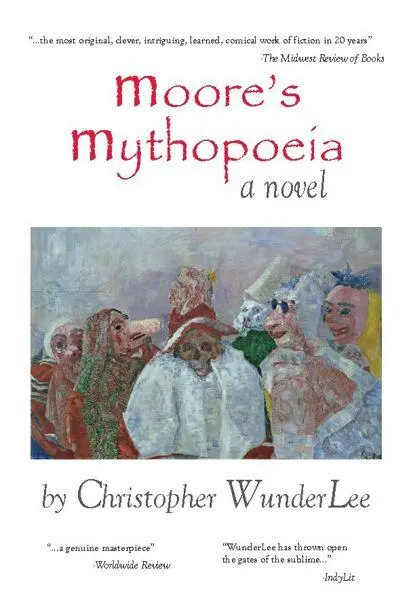
- Название:Moore's Mythopoeia
- Автор:
- Издательство:Picaro Editions
- Жанр:
- Год:2010
- ISBN:нет данных
- Рейтинг книги:3 / 5. Голосов: 1
-
Избранное:Добавить в избранное
- Отзывы:
-
Ваша оценка:
Moore's Mythopoeia: краткое содержание, описание и аннотация
Предлагаем к чтению аннотацию, описание, краткое содержание или предисловие (зависит от того, что написал сам автор книги «Moore's Mythopoeia»). Если вы не нашли необходимую информацию о книге — напишите в комментариях, мы постараемся отыскать её.
Moore's Mythopoeia — читать онлайн бесплатно полную книгу (весь текст) целиком
Ниже представлен текст книги, разбитый по страницам. Система сохранения места последней прочитанной страницы, позволяет с удобством читать онлайн бесплатно книгу «Moore's Mythopoeia», без необходимости каждый раз заново искать на чём Вы остановились. Поставьте закладку, и сможете в любой момент перейти на страницу, на которой закончили чтение.
Интервал:
Закладка:
Carl Reagan is not present at this time. Although, seemingly always present for the entire interview, is Noah Petrov, known as Granny Winslow to the children’s book reading public (and amongst the rebels: the Pirate), who, unbeknownst to Joseph, is given to treating the movement as his very own expergefaction due to his undiagnosed sophomania coupled with bipolar desipiency, causing Noah to say things like: “the rhadamanthine hierodule that I am, I cannot uncover a dolorifuge to end my suffering.” Noah scurries about the room, mumbling, stopping to see if he can add anything to the conversation, and then, continuing his asymmetrical hyperboles. He is a small man, easily confused as a woman if seen from the back, due to slight shoulders, supple arms, and a tendency to swing his hips quite violently when he walks (which has recently become a point of great irritation for poor Noah, who realizes that he’s doing it and tries to stop it, giving the appearance of a hula dancer with no tempo). In order to combat his effeminate stature, Noah Petrov has an enormous Whitmanesq beard that he allows to grow impudently and unwashed hair he slicks back with grease.
Standing in the corner, as though he’s Noah’s personal trainer, as he enjoys providing commentary on the other’s obvious geometrical swath, is an angular man who could very well have been a ballet dancer but who was not, never trusting himself diametrically in tights, whose name is Oxford Carlyle, although he writes under the name Oxy Freelander (and is known amongst the rebels as the Captain). Oxford, unmedicated as the rest, suffers bouts of lygophilia, that sprang, in the clinical opinion, from his attempt to cure himself of taphephobia, which was brought on from an obvious xenogenous episode during his childhood in which he buried his dog, believing it to be dead, only for it to start whining an hour or so later and for poor Oxy to dig it out with his hands in a frightfully guilty mania. Otherwise, Oxford Carlyle is outwardly, a normal man of thirty-seven, with no features too defined and no character traits one could say were ill-becoming.
Although Michael Rand would disagree, having had a considerably long rivalry with Oxford over the Indigo World Book Award that they were both in the running for during their secondary education and which, unfortunately, went to neither of them (although Oxford received an honorable mention). Michael writes under his real name, Michael Rand (known to the rebels as the Angel), and has the sorry ophthalmic condition of xanthopsia, caused by years of ingesting a prescription pill called Vemodremium that was supposed to help him with the unfortunate witzelsucht he suffered after his first book was so well received ( the Guardian calling it: “a clever chuckle wrapped in a hilarious up-chuck”) and after his proceeding attempts did not receive the same praise. Now Michael avoids humor like his own voice is urticant and is very near to becoming a valetudinarian, so much so that Arthur Dodger has to make certain concessions in order to get him to attend meetings (which is key, since he is the minute-taker). Michael pays no attention to Joseph or Arthur or Oxford or Noah as they begin their interview, he is too busy considering whether or not he is claustrophobic or just a little too warm.
At this point, Arthur began to actually speak with Joseph, who listened attentively, if not a little distractedly, and nodded his head when it appeared that this would be appropriate and turned his attention to either Noah or Michael or Oxford every four and a half seconds to allow them the opportunity to add a little something or to amend their leader’s point. Then, it was Joseph’s turn, or at least it appeared to be Joseph’s turn, as Arthur finally went quiet.
"Listen… I was reading to my children, from a popular series of books concerning orphans, and as I read, I found myself elaborating on some of the characters' names, titles of chapters, ideas presented… it was more of an intellectual exercise than the books proffered for my consumption… because I was investigating why the author chose particular names, titles and ideas and relaying that to my kids… I was saying, do you know why the author chose to name that character Ersatz? Because that means replacement or substitute… and what does that say about this character? About who he is in the narrative? They were learning about allusion and reference, about metaphor and narrative devices at its base… the book became an intellectual experience… one in which my children could chime in and say, ah ha! that is why he's named that… that is why the chapter is titled that… that is why the author presented an idea… We're so preoccupied with how it feels… my wife will suggest emotion from the slightest hint… from a commercial… from a puppy… from a card… and yet, we've relegated so much of our art to a dependence and a myopia on expressing the emotions of characters… providing drama… which is, of course, an essential human feature… however, anyone with a pet will tell you that it is not an exclusive human trait… that we share it with most animals on the planet… dogs smile, pigs weep, and monkeys riot… our novels are filled with dramatic interludes so overused, we already know the prescribed outcome… we can see the protagonist turn his or her back on the other character… stare into the mirror… we insert dramatic pauses… and for all this drama, there is no catharsis… no enlightenment from invented emotion… we do not benefit from it… and so I wonder, why do we feel it needs to be there? Why is there such a requirement that to call a book a novel, it must tell us how the characters feel? Of course they feel… even as millions of us non-fabricated figures do not… it is a given… and some critics may argue otherwise, they may say so much fiction is filled with fodder… the minutia of one author's research to the point of boredom… but if I am reading a novel and the protagonist is a scientist, wouldn't that character be filled with scientific fodder the rest of us would find rather mundane? Of course he will feel anger, remorse, sadness, love… he is supposed to be human… but what of his intellectual capacity? The greatest novels enlighten… and not from catharsis… not from an emotional awakening… but from the font of a crackling mind… when the reader is engaged in an intellectual test with the novelist… when the novelist is providing the audience with ideas that are new and different and strange… when characters are challenges… when they dwell in an environment altogether normal but express to us a wholly new vision, creating for us a place where our minds can engage the subject and mull it over… put the book down and consider what has just been said, what that lines means, what the piece of dialogue suggests about any number of human adjectives… who are we and why are we here? What is the meaning? By asking that, from a painting, from a sculpture, from a book, from music, we demand from our minds more than what we know… I know sadness… I know pleasure… I think I know love… lust… beauty… but tell me not how does it feel… tell me how it illuminates my finite condition… my relation to the idea… the idea is the thing… give me an idea… please… I beg you… one new idea! Just one… and you will have accomplished more than a million believable emotions… yes… I believe that character was sad when she left him… you do not need to tell me that… you do not need to tell me he was depressed… you don't need to show me… I believe… I know because I am human… I am so human I knew before I read the onomatopoeia of the slamming door that he would be crushed… I knew his reflections would swirl around her presence and her absence… the shock of her departure is like the crash of cold wave on the seashore… indeed… I agree… I understand the ruminations on suicide… the fears and the pain… the prediction of this response is so inherently human, so expected, it is seemingly predestined… so then why do you bother me with long tracts detailing the phases of despair? They are there… hanging… dangling… obvious… in the mood… and for all the eloquence and all the expression… I am left hollow… shall I move on to the next book? Perhaps there I may find some awakening… something more than a retreat to the given… something altogether inquisitive and something that causes my mind to stir… to consider for just a brief second more than the bombardment of emotions… something that will cause me to pause and consider the ether of intellectualism… something that bears an idea and causes me to wonder… to wonder for days… reexamining this small notion so profoundly… or, are you afraid? Are we afraid? What will happen if we have a million readers wondering about… considering more than the emotions life gives them organically… actually philosophizing… and what if they actually verbalize this notion? Say to another citizen, I was reading a book and it caused me to consider a very important question, which has nothing to do with practical life or shared emotions, but is wholly subjective and useless… it won't help anyone… it is odd and scary… but I can't seem to stop thinking about it because it means something more and it itches my mind… what do you think? And of course, you will say, shut up! Do you want to cause the French Revolution? No, no, no… think about emotions… think about the obvious… the expected… the given… this whole dalliance with ideas is useless… it will only make you unhappy and unsure… what good can come from you considering it? Where is the money in it? Where is the progress? Egads… try to think of other people for once… and so, we read what we are told and we swallow their regurgitation like good chicks… all the while, wanting something more… something we know is right there… on the periphery of the written word… the possibility… but we won't go there… we can't… that way madness lies… and the critics say, tell me how does it feel? I know… I know…"
Читать дальшеИнтервал:
Закладка:
Похожие книги на «Moore's Mythopoeia»
Представляем Вашему вниманию похожие книги на «Moore's Mythopoeia» списком для выбора. Мы отобрали схожую по названию и смыслу литературу в надежде предоставить читателям больше вариантов отыскать новые, интересные, ещё непрочитанные произведения.

Обсуждение, отзывы о книге «Moore's Mythopoeia» и просто собственные мнения читателей. Оставьте ваши комментарии, напишите, что Вы думаете о произведении, его смысле или главных героях. Укажите что конкретно понравилось, а что нет, и почему Вы так считаете.