Christopher WunderLee - Moore's Mythopoeia
Здесь есть возможность читать онлайн «Christopher WunderLee - Moore's Mythopoeia» весь текст электронной книги совершенно бесплатно (целиком полную версию без сокращений). В некоторых случаях можно слушать аудио, скачать через торрент в формате fb2 и присутствует краткое содержание. Год выпуска: 2010, Издательство: Picaro Editions, Жанр: Современная проза, Фантастика и фэнтези, на английском языке. Описание произведения, (предисловие) а так же отзывы посетителей доступны на портале библиотеки ЛибКат.
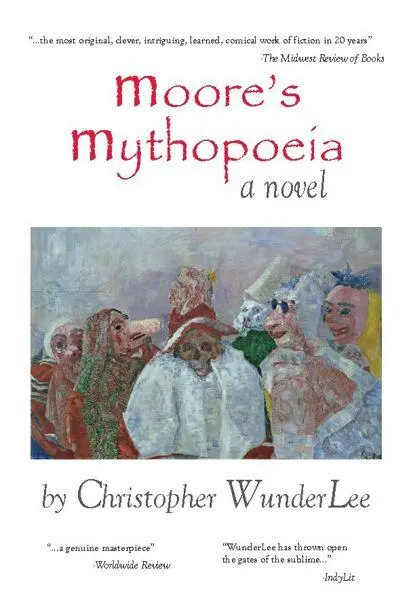
- Название:Moore's Mythopoeia
- Автор:
- Издательство:Picaro Editions
- Жанр:
- Год:2010
- ISBN:нет данных
- Рейтинг книги:3 / 5. Голосов: 1
-
Избранное:Добавить в избранное
- Отзывы:
-
Ваша оценка:
Moore's Mythopoeia: краткое содержание, описание и аннотация
Предлагаем к чтению аннотацию, описание, краткое содержание или предисловие (зависит от того, что написал сам автор книги «Moore's Mythopoeia»). Если вы не нашли необходимую информацию о книге — напишите в комментариях, мы постараемся отыскать её.
Moore's Mythopoeia — читать онлайн бесплатно полную книгу (весь текст) целиком
Ниже представлен текст книги, разбитый по страницам. Система сохранения места последней прочитанной страницы, позволяет с удобством читать онлайн бесплатно книгу «Moore's Mythopoeia», без необходимости каждый раз заново искать на чём Вы остановились. Поставьте закладку, и сможете в любой момент перейти на страницу, на которой закончили чтение.
Интервал:
Закладка:
And he expanded within her, he didn’t go room to room, he no longer moved within her, he filled her. Elisa quivered noticeably, her upper lip curled around her teeth, her nostrils flared, and she exhaled him. She felt wasted, deliciously exhausted, she felt as she had never before, a purposefully sublime feeling that slowly dissipated, emanating out of her body and she only wanted one thing, to feel it again.
His eye closed and she was released. She was able to move again, she regained her composure, she touched her own face, she hadn’t been able tell her own expression and then, she regained control. His ownership had been complete and he had chosen to relinquish it back to her. She was frightened by it and she wanted nothing more than for him to take it back, for his presence to be once more within her, but she didn’t look at him again. She told herself that she couldn’t, that she could not give up again. She only needed to make it through the proceedings without ever looking at him again.
* * *
Him the omnipotent state tossed headfirst, like a comet, from their spires down to endless perdition, there to dwell in defiance. His doom reserved for him a wrath, a foresight of conviction, for now the thought of happiness did not torment him. Joseph moved lengthily down a hollowed street towards his destination. He had deciphered the message, he had argued with the causes and the effects, the thesis and the antithesis, he was lighting his lantern and venturing out, towards a supreme enterprise, to be initiated, joining the baleful and the afflicted, the rebel angels. At the door, where peace and rest can never dwell, hope comes in utter darkness, a password delivered and a final step into the pale hallway. Joseph, in the dungeon, listens only to the silence of the hall, the movement of lips against earlobes, the shifting of cloaks against arms, the plastic rubbing against the collar, the faces all disguised as Halloween deities, the crowd amassing around him as he’s led to his place, the stage unlit, the furnace flaming without light, the congregation quietly waiting.
In the beginning he knew no difference, no heaven or hell or paradise or pandemonium, only the sameness of lack-luster days, the information told over radio waves, the screen’s promises, the packaging of tranquility in rainbow boxes, the inert force of future conquests, of suppressed sexuality leaking out of the hooded tubes of products, the whole perfect world balancing on terms and definitions. These were the prejudices, myths in a definite Sorelian context, the foundations of which held the entire structure of his consciousness.
The stage was set, a great black wolf joining a friendly ghost, Frankenstein, a skeleton, and a pirate. They cheered quietly. Joseph watched without joining in, he was already a member, the words were impeded within the text he’d read to his children for years, they’d been hiding in the last place, having been systematically gleaned from all the rest, they’d wisely escaped to children’s books. There are no more courageous verses, no cadence of bardic splendor, timbre has been called on their poetry, they are checked, censored, stiffly adjusted for maximum consumption, they are made democratic, they are the victims of Readian notions of accessibility, they are the failing voices of dissention. He is introduced; there is no guilt. They look upon him suspiciously.
Prowling on stage the Cat advances on cue, fluid, graceful, publicly expressing midnight thoughts, romantic poses, cocked head, hips extenuated, the long line of her abdomen, the crescent shadows of pert breasts, the posture of a siren. Joseph watches her consciously maneuver their eyes to the Wolf. She sees him as he wonders what she thinks of her role in the proceedings. She does not turn away.
“Good, good, I’m glad you came, we’re all very glad to have you,” the ghost of Carl Reagan’s voice says into his ear. “He’ll speak for a little while, then it’s off to meet and greet your new friends. We’re calling you Morning Star.”
Mr. Mephisto.
“No one has a name here, that’s the Wolf, I’m ghost, the woman we’re all gawking at’s Miss Kitty, and so on. The Wolf’s the boss, he’s going to ask you to agree to certain terms, the most important of which is for you to throw off the manacles of your oppression, namely the drugs, we’re all off of them, not a bite. You see that’s the control factor, the rebranding technique, the gone for the thirty days and brainwashed into submission, convincing us all we need tranquility and can only achieve it through managed care of our emotions, but they’ve engineered us that way, my friend, you see, I may have my problems, but they’re not natural, no, for every solution they’ve coded into my chemistry they’ve added their little defense systems, making it oh so believable my friend. But I’ll let him tell you about it more. But welcome, welcome, welcome to the Players.”
Joseph had not turned his eyes away from her; he saw her standing alone (usually meaning one is in bad company) on the podium. There was expression to her stance; it was odd to see her body capped by a mask so queer, so opposing to the organic angularity of her limbs. Her legs were posed oddly, highlighting the curve of her posterior and the slope of her back, as if she always advertised her body parts, those portions of her flesh that men noticed first, her chest, her stomach, her crotch, her backside, her legs, and hid her personality. He felt a soothing pleasure, she seemed unable to turn away from him, undisguised, her eyes searching him without turning away, he felt himself transported across the wires between them.
Then he was guided away. She watched him. He was looking off, above them as they were introduced. He glanced back towards her every few minutes, as if he was making sure that she was still watching, as if he was about do to something and she needed to see it.
* * *
As an introduction, which is currently, coincidentally, occurring in the plot, the Player’s Rebellion (they prefer the more anfractuous term ‘resistance’) is a loose rabble of hardly fifty members that meet infrequently to devise nyctophoniac plots against their fellow citizens in order to ‘awaken’ them to their own (subjectively speaking) proverbial social incarceration. Arthur Dodger, also known as Father Nicholas (and amongst the rebels: the Wolf), is recognized, both ceremonially and conventionally, as the leader (however he knows far better), and during this initiation service, as Joseph is, shall we say knighted, he passively (very nobly) welcomes the new recruit by delivering a kalokagathical sermon that is Derridian in its pure deconstructionalism, although the Bonhoefferian undertones are missed by many of his listeners. If we were to be metoposcopic about Arthur Dodger, we would have to say he appeared to be reflective, while at the same time given to grinning widely (this we deduce from facial etchings) rather than jocularity, that he had unused working man hands (thick fingers with cinnamon rolls for knuckles), a prejudice for treating people as inferiors (he puts on certain apparent airs), and a philosophical brow. His eyes were slightly large in comparison to the phrenologically sound size of his head, giving Arthur an innocence that was mere mirage, and providing him with that attribute so utilitarian in his occupation that one might say it was exploited. Seated in a large, plush (throne) chair and surrounding himself in bona fide tobacco smoke, Arthur Dodger stares at the new initiate as three other ‘players’ co-mingle in hushed voices and in an evident orchestration of dutiful behavior.
Since Joseph doesn’t know him, he cannot be aware of Arthur’s true nature (we won’t offer a prosopography here), and is forced to rely on the face set so strictly before him. However, the paradox has some indications, Arthur’s interest in grapholagnia while at the same time being afflicted with gymnophobia is indicated somewhat disinterestingly by his tendency to cloth himself in high collars, long sleeves (overly long, down to his own fingers), and full-length socks (so that when he sits, there is no sliver of hairy leg between his trousers and his socks). But, of course, Joseph makes no mention of this and patiently waits to be addressed (as per the instructions of Carl Reagan).
Читать дальшеИнтервал:
Закладка:
Похожие книги на «Moore's Mythopoeia»
Представляем Вашему вниманию похожие книги на «Moore's Mythopoeia» списком для выбора. Мы отобрали схожую по названию и смыслу литературу в надежде предоставить читателям больше вариантов отыскать новые, интересные, ещё непрочитанные произведения.


Обсуждение, отзывы о книге «Moore's Mythopoeia» и просто собственные мнения читателей. Оставьте ваши комментарии, напишите, что Вы думаете о произведении, его смысле или главных героях. Укажите что конкретно понравилось, а что нет, и почему Вы так считаете.