Tash Aw - Five Star Billionaire
Здесь есть возможность читать онлайн «Tash Aw - Five Star Billionaire» — ознакомительный отрывок электронной книги совершенно бесплатно, а после прочтения отрывка купить полную версию. В некоторых случаях можно слушать аудио, скачать через торрент в формате fb2 и присутствует краткое содержание. Год выпуска: 2013, Издательство: Spiegel & Grau, Жанр: Современная проза, на английском языке. Описание произведения, (предисловие) а так же отзывы посетителей доступны на портале библиотеки ЛибКат.
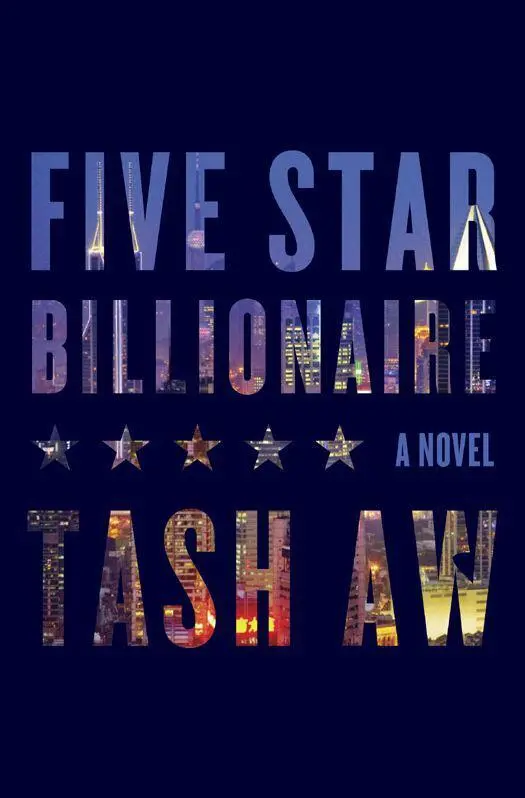
- Название:Five Star Billionaire
- Автор:
- Издательство:Spiegel & Grau
- Жанр:
- Год:2013
- ISBN:нет данных
- Рейтинг книги:3 / 5. Голосов: 1
-
Избранное:Добавить в избранное
- Отзывы:
-
Ваша оценка:
Five Star Billionaire: краткое содержание, описание и аннотация
Предлагаем к чтению аннотацию, описание, краткое содержание или предисловие (зависит от того, что написал сам автор книги «Five Star Billionaire»). Если вы не нашли необходимую информацию о книге — напишите в комментариях, мы постараемся отыскать её.
the dazzling kaleidoscopic new novel by the award-winning writer Tash Aw, offers rare insight into China today, with its constant transformations and its promise of possibility.
Five Star Billionaire — читать онлайн ознакомительный отрывок
Ниже представлен текст книги, разбитый по страницам. Система сохранения места последней прочитанной страницы, позволяет с удобством читать онлайн бесплатно книгу «Five Star Billionaire», без необходимости каждый раз заново искать на чём Вы остановились. Поставьте закладку, и сможете в любой момент перейти на страницу, на которой закончили чтение.
Интервал:
Закладка:
The weight of lingering suspicion began to affect his health, and he suffered a small stroke one night. Although his condition improved enough for him to return to work, he resigned a few months later, reputation ruined. If people remembered him at all, they would recall not a hardworking man of humble roots but yet another inefficient politician whose major preoccupation was to amass as much money as possible before he was discovered. But in this regard he was barely remarkable, and after a few years no one would remember him at all. No one remembers you if they don’t respect you; and he had lost all the respect he had worked so hard to gain.
When he died, several months after resigning, the scandal reignited briefly before fading away again. The manner of his death was fitting for a corrupt politician, violent and sudden and even — to be honest — unsurprising. That was what most people thought in private, Yinghui knew. For her, the end was not the end, it was merely the postscript: His life had finished the moment he had lost the respect he so craved.
She left Malaysia two months after his funeral, heading for Singapore, but it was too familiar, too much like home. It was not until she reached Shanghai that she felt she was sufficiently far away from all she had lost. She began to change the way she lived, consciously hardening herself to the world around her, taking an interest in matters she had barely noticed before. Art, music, literature — all the things she had once loved — now seemed less solid, more dangerous in their fluidity than business and finance. She found reassurance in the methodical workings of money. Every time she struggled to comprehend something in the financial press, she remembered her father saying that she would never understand how money worked, and she would begin to cry, though she was not sure if it was out of frustration or grief. She would press on, forcing herself to be at ease with company reports and meetings with bankers. She would become a great businesswoman, she promised herself. Her parents had been wrong about her, as they had been about many things. Every time she thought about them, she felt a huge swell of sadness, an inarticulate yet crushing sense of injustice: Her parents had been victims, yet there had been no perpetrator, no target for her anger. She had messed around with a boy who hadn’t loved her, devoted years of her life to him — the memory of her fecklessness, too, made her teary and unstable and even ashamed. Her businesses comforted her, made her feel that she was on solid ground; they helped her forget the aimless young girl she had once been.
Time and distance allowed her to look forward, ever forward, and the momentum she built up along her journey allowed her to breathe, to settle as the years passed, changing until she became who she was now. As she walked in to the offices of the bank in the new IFC Tower, the sweet-toxic smell of varnish hanging richly in the air, an image briefly came to Yinghui’s mind: her mother wailing at her father’s funeral, the loud sobs turning swiftly to shrieks, all her poise lost in a matter of seconds as she muttered gibberish about the injustices her husband had suffered, about the cruelty that life had inflicted upon him, sprinkled with profanities against his numerous and unnamed killers.
It was so undignified, a total loss of self-respect.
The memory flashed into Yinghui’s mind for just an instant before she snuffed it out again. Like a candle flame pinched between the fingers, it hurt for only a half second before being extinguished, leaving nothing but a bland waxy impression on her brain.
She announced herself to the receptionist and sat down to have one last look at her papers. She had spent most of the previous evening rehearsing what she would say and how she would say it: a winning combination of forcefulness and seduction. Walter had rung her at midnight, as she was finalizing her presentation, to see how she was doing. He spoke on his mobile from his car; he had just finished a long, tedious evening with business associates and wanted to call before it got too late. He was brief but warm and encouraging. And that morning the first message on her BlackBerry was from him. It said: They will BEG to give you a loan. Hugs W .
She checked her appearance in the compact mirror she kept in her handbag. She stood up and smoothed her trouser suit, discreetly looking into the mirror that ran along the wall of the reception area. She breathed steadily, calmly.
She would never allow herself to be like her mother, not even for one second.
HOW TO BE INVENTIVE — PROPERTY-MANAGEMENT CASE STUDY, CONTINUED
Nearly two months passed with no communication from my father, and then, suddenly, a letter brimming with his customary positive thinking arrived. He had had a bad cough, he said, and had spent several feverish days confined to his little room. Lying on the camp bed, he noticed small, quick birds flitting in and out of the airy rooms of the ground floor. When he finally summoned the strength to go upstairs, he noticed more of them darting about in the darkness like bats, even though he had boarded up the windows to protect the building from the elements. They were squeezing through the cracks in the plywood, wheeling around in the gloom. He mentioned his discovery casually in the coffee shop one day and was surprised to learn that everyone seemed already to know of these birds: They were swiftlets, the very kind whose nests were prized as a delicacy by the Chinese, who boiled them in soups and served them at banquets. Yes, the famous bird’s nest soup that cured everything from bad skin to rheumatism to lethargy to sluggish digestions — well, that came from these little birds. And Kota Bharu was becoming a bit of a bird town: The swiftlets fed on the clouds of tiny winged insects along the banks of the great muddy river, and colonies of them were being established in the abandoned buildings in the part of town where my father lived. No one knew why they went into some buildings and not others, but if they were nesting in your house, it was as good as having a small jewelry shop! Did I know what those birds’ nests sold for in Hong Kong? U.S. $100 per hundred grams — or just three nests! As soon as you harvested one nest, the birds would simply make another, which you could then harvest, and so on — it was as easy as that!
Thus began the frenzy of building work of a bizarre nature, which added to the hotel’s air of ghostly decrepitude. Every single window, bar the one in my father’s room, was boarded up and sealed with cement rendering. Water was allowed to seep slowly through the leaky pipes, making the floors and walls damp with constant humidity ( Lucky thing I could not afford to replace the old pipes with good new ones! he exulted in one letter). The aim, he explained, was to re-create the atmosphere of a dank, gloomy cave — the natural habitat of the birds. Encouraged in his endeavors by acquaintances and other birdhouse owners who offered helpful tips, he bought a portable stereo set and played a hissy cassette recording of the birds’ sonar clicking, which echoed in the darkness of the Tokyo Hotel. Hearing the noises of a nesting colony would not only encourage birds to enter the building but, once they were inside, would make them feel at home and believe that there were many other birds already breeding there. He had to use all these modern scientific techniques, you see.
I began to receive excited letters, increasing in their frequency, detailing the nature of his progress. He had never been a literary type and he provided only the bare outline of what he was doing, but it was easy to chart the upward curve of his sentiments, initially at least:
Birds nesting on floor number 3! Number of nests: 4. Must increase humidity level. Just finished closing up windows on floor number 2—very dark up there now!
Читать дальшеИнтервал:
Закладка:
Похожие книги на «Five Star Billionaire»
Представляем Вашему вниманию похожие книги на «Five Star Billionaire» списком для выбора. Мы отобрали схожую по названию и смыслу литературу в надежде предоставить читателям больше вариантов отыскать новые, интересные, ещё непрочитанные произведения.

![Scott O’Hara - Five-Star Fugitive [= Border Town Girl]](/books/432138/scott-o-hara-five-thumb.webp)





Обсуждение, отзывы о книге «Five Star Billionaire» и просто собственные мнения читателей. Оставьте ваши комментарии, напишите, что Вы думаете о произведении, его смысле или главных героях. Укажите что конкретно понравилось, а что нет, и почему Вы так считаете.