Tash Aw - Five Star Billionaire
Здесь есть возможность читать онлайн «Tash Aw - Five Star Billionaire» — ознакомительный отрывок электронной книги совершенно бесплатно, а после прочтения отрывка купить полную версию. В некоторых случаях можно слушать аудио, скачать через торрент в формате fb2 и присутствует краткое содержание. Год выпуска: 2013, Издательство: Spiegel & Grau, Жанр: Современная проза, на английском языке. Описание произведения, (предисловие) а так же отзывы посетителей доступны на портале библиотеки ЛибКат.
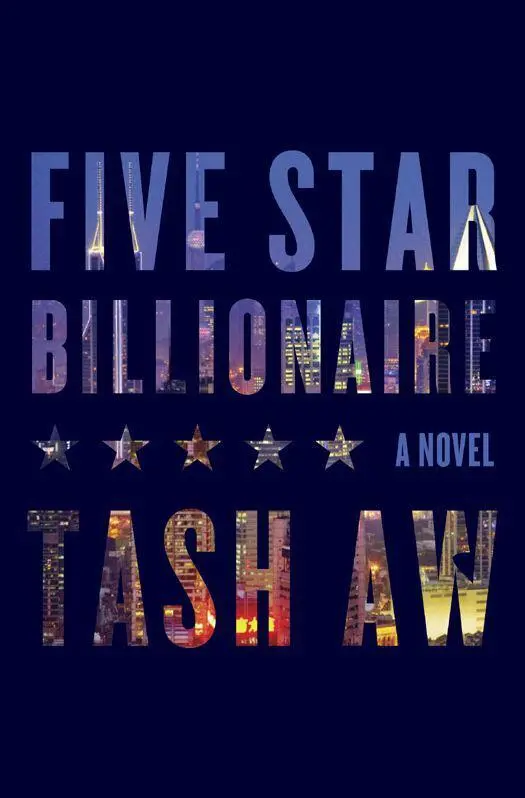
- Название:Five Star Billionaire
- Автор:
- Издательство:Spiegel & Grau
- Жанр:
- Год:2013
- ISBN:нет данных
- Рейтинг книги:3 / 5. Голосов: 1
-
Избранное:Добавить в избранное
- Отзывы:
-
Ваша оценка:
Five Star Billionaire: краткое содержание, описание и аннотация
Предлагаем к чтению аннотацию, описание, краткое содержание или предисловие (зависит от того, что написал сам автор книги «Five Star Billionaire»). Если вы не нашли необходимую информацию о книге — напишите в комментариях, мы постараемся отыскать её.
the dazzling kaleidoscopic new novel by the award-winning writer Tash Aw, offers rare insight into China today, with its constant transformations and its promise of possibility.
Five Star Billionaire — читать онлайн ознакомительный отрывок
Ниже представлен текст книги, разбитый по страницам. Система сохранения места последней прочитанной страницы, позволяет с удобством читать онлайн бесплатно книгу «Five Star Billionaire», без необходимости каждый раз заново искать на чём Вы остановились. Поставьте закладку, и сможете в любой момент перейти на страницу, на которой закончили чтение.
Интервал:
Закладка:
As Gary stands in the middle of the stage, he watches the audience drift away slowly. The waiters at Red Rooster stay for a while at the front of the restaurant, but eventually they, too, go back inside. He waits, and waits some more: Experience tells him that the sound system is broken; there will be no more music. But he is a professional; he will finish his job here. He lifts the microphone to his lips and begins to sing unaccompanied, his voice too fine, almost frail amid the sounds of the building work ringing out around him.
16. BEWARE OF STORMS ARISING FROM CLEAR SKIES

YINGHUI THOUGHT ABOUT WHAT WALTER HAD SAID ABOUT BANK loans amounting to respect. It seemed an odd concept to begin with, but gradually she began to see how true it was — that a person’s entire value to society could be measured by how much bankers trusted and respected them. What she actually contributed to the world was irrelevant. It had taken her more than a decade to come to this simple conclusion. Maybe her father had been right all along: She would never understand the way money worked.
As she prepared her dossier for the meetings she had arranged with the banks, she thought about how her father had spent all his life working to amass respect. Money was — it was clear now — a secondary consideration for him, despite what the newspapers had said in the aftermath of the tangled mess that followed his death. Yinghui had not been able to bear all that was said about him during that time; after the funeral, she had fled, first to Singapore, which wasn’t far enough away, then to Hong Kong, which had been lonely, and finally to Shanghai, where she ran little risk of running into anyone from home.
Like most people who craved respect from others, her father had led a life based on caution. It was a value he had sought to inculcate in his daughter, who, as it turned out, showed little signs of prudence even at an early age. Like other poor people who had become middle-class, he was always careful; and like other people who were born middle-class, she wanted to be anything but. In the main, though, Yinghui was (more or less) dutiful, respectful, and good at school. She helped her mother prepare meals and do the shopping at the market, where her mother tried her best to teach Yinghui the value of thrift — another attribute much prized by the new middle class. Even after her father had acceded to the ministerial position in which he was to end his life, her family continued to make a virtue of thrift, as if to emphasize their disadvantaged rural origins in the face of their growing urban wealth.
Dinners were the primary showcase of their carefulness with money — elaborate spreads consisting of five or six dishes when it was just the three of them on a weekday evening, the number of dishes doubling on a Sunday when they had a couple of guests. Always, there would be discreet (and sometimes not-so-discreet) mention of how cheaply those delicious meals had been prepared — a blithe commentary on the state of food prices, even in the presence of guests: how cheap spinach was that month; how they would usually have used choy sum but didn’t because the floods had made it expensive; how the kembong fish was very inexpensive but underrated; how the judicious addition of Chinese black mushrooms could make nondescript vegetables seem luxurious; how the free-range village chicken they were serving that evening was a rare treat, seldom seen in their household. Her mother wore a gentle air of martyrdom as she smilingly produced these meals from the large but sparsely equipped kitchen; of course they did not have anyone to help, not even an Indonesian maid, as most people in the neighborhood seemed to have in those days.
Looking back on it now, it was clear to Yinghui that it was not a charade to deflect the attention of friends and neighbors from their new Mercedes (and driver) or their extended bathroom suite and generally upwardly mobile status: Her parents truly believed that, in clinging to a certain way of life that was no longer theirs, they could protect themselves from the unknown dangers of newfound wealth, even as they reveled in it.
By and large, Yinghui was comfortable with their modus vivendi; having grown up with it, she did not find it contradictory and grew to admire their sense of financial prudence and their general distrust of ostentation. Indeed, in her later teenage years she began to affect a certain down-at-heelness, a disregard for material possessions that — she now recognizes — only well-off people are able to enjoy. The resulting overcasual nature of her dress style — consisting largely of cheap, loose-fitting T-shirts bought from the night market, worn with bleached jeans — attracted only mild rebuke from her parents, who were evidently pleased with their daughter’s sartorial miserliness. “People will think you’re a washerwoman,” her mother once said, but in this seeming criticism there was a clear message: that it was safer for strangers to think of you as a servant rather than as a daughter of a government minister.
It was only when Yinghui started going out with boys that she began to discover that her parents’ natural prudence extended way beyond money, affecting every aspect of life; she began to discover how little of it she had absorbed into her own philosophy of life and, most of all, how much she hated it. “Be careful, don’t take buses. Be careful, don’t take taxis on your own. Be careful, don’t go to Brickfields. Be careful, don’t eat laksa there. Be careful, Singapore is so expensive these days.” She could accept their admonishments, albeit with a growing annoyance common to all teenagers, but she had a harder time dealing with the warnings about boys, which were more forceful and therefore harder to shrug off. “Don’t go out late; otherwise, people will talk. Don’t have too many boyfriends; otherwise, people will think you are loose.”
She dated two boys, both briefly, knowing her outings with them would amount to nothing. And then, not long after turning eighteen, she met C.S. Lim. It was then that she really found out just how much her parents had based their lives on caution and respect.
Don’t hang out with that Lim boy. We hear the younger one is bad news .
Don’t let people know you are seeing him. Second Auntie saw you the other day .
Don’t get so close to him; don’t let his parents look down on you .
Don’t go out to those flashy Western places with him; his friends are too flashy .
And yet, four years later, when she and C.S. had both returned from university abroad and were still happily a couple, her parents managed to overcome their natural reticence toward C.S. and his tendency for flamboyance. Solidity had its benefits: They could see that Yinghui and he had lasted more than three years, which must have meant that they were serious. They could not quite understand the nature of the relationship, which involved holidaying in India and dressing like hippies long after the end of hippiedom and hanging out with people who seemed never to work but knew a lot about politics and philosophy, but they could understand that three years signaled a certain intention, and it was this that they supported.
Her father gave her a generous loan to start her café, Angie’s — she was so bad with money that she forgot how much it was even as the check was being written. It was clear that he did not expect the loan to be repaid; it was more, even, than a gift: It was a symbol of her parents’ trust in her relationship with C.S. Lim, of whom they had once disapproved. Of course, they never quite got the concept of the café, and when her parents visited the space over its initial months, Yinghui was treated to such comments as, “I didn’t even know they grew coffee in Australia,” or, “Tofu … in a bun? Ei , is it the same tofu that we use, ah?” And yet they laughed when she came home and told them tales of her gross mismanagement — how she had placed a bulk order for coconut milk without specifying that it had to be canned rather than fresh and was now facing hundreds of ringgits’ worth of fermenting santan in the storeroom; or how some of her friends were running up credit accounts worth a thousand bucks from just espresso and cake (they couldn’t believe that coffee could ever amount to that much). All her father offered by way of chastisement was a benign comment now and then. “You have so much to learn about money,” he would say, or, sighing, “I don’t think you’ll ever understand about money.”
Читать дальшеИнтервал:
Закладка:
Похожие книги на «Five Star Billionaire»
Представляем Вашему вниманию похожие книги на «Five Star Billionaire» списком для выбора. Мы отобрали схожую по названию и смыслу литературу в надежде предоставить читателям больше вариантов отыскать новые, интересные, ещё непрочитанные произведения.

![Scott O’Hara - Five-Star Fugitive [= Border Town Girl]](/books/432138/scott-o-hara-five-thumb.webp)







Обсуждение, отзывы о книге «Five Star Billionaire» и просто собственные мнения читателей. Оставьте ваши комментарии, напишите, что Вы думаете о произведении, его смысле или главных героях. Укажите что конкретно понравилось, а что нет, и почему Вы так считаете.