Tash Aw - Five Star Billionaire
Здесь есть возможность читать онлайн «Tash Aw - Five Star Billionaire» — ознакомительный отрывок электронной книги совершенно бесплатно, а после прочтения отрывка купить полную версию. В некоторых случаях можно слушать аудио, скачать через торрент в формате fb2 и присутствует краткое содержание. Год выпуска: 2013, Издательство: Spiegel & Grau, Жанр: Современная проза, на английском языке. Описание произведения, (предисловие) а так же отзывы посетителей доступны на портале библиотеки ЛибКат.
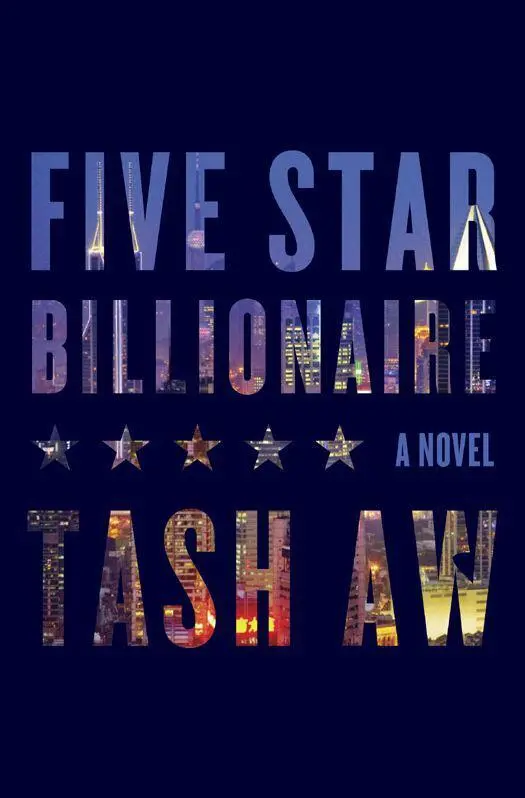
- Название:Five Star Billionaire
- Автор:
- Издательство:Spiegel & Grau
- Жанр:
- Год:2013
- ISBN:нет данных
- Рейтинг книги:3 / 5. Голосов: 1
-
Избранное:Добавить в избранное
- Отзывы:
-
Ваша оценка:
Five Star Billionaire: краткое содержание, описание и аннотация
Предлагаем к чтению аннотацию, описание, краткое содержание или предисловие (зависит от того, что написал сам автор книги «Five Star Billionaire»). Если вы не нашли необходимую информацию о книге — напишите в комментариях, мы постараемся отыскать её.
the dazzling kaleidoscopic new novel by the award-winning writer Tash Aw, offers rare insight into China today, with its constant transformations and its promise of possibility.
Five Star Billionaire — читать онлайн ознакомительный отрывок
Ниже представлен текст книги, разбитый по страницам. Система сохранения места последней прочитанной страницы, позволяет с удобством читать онлайн бесплатно книгу «Five Star Billionaire», без необходимости каждый раз заново искать на чём Вы остановились. Поставьте закладку, и сможете в любой момент перейти на страницу, на которой закончили чтение.
Интервал:
Закладка:
Her parents had become indulgent, they knew; but they also knew that Yinghui was happy living her life differently from theirs. In their own way, they, too, must have sensed that the world was changing.
Maybe their increasingly relaxed approach to Yinghui and C.S.’s lifestyle (which might not long ago have been deemed too ostentatious) had something to do with her father’s growing ease at being in the public eye. He had been in his post for more than seven years by the time Yinghui and C.S. returned from university — long enough to become accustomed to being in the press and on TV on a regular basis. As Deputy Minister for Housing and Local Government, he was not one of the more high-profile government ministers, and his natural awkwardness in front of cameras did not make him an obvious candidate for media appearances. Nonetheless, a certain degree of exposure to the press and public alike was required of a man in his position, and he gradually became used to the idea that his life was not, and could not be, an entirely private affair.
The house in which they lived began to reflect this change in attitude; this was clear to Yinghui even then. They continued to reside at the same address, but the physical structure had grown enormously, nearly doubling in size following renovation work of various kinds — two new guest bathrooms, an entirely new kitchen, an air-conditioned breakfast room that led to a shaded terrace cooled by ceiling fans and capable of being turned into a banqueting space that seated fifty quite easily. Everything was done to accommodate their increased entertaining: the turning of messy private spaces into coolly impersonal public ones. The shabby bits of mismatching furniture were either thrown away or banished to the bedrooms upstairs, replaced downstairs by carefully coordinated bland, modern furniture. “Good taste,” Yinghui joked. “The curse of the nouveaux riches.” Sometimes, when she drove in to the garage, she would be struck by how their once-expansive garden had now been reduced to a few slivers of grass here and there, bordered by palm trees; the rest had been swallowed up by the immensity of the house. Stealthily and without them even realizing it, her parents’ own lives had become that very thing they most feared: flashy.
They clung to the token display of frugality, their family dinners, now confined to a Sunday evening, when Yinghui’s café was shut and her father was freed from ministerial duties. The dishes they ate were markedly different now, vegetables augmented by abalone as well as mushrooms, the meat often taking the form of whole suckling pig; and they would have Western desserts, too, plus chocolate — previously unthinkable symbols of decadence. But the appearance of each of these items was easily explained: They were gifts from so-and-so, a colleague of her father’s, or Signor Franchetti, a visiting Argentinian dignitary, and so on. Left to their own devices, they could never — would never — afford such extravagant treats.
This was the conceit that Yinghui found harder to stomach with each passing Sunday: that somehow their new wealth was an accident, a burden that happened to befall them but which they shouldered admirably by pretending it didn’t exist. Even as the driver sat outside by the black Mercedes, waiting to take her father to late-night meetings, her mother would be complaining about the rising prices of vegetables now that everything was being exported to Hong Kong and Singapore.
Perhaps the fixation with the minutiae of food economics was a way to avoid talking about other things — like her father’s new job, which was still referred to as a recent occurrence, even after eight or nine years. Yinghui had little idea what he did on a day-to-day basis and did not seek to find out. Like most of her friends whose parents were well-off members of the establishment, she had drifted naturally and easily into an antiestablishment circle, surrounding herself with other young overseas-educated people who adopted an antigovernment point of view as a matter of course. For reasons of street cred and gaiety of conversation, their parents’ jobs were conveniently ignored. It was almost an unwritten rule that they should not discuss what their parents did for a living — the source of the income that allowed these bright young things to spend so much time discussing how to improve the world was better left unexplored.
Nonetheless, there were often instances that made the indiscretions of the older generation impossible to overlook — cases of fraud, embezzlement, or abuses of power that were just too excessive in a country already becoming inured to excess. There were the parents of someone who had been at St John’s Institution with C.S. Lim, a geeky boy who liked jazz; his father was a lawyer who had gotten rich handling the corporate affairs of government companies — a shadowy area if ever there was one. But on paper everything was impeccable, and even though everyone had their doubts, nothing was ever said apart from good-natured teasing every time the boy appeared with a new pair of shoes or a new laptop computer. “Looks like the government’s doing good business in hi-tech shares!” his friends would joke. But when the scandal broke in the press that his father had in fact been channeling parts of the proceeds of share deals into his private bank account, humor was no longer possible. All the jokes Yinghui and their circle of friends had been making now carried a dreadful truth to them. Likewise, when the father of another member of their circle, a state minister, was found stealing from public funds, all the banter that the group of friends had previously shared now became out of bounds. Although the subsequent inquiries cleared both parties of wrongdoing, as they always did, there was only one option left to the children of the culprits — they had to slip away quietly, swiftly detaching themselves from their circle of friends, who would, in turn, refrain from speaking about them.
There were important nuances, however. If your parents were exposed as shady characters because they had fallen out of favor with the government, that was acceptable and would, in fact, increase your street cred within the circle of cool kids: The family was being persecuted by the establishment, even though they had enjoyed years enriching themselves within it. This is what happened to a scholarly, Godard-loving girl called Nurul: It wasn’t her parents’ fault that they’d backed the wrong horse, someone who had since been ousted from power and whose entourage was now paying the price for their loyal support. Their predicament earned her the unqualified right to deliver lengthy, impassioned analyses of the ills of the country to a sympathetic audience every night at Angie’s, where Yinghui made sure she never had to pay for her cappuccinos. Nurul hung out regularly at Angie’s, adding to its edgy, on-the-fringes appeal, until finally she fled to Australia to do a PhD in Asian politics at Canberra.
Her father’s accession to the highest reaches of government placed Yinghui in a tricky position. On the one hand, the very fact that he was a sitting member of the cabinet made him a central part of the government, which in turn meant that he was part of the malaise facing the country. On the other hand, his relatively uncontroversial job meant that the potential for abuse was limited — deciding on the routing of interstate highways around housing developments seemed to be as serious as his job got. Besides, his reputation was that of a modest, somewhat unimaginative workhorse, someone so dull he was above corruption. He was from the far northern reaches of Kelantan; his fluency in the local Malay dialect and his continued loyalty to the region had proved an asset to the government, which needed someone with strong grassroots appeal. He was a rarity, someone who not only identified with voters in the poor, antigovernment northeast but who had proper multiracial credentials, being firmly Chinese yet speaking the Kelantanese dialect as his first language.
Читать дальшеИнтервал:
Закладка:
Похожие книги на «Five Star Billionaire»
Представляем Вашему вниманию похожие книги на «Five Star Billionaire» списком для выбора. Мы отобрали схожую по названию и смыслу литературу в надежде предоставить читателям больше вариантов отыскать новые, интересные, ещё непрочитанные произведения.

![Scott O’Hara - Five-Star Fugitive [= Border Town Girl]](/books/432138/scott-o-hara-five-thumb.webp)










Обсуждение, отзывы о книге «Five Star Billionaire» и просто собственные мнения читателей. Оставьте ваши комментарии, напишите, что Вы думаете о произведении, его смысле или главных героях. Укажите что конкретно понравилось, а что нет, и почему Вы так считаете.