Sorj Chalandon - Return to Killybegs
Здесь есть возможность читать онлайн «Sorj Chalandon - Return to Killybegs» весь текст электронной книги совершенно бесплатно (целиком полную версию без сокращений). В некоторых случаях можно слушать аудио, скачать через торрент в формате fb2 и присутствует краткое содержание. Год выпуска: 2013, Издательство: Lilliput Press, Жанр: Современная проза, на английском языке. Описание произведения, (предисловие) а так же отзывы посетителей доступны на портале библиотеки ЛибКат.
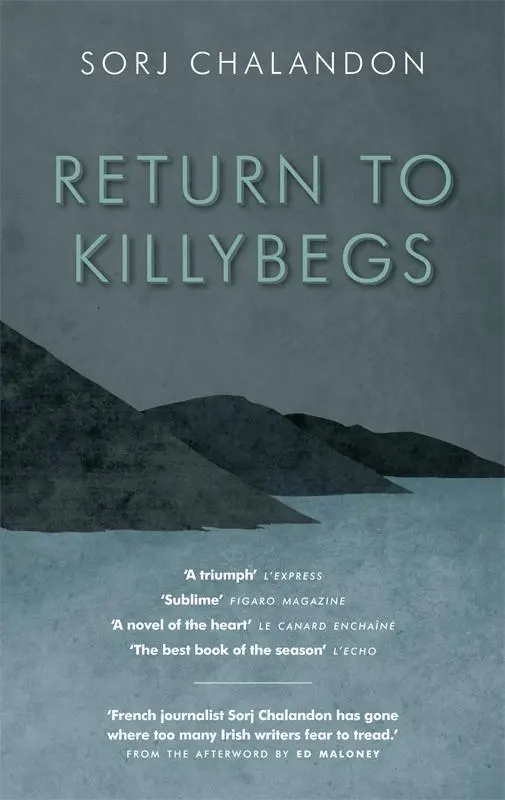
- Название:Return to Killybegs
- Автор:
- Издательство:Lilliput Press
- Жанр:
- Год:2013
- ISBN:нет данных
- Рейтинг книги:4 / 5. Голосов: 1
-
Избранное:Добавить в избранное
- Отзывы:
-
Ваша оценка:
Return to Killybegs: краткое содержание, описание и аннотация
Предлагаем к чтению аннотацию, описание, краткое содержание или предисловие (зависит от того, что написал сам автор книги «Return to Killybegs»). Если вы не нашли необходимую информацию о книге — напишите в комментариях, мы постараемся отыскать её.
Return to Killybegs — читать онлайн бесплатно полную книгу (весь текст) целиком
Ниже представлен текст книги, разбитый по страницам. Система сохранения места последней прочитанной страницы, позволяет с удобством читать онлайн бесплатно книгу «Return to Killybegs», без необходимости каждый раз заново искать на чём Вы остановились. Поставьте закладку, и сможете в любой момент перейти на страницу, на которой закончили чтение.
Интервал:
Закладка:
— Tiocfaidh ár lá!
— Our day will come!
A roar in the corridor. The last of us had got back to his cell. I had dozed off, back against the wall. I looked up. Aidan was questioning me silently. He was smiling in the dark. The warders still hadn’t turned on the lights. And then he got up. He went over and squatted next to the door, in his little corner, under the crucifix. So I got up. He shit on the ground, I shit in my hands. And we began to repaint our cell.

When I left the Kesh on 7 January 1981, I hugged Aidan. I squeezed him as I would Jack. Our beards, our hair tangled together, our soiled blankets, our pride. Bobby Sands was organizing a hunger strike in order to obtain political prisoner status. From cell to cell, we had reformulated our demands. We had five of them and they were pathetic. The right to wear civilian clothes, to associate freely with other prisoners and not to have to work for the prison. We wanted to receive one visit, one letter and one parcel per week. We also wanted full restoration of remission lost through our protest.
I asked Aidan not to add his name to the list of prisoners volunteering for martyrdom. He was nineteen and had a little girl aged two. Sentenced to barely five years, he would walk out one day. He’d take care of her.
Because we knew that this strike would be fatal.
The previous year, in October 1980, seven prisoners had fasted for two and a half months. In Armagh Prison, three women had stopped eating. London bided its time. Negotiating a halt to the movement, the British promised to re-examine prisoner status. The hunger strike ceased. Mary and the two Mairéads agreed to eat, as did Tom, Séan, Leo, Tommy, Raymond and John. As did Brendan, the IRA officer running the prison camp, who was later replaced by Bobby Sands. One month on, the Northern Ireland Secretary of State, Humphrey Atkins, went back on his word. The Republican prisoners remained common criminals.
Bobby had accepted bringing the first fast to a halt, so it was up to him to take the lead in the second. The anguish of having been deceived added to his determination. He began his hunger strike on 1 March 1981, others followed, one per week, and the living men took over from the dead.
But not Aidan. Not him. I don’t know why I made him promise. There, between those walls, I had no authority to give him orders. Officer on the outside, the barbed wire and watchtowers had made me a simple soldier. Nobody could ever persuade Bobby Sands to quit his hunger strike. Not the Irish Republican Army Council, not all our leaders, not all our priests, not all the prayers of the women in our streets, not his sister, not his mother, not the tears of Gerald, his seven-year-old child. And yet I was begging this young lad to live. I asked him to do it for me.
— You stay alive, I said to Aidan Phelan.
He promised me as a son. And he kept his word.
13
On 8 January 1981, at four in the morning, three of the army’s Saracen armoured cars, two British-army Land Rovers and a dozen soldiers invaded Dholpur Lane. It was me they wanted, nine hours after I’d been released. I was sleeping, Sheila woke me abruptly. They were forcing in our front door with a battering ram. I ran into the stairwell in pyjamas and bare feet.
— Tyrone Meehan?
It wasn’t my name. It was a challenge. The soldier was at the bottom of the stairs, cheek stuck to his gun butt. I nodded, my arms in the air, waiting to be searched. One policeman grabbed me by the hair, another by the nape of my neck. The door was smashed, torn from its hinges. Sheila was shouting.
— He only got out yesterday! For the love of God, leave him! He’s just got out!
I arrived on the street broken, arms twisted back and chin forced down against my chest. The grey armoured car was up against the front of our house, door open. Barely ten paces from my doorway to its wire-covered steel. Dholpur Lane rose up once again. The convoy departed amidst shouting, stones and bottles. I was pinned on the floor of the vehicle, hands bound at my back. A peeler slid a black plastic bag over my head. I panicked. I thought they were going to suffocate me. Three policemen kept me from moving with their shoes, crushing my neck, my legs and my back. I saw Aidan again, the cell, the putrid floor, our walls covered in excrement. I wanted to die. I didn’t want to go back to prison.
An officer knelt down, his mouth against my ear. He stank like a sewer.
— So, Paddy! Freedom nice, was it? A little too long though, no? You got out, what was it? Ten, twelve hours ago?
I didn’t answer.
Since crossing the border in 1941 with Mother and Uncle Lawrence, I had learned when to challenge and when to lower my head. One day when threatened by a patrol, my brother Seánie placed his arms in front of his face, wincing like a peasant who fears his master’s stick. The soldiers laughed. He had a gun and two grenades on him.
— The enemy underestimates us, that’s its weakness, he used to say.
When he’d come across British patrols, he’d often pretend to be retarded. He’d limp heavily, stick his lips out, jut out his chin, stare wide-eyed and put on the lantern-jawed look of Irish caricatures published in the English press. He’d do it for me, giving me a surreptitious look from the corner of his eye. And there was always a soldier who’d say to the others: ‘Oh that one! He’s perfect!’
We weren’t going to the holding centre in Castlereagh, the journey was too long. Neither was I going back to the Kesh. We weren’t on the main road, but small, winding roads. My right cheek was squashed against the ground. There were no projectiles hitting the van, no bricks or clods of earth. No sudden accelerations to shake off swarms of hostile children. We were in a Protestant zone.
I got out of the Land Rover blind, the bag still covering my face. There were hands supporting me, but not shoving me around. Men’s and women’s voices. A door, then another. No iron gates, no bolts slamming shut, no keys, either, a corridor of free men. I sensed the enclosed acoustic of a small room. The cell had taught me the sound of that space. A chair against my calves. A hand pressing down gently on my shoulder. A radiator’s warmth. I sat down.
When they released my wrists and lifted the hood, I kept my eyes half-closed for a moment. The neon light was unpleasant. On the walls were a flaking painting of a hospital and the poster for Alfred Hitchcock’s film The Birds . The window was covered with wire. It looked out on unfamiliar buildings. The rain was pressing against the panes.
— Tea?
I was facing a large table and there were three of them. No uniforms: plain clothes. I recoiled. I had thought they were Loyalists at first but their accent was English.
— Coffee, maybe?
The one speaking took off his anorak without breaking eye contact. He had very red hair, a bushy moustache, and his left eye was sunken in its socket. The second guy was skinny. The third had white hair. He was looking out the window. Watching my reflection in the glass. Our eyes met.
— Why am I here?
I was accustomed neither to the chair nor warmth from my enemy. I had learned how to protect my head from blows, how to survive in prison, how to endure being insulted and shouted at. I knew how to bear their violence, not their calm. The skinny guy handed me a cup of tea. He was watching for my reaction. I drank, ignoring the queen smiling from the blue china.
— We know everything about you. Now it’s our turn to give you some information.
Читать дальшеИнтервал:
Закладка:
Похожие книги на «Return to Killybegs»
Представляем Вашему вниманию похожие книги на «Return to Killybegs» списком для выбора. Мы отобрали схожую по названию и смыслу литературу в надежде предоставить читателям больше вариантов отыскать новые, интересные, ещё непрочитанные произведения.









Обсуждение, отзывы о книге «Return to Killybegs» и просто собственные мнения читателей. Оставьте ваши комментарии, напишите, что Вы думаете о произведении, его смысле или главных героях. Укажите что конкретно понравилось, а что нет, и почему Вы так считаете.