Russell Banks - Continental Drift
Здесь есть возможность читать онлайн «Russell Banks - Continental Drift» весь текст электронной книги совершенно бесплатно (целиком полную версию без сокращений). В некоторых случаях можно слушать аудио, скачать через торрент в формате fb2 и присутствует краткое содержание. Год выпуска: 2007, Издательство: Harper Perennial Modern, Жанр: Современная проза, на английском языке. Описание произведения, (предисловие) а так же отзывы посетителей доступны на портале библиотеки ЛибКат.
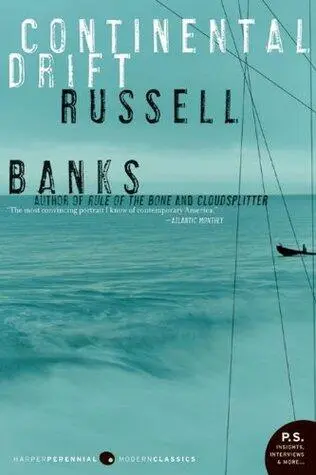
- Название:Continental Drift
- Автор:
- Издательство:Harper Perennial Modern
- Жанр:
- Год:2007
- ISBN:нет данных
- Рейтинг книги:4 / 5. Голосов: 1
-
Избранное:Добавить в избранное
- Отзывы:
-
Ваша оценка:
Continental Drift: краткое содержание, описание и аннотация
Предлагаем к чтению аннотацию, описание, краткое содержание или предисловие (зависит от того, что написал сам автор книги «Continental Drift»). Если вы не нашли необходимую информацию о книге — напишите в комментариях, мы постараемся отыскать её.
is a masterful novel of hope lost and gained, and a gripping, indelible story of fragile lives uprooted and transformed by injustice, disappointment, and the seductions and realities of the American dream.
Continental Drift — читать онлайн бесплатно полную книгу (весь текст) целиком
Ниже представлен текст книги, разбитый по страницам. Система сохранения места последней прочитанной страницы, позволяет с удобством читать онлайн бесплатно книгу «Continental Drift», без необходимости каждый раз заново искать на чём Вы остановились. Поставьте закладку, и сможете в любой момент перейти на страницу, на которой закончили чтение.
Интервал:
Закладка:
A curious trait in humans, one that gives aid and comfort to the dark angels of entropy and makes it all the more difficult to establish here on earth once and for all a Heroic Age, is the ease with which we take everything personally. At sea level, we cannot even see the Gulf Stream; yet if it benefits us, we think it’s only right it does so. And standing on the earth, we cannot feel it move beneath our feet, but if we could, we would wonder what we had done wrong this morning and say ten Hail Marys, just in case. All the more, then, when a hurricane, namely familiarly Jean or Hattie or Allen, spins slowly north from the coast of Guyana, gathers force and moisture from the warm waters off Trinidad and Tobago, crosses the Lesser Antilles, destroys everything in its path and chews its way toward us, here, in the Greater Antilles, let’s say, for this we can see, this we can feel: the skies in the southeast darken slowly as ten-mile-high towers of cumulonimbus clouds cross the horizon, the air pressure drops so rapidly our heads ache, seabirds fly inland and disappear behind dark green jungle-covered hills, and the onshore breeze replaces the offshore breeze as if rushing from the island to greet the approaching wall of gray clouds: and it’s because we can see the hurricane with our eyes and feel it with our bodies (though it’s caused by something no more concerned with us and our individual and paltry fates than is the rotation of the earth) that we nevertheless take it personally. We make it “our” hurricane, and when we talk with tourists from America, we speak of “our” weather, just as the New Englanders among them speak with wry pride of blizzards and Californians brag about sunshine.
If, however, we are a poor, middle-aged woman with five children living in a daub-and-wattle cabin in the hill country of Haiti a few kilometers west of Port-de-Paix on the north coast, we know the hurricane comes because the loas have not been properly fed. It’s not that we have been bad; it’s that the quality of our attention has waned. We’ve forgotten the dead, les Morts , and les Mystères , we’ve neglected to feed them, and it’s not we alone who have been neglectful, this poor, solitary woman, let’s say, a woman with a husband gone off to America in a boat, not we alone, but all les serviteurs , all of us who serve the loas. It’s true, for a long time now we have not fed the loas, so today the hurricane comes to remind us that it is we who live for the dead and not the dead who live for us.
In early August our side of the island was struck by a hurricane. We learned too late that it was coming — not that we would have done anything differently had we known about it sooner, for it was too late to stop it, the waters had already been stirred. We would deal with the loas later, we said, for that is how it has been done in the past. There have been other hurricanes, and after they have passed over us, even before we have patched up our houses and repaired our gardens, we have fed the loas. This year, however, when the hurricane came, it was different, for things got confused. And though we did not think we were a part of the confusion, we watched it and slowly got drawn into it and soon began to behave as if we, too, were confused. Here is how it happened:
Our settlement is called Allanche and it is located behind the first line of hills on the northwest coast a few kilometers off the road from Port-de-Paix to Saint Louis du Nord, which, because Allanche is too small to be a market town, is fortunate, for the women can carry their baskets of yams, mangoes and breadfruit, their apricot mameys and jamelacs, over the ridge on narrow pathways down to the coast road early on the morning of market day, and if they cannot hail a truck or car or wagon for a ride into Port-de-Paix, it is still not too late to walk the other way to the smaller market town of Saint Louis du Nord and arrive there in time to sell most of their goods.
First it rained for several days, a breezy, late summer rain, warm and various, turning the leaves of the trees, like wet, silver-palmed hands, this way and that, as the breeze off the sea tumbled against the hills. All the wood got soaked through, and when their cookfires went out, the people slept long and late inside their houses and shops, waking to talk in low voices and to peer out the door again and again at the red ground still riddled and puddled from the stoop to the lane, dribbling down the lane and down the hillside in new streams that ran red as blood all the way to the sea. These were long, boring days of waiting, gossiping, thinking of food and of the past, fussing with children’s hair and guessing and arguing lightly about when the rain would stop and wood dry out so cookfires could be lit and yams baked again, damp clothes dried, bedding spread in the sunlight, children sent scurrying to the fields for greens and to the shop for a can of tinned beef or a box of yellow cheese. A few people in the settlement, Aubin, the police chief, Chauvet, the shopkeeper, and Placide, who owns a small truck, have kerosene stoves and were able to cook inside their houses. Soon the smell of their food cooking in the morning and again late in the day drifted through the settlement and set our stomachs to grumbling and made it difficult to keep our hearts from tightening with anger against everything — against our neighbors with their stoves, against our restless children, against the pair of uncooked yams in the corner on the floor, against the pair of chickens under the cabin scratching in the dirt and clucking quietly to each other, against the cold chunks of breadfruit crumbling in our mouths. We smelled a stew, a dense tangle of threads of tomato, chicken, onion and greens, and we looked across the dark room at each other’s faces, the small children lying on the bed, the boy by the window, the sister-in-law and her baby in the chair by the window, and it was difficult for us not to hate the world so much that we hated even each other, we who must live in this world.
Then the rain stopped. The wind died, and the sky seemed to lift: and lighten to a milky white. We smiled and stepped to the open doorway and looked at the yard, where everything dripped and glistened, as if the entire valley had all at once been plucked from under the sea by a gigantic hand and set down there between the blue-green mountains inland and the pearly sea beyond the hills. It was beautiful and newborn.
Then, before we could stop him, the boy darted around us and ran down the path, quickly gone, eager to see his friends and walk with them to Port-de-Paix, where they follow older boys and men who teach them how to make a little money doing things we will not permit them to do here in Allanche. We cannot keep them here, where they have no land to raise a crop and yet have no other way than farming to earn money for their families or themselves. These days all the boys soon go away to the towns and cities, even to Port-au-Prince, where, without their mothers and fathers, they become drunkards and pimps and beggars and even worse. Most of them never come back.
Aubin — the chief of police, he’s called, though he has no assistant — came down the lane from his office, which is also his home, and as he passed the cabin, he called out, You should shutter your window, ladies, and lock your door! This is the start of a hurricane!
He came to the window and peered in at us. He was wearing his cap and the jacket of his uniform, so we knew this was official business, this warning, even though he often called on us or shouted hello when he passed by, for the sister-in-law, Vanise, is the mother of his child and he enjoyed keeping track of the child, although he no longer cared for the mother, who, despite her youth, had grown thin and sour-faced and silent, except when she talked to us or to her baby.
Читать дальшеИнтервал:
Закладка:
Похожие книги на «Continental Drift»
Представляем Вашему вниманию похожие книги на «Continental Drift» списком для выбора. Мы отобрали схожую по названию и смыслу литературу в надежде предоставить читателям больше вариантов отыскать новые, интересные, ещё непрочитанные произведения.










Обсуждение, отзывы о книге «Continental Drift» и просто собственные мнения читателей. Оставьте ваши комментарии, напишите, что Вы думаете о произведении, его смысле или главных героях. Укажите что конкретно понравилось, а что нет, и почему Вы так считаете.