Russell Banks - Continental Drift
Здесь есть возможность читать онлайн «Russell Banks - Continental Drift» весь текст электронной книги совершенно бесплатно (целиком полную версию без сокращений). В некоторых случаях можно слушать аудио, скачать через торрент в формате fb2 и присутствует краткое содержание. Год выпуска: 2007, Издательство: Harper Perennial Modern, Жанр: Современная проза, на английском языке. Описание произведения, (предисловие) а так же отзывы посетителей доступны на портале библиотеки ЛибКат.
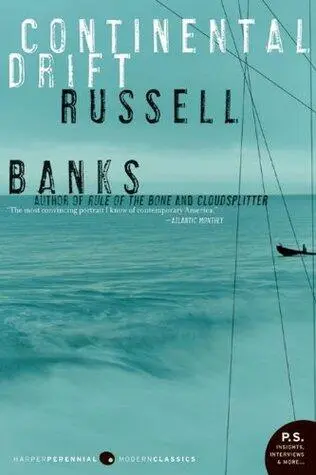
- Название:Continental Drift
- Автор:
- Издательство:Harper Perennial Modern
- Жанр:
- Год:2007
- ISBN:нет данных
- Рейтинг книги:4 / 5. Голосов: 1
-
Избранное:Добавить в избранное
- Отзывы:
-
Ваша оценка:
Continental Drift: краткое содержание, описание и аннотация
Предлагаем к чтению аннотацию, описание, краткое содержание или предисловие (зависит от того, что написал сам автор книги «Continental Drift»). Если вы не нашли необходимую информацию о книге — напишите в комментариях, мы постараемся отыскать её.
is a masterful novel of hope lost and gained, and a gripping, indelible story of fragile lives uprooted and transformed by injustice, disappointment, and the seductions and realities of the American dream.
Continental Drift — читать онлайн бесплатно полную книгу (весь текст) целиком
Ниже представлен текст книги, разбитый по страницам. Система сохранения места последней прочитанной страницы, позволяет с удобством читать онлайн бесплатно книгу «Continental Drift», без необходимости каждый раз заново искать на чём Вы остановились. Поставьте закладку, и сможете в любой момент перейти на страницу, на которой закончили чтение.
Интервал:
Закладка:
In these years, the early 1980s, most events and processes that have been occurring for millennia continue to occur, some of them silently, slowly, taking place an inch at a time miles below the surface of the earth, others noisily, with smoke and fire, revolution, war and invasion, taking place on the surface. We measure the geological change in millimeters per annum, feel nothing move beneath our feet and conclude, therefore, that nothing has happened. By the same token, when we read in newspapers and hear from the evening news broadcasts that there is revolution in Iran, war in Iraq, foreign soldiers and tanks in Afghanistan, because each new day brings a surfeit of such news, blotting out the news of the day before, news of Israelis in Lebanon replacing accounts of Russians in Afghanistan, Americans in Grenada replacing Israelis in Lebanon, we conclude here, too, that nothing has happened.
The metabolic rate of history is too fast for us to observe it. It’s as if, attending to the day-long cycle of a single mayfly, we lose sight of the species and its fate. At the same time, the metabolic rate of geology is too slow for us to perceive it, so that, from birth to death, it seems to us who are caught in the beat of our own individual human hearts that everything happening on this planet is what happens to us, personally, privately, secretly. We can stand at night on a high, cold plain and look out toward the scrabbled, snow-covered mountains in the west, the same in the suburb of Denver as oustide a village in Baluchistan in Pakistan, and even though beneath our feet continent-sized chunks of earth grind inexorably against one another, go on driving one or the other continent down so as to rise up and over it, as if desiring to replace it on the map, we poke with our tongue for a piece of meat caught between two back teeth and think of sarcastic remarks we should have made to our brother-in-law at dinner.
While we stand and think of trivialities on the plain in Baluchistan, the crust of the earth, in plates, diverges, carves long, bottomless trenches beneath the sea between India and Antarctica and shoves the last, lost child of Gondwanaland north into Eurasia, attaches India and Pakistan to China, Afghanistan and Iran with such irresistible force that the subcontinent bends and dips down at the line of convergence, buckles and crumbles at the edges and heaps up, as if with the blade of a colossal shovel, the Himalayas and the Hindu Kush, a thousand miles of mountain peaks twenty and twenty-five thousand feet high, the very mountain peaks and passes we can see in the distance and have watched night after night all our brief, distracted lives.
And while we wait with one son, the eldest, and a brother-in-law from Peshawar who has told us of the money to be made leading rich Afghans down from the passes to the refugee camps, we hope that he is right, we hope that the Afghans will indeed be wealthy and will be eager to pay us handsomely for escorting them down the mountain pathways, where thieves hide and wait. But at the same time, we know the brother-in-law is wrong, for we have heard for years that the Afghans who flee into Pakistan are poor. It is the Iranians, we have heard, who are rich, the merchants who, crossing their border at Ruhak, face the desert and then the mountains of the Makran Range and turn south, heading for Karachi and the sea and eventually to America. Those who live down there, near the Iranian border, they are the ones who grow fat from escorting refugees, while we risk our lives up here with the Afghans for nothing.
But the brother-in-law, an arrogant man who had played professional football in Lahore and therefore believes he knows what we do not, has insisted that we can make a year’s money from a few days’ work with little risk, and to convince him that he is wrong (or so we have said to him) we have agreed to come up here with the boy, who is old enough to carry a rifle and walks behind us. Bandits, murderers, madmen — they live up here near the snow year-round and prey on travelers without guns, so we, the boy, and even the brother-in-law, make a show of our weapons.
As we climb closer and closer to the snow, we know that now they are watching us from behind rocks and from cliffs overhead. Then, after a long while of climbing, we emerge from a narrow defile, and before us, beneath a long, pale yellow ridge and in a large wedge of shadow, there is suddenly a mound of snow in the path, hard, old snow the shape and size of a collapsed tent, and we see the bodies in the snow, a woman and two men and a child, throats slashed, old blood pinking the whiteness around them, clothes partially wrenched off and torn back from frozen bodies, bags and cases opened and scattered, papers, clothing, household utensils tossed aside in an angry hunt for coins.
You see now, we say to the brother-in-law. They are poor.
He pulls thoughtfully at his mustache, and the boy comes up alongside him and sees the Afghans lying in the snow, and frightened, he turns in a slow circle, searching the rocks and crevices around us.
There are plenty more Afghans coming, the brother-in-law says in a low voice. But … perhaps another day would be better, he adds, and we turn and commence making our way back down the mountain to the village.
The brother-in-law is a fool. And we are a fool for not believing what we know is true, what we know with our deepest brain, the one embedded in the very center of our skull, where we know that forever, from the beginning of time, the only outsiders who have come through here and have needed us to help them have been poor, sad, frightened creatures running from some army.
Yes, there are more coming, we say, when soon the descent is not so difficult and we can walk alongside one another again. And they will keep on coming until after we are gone and the boy is gone and even after that. And they will always be poor. You cannot help the poor, not when you also are poor. Let the bandits have them, we say.
I suppose you are right, the brother-in-law murmurs, which pleases us, but we say nothing of it to him.
Systems and sets, subsystems and subsets, patterns and aggregates of water, earth, fire and air — naming and mapping them, learning the intricate interdependence of the forces that move and convert them into one another, this process gradually provides us with a vision of the planet as an organic cell, a mindless, spherical creature whose only purpose is to be born as rapidly as it dies and whose general principle informing that purpose, as if it were a moral imperative, is to keep moving. Revolve around points and rotate on axes, whirl and twirl and loop in circles, ellipses, spirals and long curves that soar across the universe and disappear at last at the farthest horizon of our human imagination only to reappear here behind us in the daily life of our body, in our food, shit and piss, our newborn babies and falling-down dead — just keep on moving, keep breeding and pissing and shitting, keep on eating the planet we live on, keep on moving, alone and in families and tribes, in nations and even in whole species: it’s the only argument we have against entropy. And it’s not truly an argument; it’s a vision. It’s a denial in the form of an assertion, a rebuttal in the form of an anecdote, which means that it’s not a recounting, it’s an accounting; not a representation, a presentation.
The universe moves, and everything in it moves, and by transferring its parts, it and everything in it down to the smallest cell are transformed and continue. Water, earth, fire and air. To continue, just to go on, with entropy lurking out there, takes an old-fashioned, Biblical kind of heroism. That the seas move, that the waters flow from gulfs across whole oceans along continents and back again, is marvelous. That the continents themselves move, that they separate from one another, regroup and gather themselves into mountain ranges, plateaus, vast savannas and grassy veldts, is a wonder. That for beneath the deepest seas the grinding of the plates that carry those continents generates sufficient heat to melt rock and erupt in fiery volcanoes, making high, conical islands appear in the North Atlantic and South Pacific where, before, dark water for millennia rolled uninterruptedly, this is truly worthy of admiration. And what is marvelous to us, what fills us with wonder and admiration, we must emulate, or we die. If the stubborn determination of the Somali tribes to find food, water and peace, even though they must cross deserts alone to get there and must often perish along the way, seems to us marvelous, and if the Afghans’ willingness to face ice and snow and murderous bandits in the high passes of the Hindu Kush rather than let government soldiers enter their villages and shoot them for having given shelter one night to a few ragtag local mujahedeen guerrillas, if their decision to move away and start over elsewhere seems wonderful to us, and if the flight of a half-million starving Khmer peasants out of Kampuchea into Thailand, where they are greeted by sympathetic but terrified Thai officials who drive the Khmer back to where the Vietnamese army wages war against the scattered remnant of Pol Pot’s suicidal regime by burning the few remaining rice fields, if that persistent, relentless determination to go on knocking at the Thai gate until someone finally opens it moves us to admiration, then we must do the same. We must cross deserts alone and often perish along the way, we must move to where we can start our lives over, and when we get there, we must keep on knocking at the gate, shouting and pounding with our fists, until those who happen to be keepers of the gate are also moved to admiration and open the gate. We are the planet, fully as much as its water, earth, fire and air are the planet, and if the planet survives, it will only be through heroism. Not occasional heroism, a remarkable instance of it here and there, but constant heroism, systematic heroism, heroism as governing principle.
Читать дальшеИнтервал:
Закладка:
Похожие книги на «Continental Drift»
Представляем Вашему вниманию похожие книги на «Continental Drift» списком для выбора. Мы отобрали схожую по названию и смыслу литературу в надежде предоставить читателям больше вариантов отыскать новые, интересные, ещё непрочитанные произведения.





Обсуждение, отзывы о книге «Continental Drift» и просто собственные мнения читателей. Оставьте ваши комментарии, напишите, что Вы думаете о произведении, его смысле или главных героях. Укажите что конкретно понравилось, а что нет, и почему Вы так считаете.