Karen Bender - Refund - Stories
Здесь есть возможность читать онлайн «Karen Bender - Refund - Stories» весь текст электронной книги совершенно бесплатно (целиком полную версию без сокращений). В некоторых случаях можно слушать аудио, скачать через торрент в формате fb2 и присутствует краткое содержание. Год выпуска: 2015, Издательство: Counterpoint, Жанр: Современная проза, на английском языке. Описание произведения, (предисловие) а так же отзывы посетителей доступны на портале библиотеки ЛибКат.
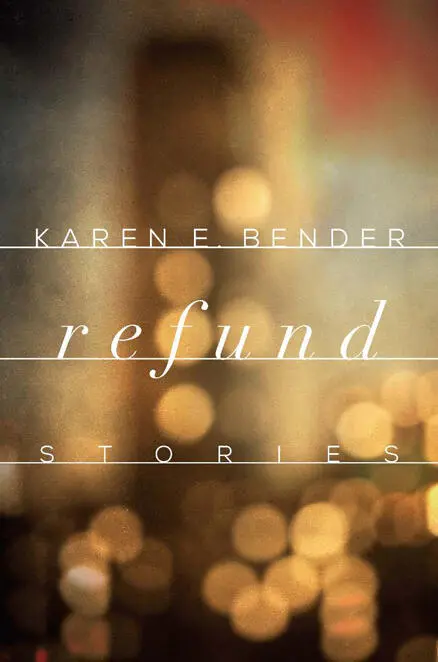
- Название:Refund: Stories
- Автор:
- Издательство:Counterpoint
- Жанр:
- Год:2015
- ISBN:нет данных
- Рейтинг книги:3 / 5. Голосов: 1
-
Избранное:Добавить в избранное
- Отзывы:
-
Ваша оценка:
Refund: Stories: краткое содержание, описание и аннотация
Предлагаем к чтению аннотацию, описание, краткое содержание или предисловие (зависит от того, что написал сам автор книги «Refund: Stories»). Если вы не нашли необходимую информацию о книге — напишите в комментариях, мы постараемся отыскать её.
In Refund, Bender creates an award-winning collection of stories that deeply explore the ways in which money and the estimation of value affect the lives of her characters. The stories in Refund reflect our contemporary world — swindlers, reality show creators, desperate artists, siblings, parents — who try to answer the question: What is the real definition of worth?
In “Theft,” an eighty-year-old swindler, accustomed to tricking people for their money, boards a cruise ship to see if she can find something of true value — a human connection. In “Anything for Money,” the creator of a reality show is thrown into the real world when his estranged granddaughter reenters his life in need of a new heart; and in the title story, young artist parents in downtown Manhattan escape the attack on 9/11 only to face a battle over their subletted apartment with a stranger who might have lost more than only her deposit.
Set in contemporary America, these stories herald a work of singular literary merit by an important writer at the height of her power.
Refund: Stories — читать онлайн бесплатно полную книгу (весь текст) целиком
Ниже представлен текст книги, разбитый по страницам. Система сохранения места последней прочитанной страницы, позволяет с удобством читать онлайн бесплатно книгу «Refund: Stories», без необходимости каждый раз заново искать на чём Вы остановились. Поставьте закладку, и сможете в любой момент перейти на страницу, на которой закончили чтение.
Интервал:
Закладка:
“How are you?” Modesto asked.
“Where were you?” she asked.
“How is your apartment?”
“I’m glad to see you.”
The meetings were hushed and tender, and then, with further discussion, she found that the neighbors had become deformed by a part of their personalities. The mothers who had been angry now were enormous, stiff-shouldered with anger; the mothers who were fearful were feathery, barely rooted to the ground. “Why do they close the park for asbestos,” said one angrily, “when before it was just full of piss and shit?”
She stood with Josh, that first week, looking out their closed window at the lines of dump trucks taking the rubble to the barge. They sat, sweaty, greasy, in their living room, listening to the crash of the crumbled buildings as they fell into the steel barge. The swerve of the cranes sounded like huge, screaming cats, and when the heavy debris crashed into the barge, the sound was so loud they could feel it in their jaws.
They drifted quickly from their damp new gratitude for their lives to the fact that they had to live them. One week after their return, they sat beside the pile of bills that had accumulated. They sat before the pile as though before a dozen accusations: then Josh got up and went to the closet and brought out suits that she had not seen since he was in his twenties. She was startled when she saw him, the same slim figure, but now with gray hair. Suddenly, she realized that she had stopped looking closely at herself in the mirror. She dragged out some of the dresses she had worn fifteen years ago: stretchy Lycra dresses that clung to her skin. Now she looked like a sausage exploding from its casing. She had been hostage to the absurd notion that by acting young, she would not age. The part-time jobs, the haphazard routine, had kept them mired in a state of hope, which now made it difficult to get off the odd welfare state that was the adjunct, freelance, part-time job.
“We were fools,” he said.
Clarissa looked at herself in the mirror. She tried to hold her stomach in.
“We have to get real jobs. We should have had them fifteen years ago.”
“What about your art?” she asked. “We can cut back. We can eat beans more.” He stared at her. “We can get another gallery, you’re doing great work—”
She hated the tinny, rotting optimism in her voice. It had pushed them forward blindly, roughly, toward an imagined place where they would be seen for who they really were. She had wanted to walk through museums to see her work displayed on the walls. That sort of presence would, she had thought, cure her sorrow for her own death. But of course, it did not.
“We were idiots,” he said.
They looked out the window at the smoke rising. His eyelashes were dark and beautiful. She remembered how when she married him, she hoped that their children would have those eyelashes, hoped that this loveliness would be protection against loneliness or cruelty. All of her previous thoughts seemed the musings of a fool. She rubbed her face, which was damp with sweat. Her mind seemed to have stopped. There was a short pause outside; the crane operators stopped for a moment of silence whenever they found part of a body. She looked out and saw one of the workers holding his hat. She opened a window. The bitter, metallic smell entered the apartment.
“Kim wants all her money back,” she said.
He lifted his hands in bewilderment.
DEAR KIM:
We are so sorry for your terrible experience. We are so glad you were not harmed. This is indeed a terrible time for the world. You did stay in our apartment for ten nights, and I have calculated this stay, at current hotel rates, at $150 a night. We are also deducting a fee for cleaning the apartment, as you did leave a window open, letting some contaminated dust inside. This leaves you with a refund of $1,000. The first installment, in $20, will arrive in a week. Peace be with you .
She took a deep breath and pressed “Send.”
SHE TOOK SAMMY TO HIS FIRST DAY OF SCHOOL. SHE WALKED down the street, past the taped fliers. The local day spa was offering free massages for firemen and policemen. A neighborhood restaurant offered a $25 Prix Fixe, Macaroni and Roast Beef, Eat American. Donations to Ladder 8 for Missing Firemen accepted. Dozens of Xeroxed faces of the missing clung to lampposts, wrapped with tape; they stared into the street. Loving husband and father. Our dear daughter. Worked on the Eighty-seventh Floor. Worked at Windows on the World. Please call. She walked by them slowly, and she could not breathe. The missing people were on every corner. They were smiling and happy in the photos, and many were younger than her.
The preschool was a block north of the wooden police barricades that separated regular life from the crumbled heap of buildings, the endless black smoke. Her stroller rattled past them and through the doors of the preschool. The school staff floated around, greeting everyone with an unnerving intimacy, by their first names. Sammy darted into his classroom, and she stood with a cloud of mothers. They had walked to school under the smoky, foul skies, wearing leather coats in blue and orange. It seemed a paltry, mean decision, deciding what to wear, waking up and hearing the broken buildings falling into the boats. They had decided to dress up. Their hair was frosted golden and brown, and they were beautiful, and when they left, they cupped hands over their mouths.
“Have you gone out to dinner yet?” she heard one mother ask another. “You wouldn’t believe the good deals down here, plus you can get reservations. Prix fixe at Chanterelle, thirty-five bucks, incredible, plus you have money for a good bottle of wine.”
“The Independence has a special, Eat American,” said another. “The waitstaff is fast and gracious. They have the most exquisite apple pie.”
Clarissa closed her eyes and rubbed her face, wondering if she should admire these mothers’ resilience or be appalled.
“We were refugees at the Plaza,” she heard another mother say. “They had a special for everyone living below Canal. We had to go. Our place was covered in dust. We started throwing up, and I knew we had to get out. It cost a ton to get it cleaned. Should we stay or go? Can someone just tell me?” She whirled around, looking.
The teacher came by. “The children are doing well,” she said. “Do you want to say bye before you go?”
Now Clarissa swerved through the room like a drunken person. Your child was not in the world, and then he was, suddenly, part of it. She crouched and breathed his clean, heartbreaking smell. “I’m going bye,” she said.
Her child ignored her. Slowly, she stood up.
In the office off the main hallway, the in-house psychologist was holding a drop-in support session in which parents could talk about their feelings about sending their children to preschool three blocks from the site. Clarissa stood with the group clustered around the psychologist. One mother said, “My child screamed the whole way here, saying she was scared and didn’t want to go, and I dropped her off, but then, well, I wonder, is she right to be scared?”
“Why is she right?” asked the psychologist.
“Well, because,” called Clarissa, from the back.
“You have to believe it is safe,” said the psychologist. “You tell them a kid’s job is to go to school, and a parent’s job is to keep you safe.”
“But what if we don’t know if it’s safe?” Clarissa asked.
“Where is it safe?” the psychologist said. “Here? Brooklyn? Vermont? Milwaukee?”
The parents leaned toward her, awaiting an answer.
“You have to tell them a little lie,” the psychologist said.
LATER THAT DAY, SHE RECEIVED AN EMAIL WITH THE SUBJECT: STUNNED:
Читать дальшеИнтервал:
Закладка:
Похожие книги на «Refund: Stories»
Представляем Вашему вниманию похожие книги на «Refund: Stories» списком для выбора. Мы отобрали схожую по названию и смыслу литературу в надежде предоставить читателям больше вариантов отыскать новые, интересные, ещё непрочитанные произведения.






Обсуждение, отзывы о книге «Refund: Stories» и просто собственные мнения читателей. Оставьте ваши комментарии, напишите, что Вы думаете о произведении, его смысле или главных героях. Укажите что конкретно понравилось, а что нет, и почему Вы так считаете.