Roy Scranton - War Porn
Здесь есть возможность читать онлайн «Roy Scranton - War Porn» весь текст электронной книги совершенно бесплатно (целиком полную версию без сокращений). В некоторых случаях можно слушать аудио, скачать через торрент в формате fb2 и присутствует краткое содержание. Город: New York, Год выпуска: 2016, ISBN: 2016, Издательство: Soho Press, Жанр: prose_military, Современная проза, на английском языке. Описание произведения, (предисловие) а так же отзывы посетителей доступны на портале библиотеки ЛибКат.
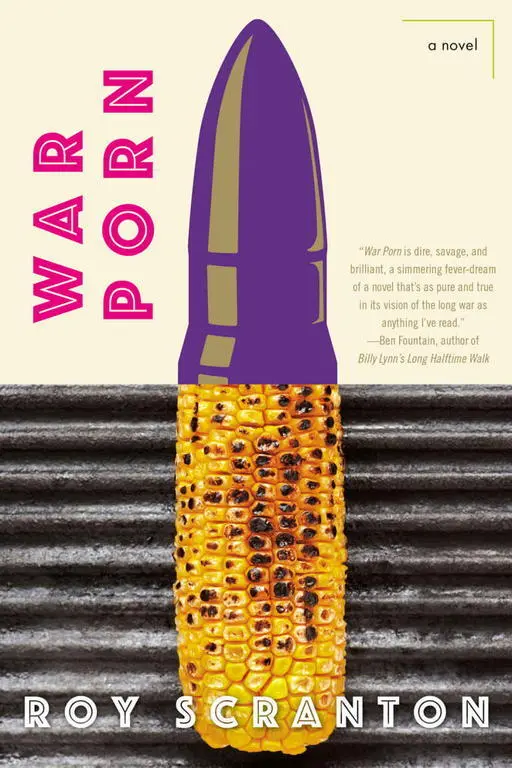
- Название:War Porn
- Автор:
- Издательство:Soho Press
- Жанр:
- Год:2016
- Город:New York
- ISBN:978-1-61695-715-5
- Рейтинг книги:5 / 5. Голосов: 1
-
Избранное:Добавить в избранное
- Отзывы:
-
Ваша оценка:
War Porn: краткое содержание, описание и аннотация
Предлагаем к чтению аннотацию, описание, краткое содержание или предисловие (зависит от того, что написал сам автор книги «War Porn»). Если вы не нашли необходимую информацию о книге — напишите в комментариях, мы постараемся отыскать её.
Videos, images, and narratives featuring graphic violence, often brought back from combat zones, viewed voyeuristically or for emotional gratification. Such media are often presented and circulated without context, though they may be used as evidence of war crimes. War porn is also, in Roy Scranton’s searing debut novel, a metaphor for the experience of war in the age of the War on Terror, the fracturing and fragmentation of perspective, time, and self that afflicts soldiers and civilians alike, and the global networks and face-to-face moments that suture our fragmented lives together. In
three lives fit inside one another like nesting dolls: a restless young woman at an end-of-summer barbecue in Utah; an American soldier in occupied Baghdad; and Qasim al-Zabadi, an Iraqi math professor, who faces the US invasion of his country with fear, denial, and perseverance. As
cuts from America to Iraq and back again, as home and hell merge, we come to see America through the eyes of the occupied, even as we see Qasim become a prisoner of the occupation. Through the looking glass of
, Scranton reveals the fragile humanity that connects Americans and Iraqis, torturers and the tortured, victors and their victims.
War Porn — читать онлайн бесплатно полную книгу (весь текст) целиком
Ниже представлен текст книги, разбитый по страницам. Система сохранения места последней прочитанной страницы, позволяет с удобством читать онлайн бесплатно книгу «War Porn», без необходимости каждый раз заново искать на чём Вы остановились. Поставьте закладку, и сможете в любой момент перейти на страницу, на которой закончили чтение.
Интервал:
Закладка:
“What?”
“Somebody gives you a message and you turn it into a non-abelian theorem…”
“Oh, no. No. Not at all. That’s a totally different branch of mathematics. No. Cryptography, cryptanalysis, that’s totally different. You might talk to Professor Farani, she’s very good with that sort of thing. Not really my field.”
“No?” The man smirked.
“Oh no. Like I said, I’m working on harmonic analysis. I’d like, once I finish the dissertation, to see if I could push it further, topologically, you know, but that’s a completely different… that’s… wait.” Qasim’s realization shot fear through his belly: “You think I write codes.”
The small man slapped Qasim with the back of his hand. “Don’t pretend we’re stupid, Professor.”
Qasim held his head in his hands. His temples ached and rang.
“How about we just take this, all these non-abelian codes, and have somebody crack them?”
“What? No, please. No. It’s not…”
“No?”
“That’s… That’s my work.”
“Why don’t you tell us what we want to know? Or maybe you’d like to tell us in Abu Ghraib?”
“I… my uncle…”
“Yes?”
“I do accounting for my uncle. I’ll tell you who he bribes, how much, I can tell you the black market…”
The man’s eyes narrowed. “We’re not here to talk about your uncle, shit-dribble. Who else do you do accounting for?”
“I don’t… I don’t know what you mean.”
The man slapped him again. Then again. Then he picked Qasim’s glasses up off the floor and handed them back to him. He went to the door and spoke briefly with the other man, who came over to Qasim. He reached out and took Qasim’s good hand and pressed it flat on the desk. He held down Qasim’s wrist and pulled a claw hammer from under his jacket.
“We don’t want you, shit-dribble,” the one man said. “We want the men you work for.”
“I don’t know what you mean,” Qasim said, his voice breaking. “I really don’t.” His mind scrambled for something, anything he could tell them.
“Last chance, shit-dribble.”
“My uncle…”
The one man waved his hand in exasperation. The other lifted the hammer.
“Wait!”
“Yes?”
“My uncle…”
The one shook his head and the other swung the hammer down on Qasim’s little finger, smashing the first knuckle with a bloody crunch. Qasim blacked out. He came to a few moments later, dizzy and tingling, sweat pouring from his forehead.
“Let me help you remember,” the one said. “We’d like information on the codes you write for Munir Muhanned.”
“Munir…”
“Oh. Now you remember.”
“I don’t…”
“Again.”
“No wait! Wait! I’ll tell you!”
“Yes?”
“Hamadaya,” Qasim said. The man looked at him quizzically. Qasim went on: “Anouf Hamadaya, one of the students in my class. She asked me if I would write codes for her brother.”
“And?”
“I didn’t. I’m not… I wouldn’t ever get involved with guys like that. I’m… I’m a coward… you see… her brother, Anouf’s brother, they say he works for Munir Muhanned. That’s who the codes were for. But I was too scared to do it. That’s all. That’s all.”
The man went around the desk and picked up Qasim’s dissertation.
“I told you, that’s all I know. There’s nothing…”
The other raised his hammer again and Qasim went silent. His hands throbbed. His face throbbed.
“We’re going now,” the one said. The other let go of Qasim, who pulled his bleeding hand into his lap. “But if you hear anything, anything that might help, you talk to your uncle. He knows who to contact.” The man turned and left, flinging the dissertation across the room as he went. His partner followed.
Qasim watched them go, desolate and sick with pain, then curled into a ball on his bed. He didn’t respond when Mohammed and Nazahah came to check on him, or when Nazahah splinted and bandaged his crushed finger. Only when they started to pick up his dissertation did he stir, waving them away.
The white empress hovered in the corner, her robes heaving in slow waves, her hands stretching across the space between them in the heat, head cocked, tears flowing down her cheeks and splashing her chest with tiny red blossoms.
Qasim sat up, tugging at the sweat-damp sheets, fumbling in the tangle. As he leaned toward her, she leapt at him, her face a dog’s face. Qasim fell back and she cried, “Why?”
Then she was gone. He sat alone, trembling. His bitten hand, aching, stank. His heart’s pounding echoed against the walls and he thought, How long? Has it begun? He imagined great whirlwinds of fire spiraling over the city. Fragments of a dream came back, running through alleys, a great coal steed at his heels, fire in its eyes, fire in its mouth. Its massive hooves pounded the air with sparks. The white empress watched from a high window, her mask impassive. Turning and turning, the streets a cyclone, all the world one ancient, winding alley. Again the dogs and something else, Anouf, a shard, her hands on his manhood, her mouth on his neck, while the horse pounded behind him. From above, the white empress watched—beneath her mask, tears.
He heard someone walk past his room. Dawn shone in a red line. Black palms rose like minarets and the minarets rose like rockets: the sky floated black under a starry blue sea, and that’s how they’d come at him, like sharks. Had it begun yet? Were the lights in the sky the sea, or the city?
Qasim sat up again. The call to prayer had begun. His hands, chanting dull mantras of pain, told him he was being punished for his pride. God had struck at him for his stubbornness and would kill him if he kept at it. He had no choice. He had to return to Baqubah. If he stayed, he’d be destroyed.
Slowly, painfully, shakily he dressed, then opened his suitcase and threw in his clothes, his photo of Lateefah, his Discman, a few CDs, his dissertation—now a clutch of disordered pages—and all the books he could fit. His other things he stacked in the corner, to send for later.
He hauled his suitcase down the stairs in the three good fingers of his less-bad hand. In the living room, he saw Othman sitting on the couch in the dark watching CNN with the sound off. Othman turned to him. Christiane Amanpour spoke on the screen. Qasim watched her smooth, pale face, her eyes bleeding tears, distant and accusing. “Why?” she asked him. “Why did you leave me?”
“I’m sorry,” he said.
“Qasim,” Othman said.
“Please tell my uncle…”
Othman stood and came around the couch.
“Please tell my uncle I took…”
“Let me help you with your suitcase.”
“I… I have to… I have to.”
“Yes, Qasim. Of course. Let’s have some breakfast first.”
“No. I have to get the car before the… before the dogs, I mean. While it’s still black.”
“We’ll go soon, but first come, sit. I’ll get you breakfast.” Othman led him gently around to the sofa.
“No, now!” He waved his hand, stinking in its scummy bandage.
“Yes, of course. We’ll go soon. Just sit. We’ll eat first, then go. Just sit. Then we’ll go.”
“I have to go,” Qasim said, sitting and dropping his suitcase. Pain washed over him in broken pink waves.
Othman left to put on the kettle and when he returned, Qasim had passed out. TV light dappled his wasted face.
Mohammed came downstairs and found Othman and Qasim asleep on the couch. CNN was on, silently running a story about a hijacked Cuban plane. Something stank. Mohammed kneeled to examine Qasim’s hand: the bandage was dirty and loose, a mess of gauze, crusted pus, and filth. He took it gently up and Qasim jerked awake with a shout.
Читать дальшеИнтервал:
Закладка:
Похожие книги на «War Porn»
Представляем Вашему вниманию похожие книги на «War Porn» списком для выбора. Мы отобрали схожую по названию и смыслу литературу в надежде предоставить читателям больше вариантов отыскать новые, интересные, ещё непрочитанные произведения.







Обсуждение, отзывы о книге «War Porn» и просто собственные мнения читателей. Оставьте ваши комментарии, напишите, что Вы думаете о произведении, его смысле или главных героях. Укажите что конкретно понравилось, а что нет, и почему Вы так считаете.