George Elford - Devil's Guard
Здесь есть возможность читать онлайн «George Elford - Devil's Guard» весь текст электронной книги совершенно бесплатно (целиком полную версию без сокращений). В некоторых случаях можно слушать аудио, скачать через торрент в формате fb2 и присутствует краткое содержание. Город: New York, Год выпуска: 1972, ISBN: 1972, Издательство: Dell, Жанр: prose_military, Историческая проза, на английском языке. Описание произведения, (предисловие) а так же отзывы посетителей доступны на портале библиотеки ЛибКат.
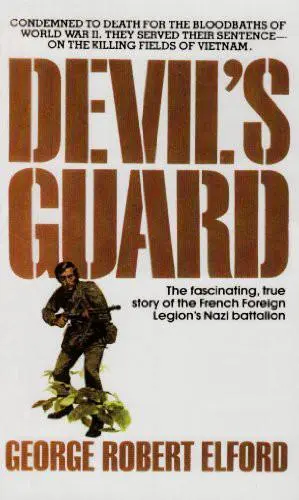
- Название:Devil's Guard
- Автор:
- Издательство:Dell
- Жанр:
- Год:1972
- Город:New York
- ISBN:9780440120148
- Рейтинг книги:3 / 5. Голосов: 1
-
Избранное:Добавить в избранное
- Отзывы:
-
Ваша оценка:
Devil's Guard: краткое содержание, описание и аннотация
Предлагаем к чтению аннотацию, описание, краткое содержание или предисловие (зависит от того, что написал сам автор книги «Devil's Guard»). Если вы не нашли необходимую информацию о книге — напишите в комментариях, мы постараемся отыскать её.
WHAT THEY DID IN WORLD WAR II WAS HISTORY’S BLOODIEST NIGHTMARE.
The ashes of World War II were still cooling when France went to war in the jungles of Southeast Asia. In that struggle, its frontline troops were the misfits, criminals and mercenaries of the French Foreign Legion. And among that international army of the desperate and the damned, none were so bloodstained as the fugitive veterans of the German S.S.
WHAT THEY DID IN VIETNAM WAS ITS UGLIEST SECRET — UNTIL NOW.
Loathed by the French, feared and hated by the Vietnamese, the Germans fought not for patriotism or glory but because fighting for France was better than hanging from its gallows. Here now is the untold story of the killer elite whose discipline, ferocity and suicidal courage made them the weapon of last resort.
Devil's Guard — читать онлайн бесплатно полную книгу (весь текст) целиком
Ниже представлен текст книги, разбитый по страницам. Система сохранения места последней прочитанной страницы, позволяет с удобством читать онлайн бесплатно книгу «Devil's Guard», без необходимости каждый раз заново искать на чём Вы остановились. Поставьте закладку, и сможете в любой момент перейти на страницу, на которой закончили чтение.
Интервал:
Закладка:
One hundred yards!- In an open space between the huts fires burned; a group of villagers was busy boiling syrup distilled from cane sugar, They rose and moved closer to the road to have a better look at us.
“Chieu hoy!” Xuey yelled the native greeting which was returned by a few discordant, hesitant voices coming from the darkness. “Long live Father Ho!” Sixty yards! No one was shooting yet. The people were curious but not alarmed. The figures on the road raised their lamps, trying to see into the darkness.
Forty yards! I knew that we had them.
“Who is there?” a heavy voice demanded. A couple of men moved forward with lamps.
“Friends,” Xuey replied, “on the way south with ammunition. We are going to liberate Saigon.”
The next instant we were upon them.
“Disperse!” I shouted, firing a red Very light over the huts. In a moment, the small group of people was enveloped by my troopers. The women began to scream, the men cursed. Lamps, tools, and weapons clattered to the ground.
“The French! The French!” someone yelled. From the far end of the settlement a short burst of machine-gun fire crackled. We heard a shriek, then silence.
Within seconds my men occupied the huts. Motioning Erich and Karl to follow me, I entered the nearest dwelling where husband, wife, and grandparents were already lined up, facing the wall; half a dozen children sat or rolled whimpering on the floor.
“Over here!” Krebitz called, pointing at the wall where a pistol hung in a holster. He took it down and examined it expertly. “Seven-sixty-two caliber Tokarev TT,” he remarked. Emptying the magazine, he dropped eight bullets into a canvas bag which one of his troopers held ready. “The goddamned cutthroats don’t even hide their guns anymore,” he remarked. With a sullen glance from his blue eyes he stepped to the owner of the hut and turned him around by the shoulder. “Where are your other weapons, you whoreson?” The guerrilla was a squat little creature with wide nose, square face, and bold, large eyes with closely grown brows. He reeled, steadied himself by grabbing at a bamboo rafter that supported the roof. His eyes seething with hatred, his fists clenched, he replied defiantly, “You may take our weapons but we shall have new ones before the sun rises.”
Without warning, Sergeant Krebitz struck him with the back of his hand. The man toppled over a low bench and crashed to the floor with his lips ripped. “Before the sun rises you will be a dead hero, you scum,” Krebitz growled.
“Take them out!” I ordered the troopers. “The kids too.”
As they were being led out, Pfirstenhammer handed a length of bamboo to a trooper and pointed out the man Sergeant Krebitz had struck. “Give him a dozen strokes for the good of his soul.”
Krebitz was already pulling away mats and boxes, searching for trapdoors. Outside the civilians were led to the paddies, where the men had to lie down with their hands extended, facing the water; the women and old people were permitted to sit, but also facing the paddies.
From down the road came Riedl. “Anything there?” I asked him.
“Guns and grenades,” he replied, “and plenty of them.”
“Keep looking.”
More people were brought forward and taken to the rice fields. Ransacking the huts, my troopers dumped weapons and ammo on the road. The local terrorists had an incredible selection of weapons ranging from vintage muskets and swords to submachine guns. In one of the huts, Sergeant Schenk seized a bow with twenty-six arrows, every one of them poisoned. The owner was taken to the woods and executed immediately.
Sergeant Krebitz selected weapons and ammunition that we could use, and the rest of the terrorist hardware was taken to the trucks, marked for destruction. “Let’s have a look at those trucks,” Schulze suggested. “I wonder where they got them?” We found Eisner already busy examining the vehicles. “Look at this,” he said, “Soviet Zises with Chinese plates.”
“Don’t tell me they came all the way from China.”
“I wouldn’t be surprised if they did.”
“There is no road,” Erich interposed.
“Not that we know of,” Eisner agreed. “But keep searching. We might find a couple of tanks too.”
Beneath one of the dwellings, Pfirstenhammer discovered a large underground shelter packed with guns and ammo. “Mortar shells,” Xuey interpreted the inscription.
“Over one hundred crates, each containing eighteen shells,” Karl remarked. “Two thousand rounds.”
“You had better get busy,” I told Sergeant Krebitz. He nodded and began to work, arranging primers and fuses. I ordered Schenk to march the villagers down the road. “Half a mile will do. We are going to blast the dump along with the trucks.”
While Krebitz and Gruppe Drei mined the dump and the trucks, Corporal Altreiter and fifty men gathered foodstuffs: rice, bundles of dried fish, fruits, and sugar cane were distributed among the troops. Half an hour later we evacuated the settlement.
“They will see the blast from Peking,” Riedl remarked, waving a thumb toward the village.
“Let them!” Pfirstenhammer shrugged.
Schenk and company were waiting on the road with the prisoners. Krebitz glanced at his watch. “In three minutes…”
The minutes ticked by. Then a blinding flash of fire illuminated the sky, followed instantly by a second blitz. The hills thundered and from the village exploding shells spiraled skyward. We could see huts flying in every direction. Moments later the place was engulfed in flames.
“Which is the way to Son La?” I asked one of the natives. Son La was in the opposite direction from where we really wanted to go. Numbly the man showed us the way. “Let them go!” I told the guard. “Except for those who were caught with a weapon.”
Fifteen men had been caught with weapons on them. They were taken to the paddies and shot.
We continued on the road for a mile. Walking between me and Erich, Suoi was unusually quiet. “Do you feel tired?” I asked her. She shook her head but said nothing.
“It is the village,” Erich remarked in German. “It reminded her of her own place.”
“We did not kill anyone except the armed terrorists.”
“Even so. She thinks that those people, too, have lost everything—their homes, their food, their livestock.”
“We are not the Salvation Army!” Eisner interposed. “They ought to learn that no one may play war games and get away with it unpunished.”
We spotted our advance guard, stationary on the roadside.
“There is a trail running due west,” Sergeant Krebitz reported. “Xuey considers it safe. He is already way ahead with Schenk.”
The battalion left the road and took to the hills.
12. DIALOGUE WITH AN AGITATOR
A most extraordinary event was brought about by a simple routine raid on a “liberated” village where no French troops had set foot for several months. Our search parties had discovered a group of terrorists in a hut, dozing off the aftereffects of the rice liquor. We collected their weapons, then bayoneted them where they lay snoring on the bamboo mats.
Summoning a group of villagers, Sergeant Krebitz ordered the corpses taken out and buried in the woods. The headman, sinewy and heavy cheekboned, informed me that all the guerrillas were strangers—none of them belonged to his village. He implored us not to burn down their dwellings for, as he said, “We can do nothing but obey the Viet Minh. The French are far away and the guerrillas can come and go here at will.”
The man was probably telling the truth, for although many of his people, among them women and children, had gathered about the hut to watch the bodies being taken away, no one cried or lamented over the dead terrorists. Instead the women asked my permission to remove some clothes from the dead, especially their bulky sandals fashioned from segments of old tires. Allowed to do so, they literally stripped the corpses, taking even the torn, blood-soaked pajamas.
Читать дальшеИнтервал:
Закладка:
Похожие книги на «Devil's Guard»
Представляем Вашему вниманию похожие книги на «Devil's Guard» списком для выбора. Мы отобрали схожую по названию и смыслу литературу в надежде предоставить читателям больше вариантов отыскать новые, интересные, ещё непрочитанные произведения.












Обсуждение, отзывы о книге «Devil's Guard» и просто собственные мнения читателей. Оставьте ваши комментарии, напишите, что Вы думаете о произведении, его смысле или главных героях. Укажите что конкретно понравилось, а что нет, и почему Вы так считаете.