George Elford - Devil's Guard
Здесь есть возможность читать онлайн «George Elford - Devil's Guard» весь текст электронной книги совершенно бесплатно (целиком полную версию без сокращений). В некоторых случаях можно слушать аудио, скачать через торрент в формате fb2 и присутствует краткое содержание. Город: New York, Год выпуска: 1972, ISBN: 1972, Издательство: Dell, Жанр: prose_military, Историческая проза, на английском языке. Описание произведения, (предисловие) а так же отзывы посетителей доступны на портале библиотеки ЛибКат.
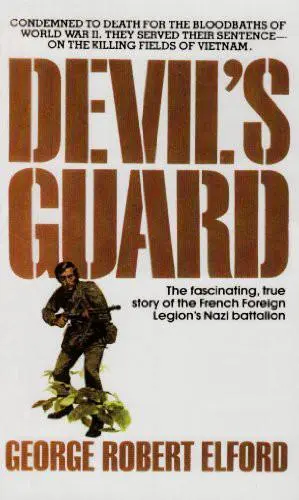
- Название:Devil's Guard
- Автор:
- Издательство:Dell
- Жанр:
- Год:1972
- Город:New York
- ISBN:9780440120148
- Рейтинг книги:3 / 5. Голосов: 1
-
Избранное:Добавить в избранное
- Отзывы:
-
Ваша оценка:
Devil's Guard: краткое содержание, описание и аннотация
Предлагаем к чтению аннотацию, описание, краткое содержание или предисловие (зависит от того, что написал сам автор книги «Devil's Guard»). Если вы не нашли необходимую информацию о книге — напишите в комментариях, мы постараемся отыскать её.
WHAT THEY DID IN WORLD WAR II WAS HISTORY’S BLOODIEST NIGHTMARE.
The ashes of World War II were still cooling when France went to war in the jungles of Southeast Asia. In that struggle, its frontline troops were the misfits, criminals and mercenaries of the French Foreign Legion. And among that international army of the desperate and the damned, none were so bloodstained as the fugitive veterans of the German S.S.
WHAT THEY DID IN VIETNAM WAS ITS UGLIEST SECRET — UNTIL NOW.
Loathed by the French, feared and hated by the Vietnamese, the Germans fought not for patriotism or glory but because fighting for France was better than hanging from its gallows. Here now is the untold story of the killer elite whose discipline, ferocity and suicidal courage made them the weapon of last resort.
Devil's Guard — читать онлайн бесплатно полную книгу (весь текст) целиком
Ниже представлен текст книги, разбитый по страницам. Система сохранения места последней прочитанной страницы, позволяет с удобством читать онлайн бесплатно книгу «Devil's Guard», без необходимости каждый раз заново искать на чём Вы остановились. Поставьте закладку, и сможете в любой момент перейти на страницу, на которой закончили чтение.
Интервал:
Закладка:
“God might know it but He won’t give you a marriage certificate!” Suoi blushed and lowered her face. “Suoi,” I spoke to her, “Do you understand that I cannot marry you legally and that if 1 do so, you will be married only in our hearts and in our eyes, but not in the eyes of the world?”
“Oui, I know,” she whispered, her voice barely audible.
“Do you want me to do it?”
“Oui, Hans. I want you to do it.”
The news spread through the camp like wildfire. And there, out in the wilderness, Sergeant Krebitz’s men erected a small altar, covered with a tarpaulin sheet and decked with flowers; on it Riedl placed a wooden crucifix which he had carved the day before, expecting the priest. I placed the open Bible in front of the cross. Noy and the girls came, each carrying a single flower which they tucked gently into Suoi’s hair, kissing her on both cheeks. The troops gathered around the makeshift shrine, everyone freshly shaved and wearing a clean shirt. They stood in solemn silence and were deeply touched when Erich and Suoi appeared, Erich with a stance of determination but Suoi blushing and with eyes averted. I motioned them to the altar and said, “Place your hands on the Holy Bible.”
Obediently they extended their hands, with Erich’s hand resting lightly on hers. Strange as it may be, I saw my men, the rugged, tough fighters, who believed in only one power—that of the gun—now standing overawed before an invisible, spiritual force, no one daring to move or to do as much as clear the throat.
“Now, with your hands on the Bible, you shall say aloud, Erich and Suoi, that. you will accept each other as man and wife,” I said.
“I do!” they whispered.
“For better or worse.”
“For better or worse.”
“Until death do us part.”
“Until death do us part.”
It was all I could remember.
I said to them, “I am not a servant of God. I cannot proclaim you man and wife in the name of God. I can speak only for us. We do accept and respect your union and we shall regard you as man and wife. And I believe that if there is a God, He, too, will accept your covenant.”
I embraced them both. One after another the troops came to congratulate and to express their good wishes. Everyone was touched. Even Eisner was clearing his throat much too often.
“Blast me,” he remarked, “if this was not the holiest of all the weddings I ever saw.”
He hugged Schulze and kissed him and then Suoi on the forehead.
“Still I suggest that you see one of God’s emissaries when we get back to Hanoi. While we take care of the worldly authority,” I added jokingly.
Four days later we were on the march again.
In the jungle the battalion was perfectly safe and could make better progress than on the roads or trails where we had to be on the alert for traps and enemy troops. We could, however, safely use remote paths, which sometimes crisscrossed the Viet Minh-controlled areas, far from the French garrisons. The chance of encountering enemy forces in the forest was minimal. In areas under guerrilla control the guerrillas no longer camped in the hills but in the villages, and they moved openly on the roads, dispersing only when reconnaissance planes happened to fly by. In districts from which the Legion had been expelled or had withdrawn for tactical reasons, the rules of the game changed; the Viet Minh occupied the settlements and the abandoned French stockades. Then our battalion assumed the role of the guerrillas with great success. We penetrated into areas which were out of reach for the regular army.
It was my intention to bypass Muong Son ten miles to the northwest The same evening our trailblazers hit a wide jungle path that seemed to run in approximately the right direction. After a brief survey, Xuey announced that the path had not been used for several weeks, and that it was safe. We proceeded openly and at a good rate, spending the nights in the woods, marching from dawn to about eleven o’clock, then again when the midday heat abated. Late in the afternoon of the third day after leaving our jungle camp, the forest became less dense and we finally arrived at an open area of grassland with a small settlement two miles away. It was not marked on our maps. Xuey observed the place for a long time and insisted that he could see a flag flying from a pole—the flag of the Viet Minh. We deployed on the forest line and Xuey decided to survey the hamlet at dusk. There was nothing we could do but wait.
Taking a submachine gun, Xuey prepared to leave. He wanted to go alone, and when Riedl asked concernedly, “Won’t it be too dangerous?” our little Indochinese companion only smiled and said, “Remember that I was one of them.”
He vanished in the dark field like a cat. Half an hour later we heard the distant baying of dogs.
Xuey returned, soaking wet but satisfied. “There are paddies all around,” he reported. “I could not get very close because of the dogs. The guerrillas are all local people, not more than fifty men. But I spotted two trucks.”
“What trucks?”
“Loaded trucks,” Xuey added. “The Viet Minh must have captured them from the army.”
“Now isn’t that great!” Eisner exclaimed. “They are trafficking in trucks, happy and unconcerned. Next time we may discover an underground railway line running between Chen-yuan and Muong.”
“I wouldn’t be surprised,” Pfirstenhammer remarked. “The way our reconnaissance works…”
“There is a road but we will have to circle the paddy fields,” Xuey explained. Then turning toward the girls he ordered, “Now face the woods, all of you. I want to change clothes.”
I switched on my shaded flashlight and examined the map.
“The road is here all right but the village is missing,” Riedl commented.
Taking my pen I marked the apparent locale of the village with a small cross. “It is about here.”
“Trucks… ,” Eisner fumed. “I believe the Chinese could build a four-lane highway to the Mekong delta without our intelligence ever noticing a thing.”
Because of the dogs we could not enter the village undetected. I made a plan for encircling the settlement and moving in right on the road. It was a bold plan but I thought it would work. Dividing forces with Eisner and Riedl, we set out, following the forest line for a mile, then skirting the paddies until we arrived at the dirt road. It was comfortably dark and the neighborhood deserted. The woods on the southern bills, the route I planned to use later on, extended almost to the road and offered ample concealment.
“What are we going to do about the dogs?” Schulze queried.
“We are going to whistle!” I replied with reserve.
He screwed up his mouth and shrugged. “If you think your whistling will quiet the dogs, Hans…”
“I want to quiet their masters, Erich!” I said, then added, “Can you hum the ‘Internationale’?”
“What ‘Internationale’?”
“The Communist one!” I hummed the first bars. Xuey glanced up and broke into a grin. He understood me. “Now we are going to turn into a bunch of real Viet Minh,” I told the troops. “We will have to confuse the enemy, if only for the first critical minute and I think the Communist song will do exactly that.”
Erich flashed a quick look of approval. “I am with you. En avant!” Splitting troops once again, I sent a hundred men to approach the settlement from the north, between the road and the forest, then we moved on. My group was about four hundred yards from the village when the dogs began to bark. Within seconds the place was alive with barking and baying.
“Whistle!” I passed the word, “whistle for all you’re worth.”
Behind me the men began to hum, at first hesitantly, seeking the proper tune; then with Xuey’s help, they found the melody and whistled “Proletarians of the world unite” as they marched with steady strides. Ahead of us lights appeared; dark shapes, carrying lamps, emerged from the huts.
Читать дальшеИнтервал:
Закладка:
Похожие книги на «Devil's Guard»
Представляем Вашему вниманию похожие книги на «Devil's Guard» списком для выбора. Мы отобрали схожую по названию и смыслу литературу в надежде предоставить читателям больше вариантов отыскать новые, интересные, ещё непрочитанные произведения.












Обсуждение, отзывы о книге «Devil's Guard» и просто собственные мнения читателей. Оставьте ваши комментарии, напишите, что Вы думаете о произведении, его смысле или главных героях. Укажите что конкретно понравилось, а что нет, и почему Вы так считаете.