George Elford - Devil's Guard
Здесь есть возможность читать онлайн «George Elford - Devil's Guard» весь текст электронной книги совершенно бесплатно (целиком полную версию без сокращений). В некоторых случаях можно слушать аудио, скачать через торрент в формате fb2 и присутствует краткое содержание. Город: New York, Год выпуска: 1972, ISBN: 1972, Издательство: Dell, Жанр: prose_military, Историческая проза, на английском языке. Описание произведения, (предисловие) а так же отзывы посетителей доступны на портале библиотеки ЛибКат.
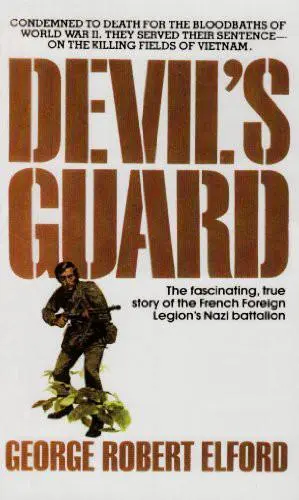
- Название:Devil's Guard
- Автор:
- Издательство:Dell
- Жанр:
- Год:1972
- Город:New York
- ISBN:9780440120148
- Рейтинг книги:3 / 5. Голосов: 1
-
Избранное:Добавить в избранное
- Отзывы:
-
Ваша оценка:
Devil's Guard: краткое содержание, описание и аннотация
Предлагаем к чтению аннотацию, описание, краткое содержание или предисловие (зависит от того, что написал сам автор книги «Devil's Guard»). Если вы не нашли необходимую информацию о книге — напишите в комментариях, мы постараемся отыскать её.
WHAT THEY DID IN WORLD WAR II WAS HISTORY’S BLOODIEST NIGHTMARE.
The ashes of World War II were still cooling when France went to war in the jungles of Southeast Asia. In that struggle, its frontline troops were the misfits, criminals and mercenaries of the French Foreign Legion. And among that international army of the desperate and the damned, none were so bloodstained as the fugitive veterans of the German S.S.
WHAT THEY DID IN VIETNAM WAS ITS UGLIEST SECRET — UNTIL NOW.
Loathed by the French, feared and hated by the Vietnamese, the Germans fought not for patriotism or glory but because fighting for France was better than hanging from its gallows. Here now is the untold story of the killer elite whose discipline, ferocity and suicidal courage made them the weapon of last resort.
Devil's Guard — читать онлайн бесплатно полную книгу (весь текст) целиком
Ниже представлен текст книги, разбитый по страницам. Система сохранения места последней прочитанной страницы, позволяет с удобством читать онлайн бесплатно книгу «Devil's Guard», без необходимости каждый раз заново искать на чём Вы остановились. Поставьте закладку, и сможете в любой момент перейти на страницу, на которой закончили чтение.
Интервал:
Закладка:
The killers had to be punished but there was no need for us to hurry. The village lay only eight miles from the Chinese border and the assassins were low on ammunition; they wouldn’t stay in the vicinity. Most of the victims had been stabbed or clubbed to death. The terrorist unit was on its way home to a base near Man-hao, China. They must have already crossed the border. The survivors insisted that there were many Chinese “officers” with the Viet Minh. The village had been attacked by at least three hundred guerrillas.
“I think this is Ming Chen-po’s handiwork,” Eisner remarked and I agreed. The people spoke of a “one-armed Chinese” who seemed to be in command of the terrorist group. Ming was known to have lost an arm to the Japanese artillery in 1939, and I had seen some of the hamlets overrun by the troops of this one-time bandit and now People’s Commissar.
It was a known fact that Chinese “experts” and even militiamen were actively engaged in terrorist ventures within French Indochina. I had sent several reports to Hanoi drawing attention to their activities in the border provinces but the High Command could do little to retaliate. “Kill as many of them as possible,” said Colonel Houssong, “but take no Chinese prisoners. Mao couldn’t care less about losing a million volunteers in Indochina but if we displayed a single Chinese prisoner, he would be pushed into saying something to the world. And Mao would never admit that he was guilty of armed intrusion into French territory. He would demand the release of a Chinese officer whom the French had kidnapped from Chinese territory (where he was probably engaged in the peaceful activity of planting potatoes in the garden behind the guardhouse).”
The Communists are superb liars. They are quite capable of delivering a fat lie so convincingly, or at least vehemently, that even their victim will later apologize for having erred.
Ming had a base across the frontier and was wary enough never to venture too deep into Indochina. We suspected that the terrorists had established a base, a sort of advance command post, somewhere within a fifty-mile radius of Man-hao. The Chinese advisers remained there, while the native Viet Minh embarked on more distant missions. Whenever the Legion pursued them, they quickly retreated into their sanctuary where no French troops could follow them. Ming was an old quarry of ours. Twice in seven months we had been compelled to abandon pursuit because of the border.
Now I felt it was time to get even with the terrorists of Ming, wherever they might be. I decided to demolish their home base some twenty-odd miles inside China. Should we succeed we could keep our mouths shut and enjoy being rid of Ming. Should we lose, none of us would give a damn what Hanoi or Peking might say or do. With a bullet in the head one has no worries. Both Hanoi and Peking were far away. Our enemy was temptingly close.
I turned the thought over and over in my mind, checked our stores, the maps, and found the idea feasible. The battalion had refrained from crossing the frontier before. The enemy would not suspect us now. I summoned my companions and motioned them to sit down around a table in the ambulance tent.
“What’s up, Hans?” Schulze queried. “Anything wrong?”
“Nothing’s wrong,” Eisner spoke before I could answer. “I think we are going to leave here soon.”
He jerked a thumb toward the Chinese frontier. “That way!” I nodded and announced without preliminaries, “We are going to blast the camp of Ming Chen-po!” Pfirstenhammer gaped. “At Man-hao?”
“That’s right.”
Riedl whistled and Karl pursed his lips in a grin. Schulze began to rub his scalp. “Well?” I asked them. “What do you think of it?” Riedl shrugged. “I always wanted to see China.”
“You won’t be seeing much of it,” Schulze chuckled, “but if we want to say good-night to Ming this is the time to say it. We don’t have to walk far.”
“That’s right,” Karl agreed as Eisner remarked, “Headquarters will be mad as hell.”
“Who cares?” Schulze hitched his chair closer. “Let’s have a look at the maps.”
He glanced at me. “I presume this is going to be a strictly private enterprise, Hans?”
“Naturally. We cannot request a permit to enter China and we can never admit having done so.”
“How about Colonel Houssong?” Karl inquired. “I am sure he would love it. Provided, of course, that we return without leaving corpses behind… our own corpses.”
Eisner thought the raid was within our “means,” and Riedl said that for him it was alles Wursl. He suggested that with the Man-hao business done we might as well take the train to Peking and free the Republic. “After all, Mao has only about seven thousand divisions and of these only seven carry guns, the rest clubs,” he said.
We quickly decided to leave our uniforms behind, along with identity tags and personal papers. Pfirstenhammer swore because we selected him to remain with the convoy and take care of the villagers. “We need a competent man to maintain the perimeter. I cannot leave the convoy to a corporal,” I stated flatly. “Some of us will have to stay, Karl.”
“How about Riedl?” Pfirstenhammer exclaimed indignantly. “He is just as competent as I am.”
He turned toward Riedl. “Aren’t you, Helmut?”
“Why pick on me? I haven’t got a sore leg. Besides I can shoot a lot better than you ever will.”
“Let’s bet on it,” Karl exploded.
“Keep your shirts on, men!” I snapped. “This is not going to be a pleasure trip into the bordellos of Man-hao and I am still the one who decides who is to stay.”
“Why not Eisner?” Karl argued. “He is old anyway.”
“Who, me?” Bernard turned sharply and began to rise. “Would you care to prove it, Karl? How about stepping behind those trucks for a moment?”
“Sit down!” I pushed him back. “And now shut up, all of you. Karl, you still have a sore leg and we cannot expect you to walk the sixty miles there and back.”
“I like your good heart, Hans,” Pfirstenhammer growled but he sat down.
I estimated the expedition would last for about four days and that we could never enter China without a proper guide. We needed a map or diagram of the area so that we could make a rough plan. Fortunately smuggling was a common and respectable profession in the border villages because French wares fetched good prices in China. Eisner thought that it should not be difficult to find people who were familiar with the other side of the frontier. Calling for our interpreter, he left for the temple to talk to the survivors.
After a while Eisner returned with two men and a girl about twenty years of age. Although her high-necked smock was burned and soiled, I noticed immediately that she belonged to the “upper class” of the community.
“You may trust them,” Eisner advised me in German. “Phu has just lost his wife and child, Cao’s father and mother were gunned down, and the girl, her name is Suoi, lost her entire family of six. She is all alone now. She has been in Man-hao.”
“And the men?”
“They know some trails across the frontier.”
Before the war Suoi had attended a French missionary school at Lao Kay, and she spoke good French. She was a very pretty girl with long black hair which she wore in braids. Small but beautifully proportioned, she had almond eyes and a slightly upturned nose. Now her eyes were swollen but dry, for she could no longer cry. Looking at her as she sat staring at the table, still in a semi-stupor, she reminded me of Lin. How identical were their stories. Separated from one another only in time and space, they were victims of a common enemy. It pained me that we had to torment her with questions.
Читать дальшеИнтервал:
Закладка:
Похожие книги на «Devil's Guard»
Представляем Вашему вниманию похожие книги на «Devil's Guard» списком для выбора. Мы отобрали схожую по названию и смыслу литературу в надежде предоставить читателям больше вариантов отыскать новые, интересные, ещё непрочитанные произведения.












Обсуждение, отзывы о книге «Devil's Guard» и просто собственные мнения читателей. Оставьте ваши комментарии, напишите, что Вы думаете о произведении, его смысле или главных героях. Укажите что конкретно понравилось, а что нет, и почему Вы так считаете.