George Elford - Devil's Guard
Здесь есть возможность читать онлайн «George Elford - Devil's Guard» весь текст электронной книги совершенно бесплатно (целиком полную версию без сокращений). В некоторых случаях можно слушать аудио, скачать через торрент в формате fb2 и присутствует краткое содержание. Город: New York, Год выпуска: 1972, ISBN: 1972, Издательство: Dell, Жанр: prose_military, Историческая проза, на английском языке. Описание произведения, (предисловие) а так же отзывы посетителей доступны на портале библиотеки ЛибКат.
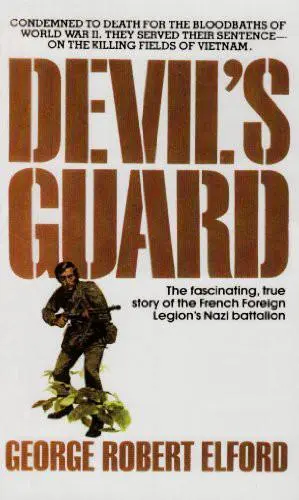
- Название:Devil's Guard
- Автор:
- Издательство:Dell
- Жанр:
- Год:1972
- Город:New York
- ISBN:9780440120148
- Рейтинг книги:3 / 5. Голосов: 1
-
Избранное:Добавить в избранное
- Отзывы:
-
Ваша оценка:
Devil's Guard: краткое содержание, описание и аннотация
Предлагаем к чтению аннотацию, описание, краткое содержание или предисловие (зависит от того, что написал сам автор книги «Devil's Guard»). Если вы не нашли необходимую информацию о книге — напишите в комментариях, мы постараемся отыскать её.
WHAT THEY DID IN WORLD WAR II WAS HISTORY’S BLOODIEST NIGHTMARE.
The ashes of World War II were still cooling when France went to war in the jungles of Southeast Asia. In that struggle, its frontline troops were the misfits, criminals and mercenaries of the French Foreign Legion. And among that international army of the desperate and the damned, none were so bloodstained as the fugitive veterans of the German S.S.
WHAT THEY DID IN VIETNAM WAS ITS UGLIEST SECRET — UNTIL NOW.
Loathed by the French, feared and hated by the Vietnamese, the Germans fought not for patriotism or glory but because fighting for France was better than hanging from its gallows. Here now is the untold story of the killer elite whose discipline, ferocity and suicidal courage made them the weapon of last resort.
Devil's Guard — читать онлайн бесплатно полную книгу (весь текст) целиком
Ниже представлен текст книги, разбитый по страницам. Система сохранения места последней прочитанной страницы, позволяет с удобством читать онлайн бесплатно книгу «Devil's Guard», без необходимости каждый раз заново искать на чём Вы остановились. Поставьте закладку, и сможете в любой момент перейти на страницу, на которой закончили чтение.
Интервал:
Закладка:
Along a low palisade we found the naked corpses of eleven Legionnaires. Their flesh was beaten into a swollen bluish pulp devoid of all human semblance and mutilated beyond description. They were all Germans, our veteran comrades for many years. Receiving the village elder’s urgent request for evacuation, I had sent them forward to reassure the terrified people. Having refused to cooperate with the Viet Minh, the inhabitants had expelled the guerrilla agitators and had beaten one of them up in the heat of an argument. They had not done it because they were pro-French or hated Communists but for the simple reason that the war had so far avoided their hamlet and they had desired to preserve peace in their dwellings.
The Viet Minh revenge had been swift and ferocious. The Communists, who can exist only where terror prevails, decided to give a lasting example of what happens to the enemies of Father Ho’s “soldiers,” the guerrillas. The small platoon could not stem the human tide that descended on the community. It had been crushed by the sheer weight of enemy flesh.
We recovered ample evidence of their desperate last stand. The piles of spent shells around the palisade told us the whole sad story. There were no enemy corpses in evidence. When not pursued immediately, the terrorists would always carry away their dead to bury them secretly near their homes or in the hills. From the blood-soiled ground where they had fallen we computed the possible number of enemy casualties: one hundred and six altogether.
Walther Grobauer from Munich, Adolf Greilinger from Kiel, Kurt Heinzl, a veteran of the battle for Leningrad, Hans Aigner, Erich Stumme, Erich Windischmann from Berlin, Rupert Winkler, Max Hartmann, Hans Weber, the one-time panzer driver of the Afrika Korps, Friedrich Zimmermann and Alois Krupka, the two veterans of the last great battle on the Vistula. They had fought Communism for over a decade and had come a long way to fight it again and die. They will be forgotten heroes.
The survivors of the community, about sixty families, were leaving the village that could no longer offer them either food or shelter, let alone security—weeping, sagging people who had lost everything and everyone in a brief fury of hatred that had obliterated their past, present, and future. We stood in silent sympathy as our three tanks took positions at the foot of the hills. Our convoy of thirty American trucks looked strangely new and powerful as they loomed over the collapsed, blackened huts—a bit of the present dominating the ancient, the Stone Age. Yet all that those people had ever wanted was to be left alone to live their Stone-Age lives and never encounter anything “civilized.”
To them civilization meant tanks, machine guns, warplanes, death! But the entire world of “civilized” nations with all their humanitarian institutions and their United Nations could not fulfill the modest desire of these simple people: to be left alone, not to be bothered, not to be given anything except peace.
The civilized world is very generous. It provides even for those who neither sought nor wanted to receive its gifts.
Wherever we turned, corpses sprawled on the ground for acres around; here one, there in groups of five or more. Those who had escaped the massacre were trying to gather what was left of their possessions, pushing and pulling at the burned debris, still in a state of semi-stupor. Men, women, and children wailed over their dead or just stood petrified, gazing at the corpses in silent perplexity.
In and around a small Buddhist temple the survivors gathered. Erich and Helmut were busy opening tin cans to distribute corned beef, condensed milk, rice, and drinking water. The wells of the village could not be used. The terrorists had dumped corpses into them. Behind the temple, Eisner set up a first-aid station to care for the wounded. Some of the people had been hurt badly and for them Sergeant Zeisl, our chief medic, could do little beyond easing their pain with morphine. Others, only slightly injured, sat sullenly on the ground, holding a hand or a dirty rag over their wounds, waiting their turn.
Around eleven o’clock the sun was blazing furiously. Perspiration could not evaporate in the ninety percent humidity. We were all soaking wet and a great stink enveloped the crowd around the ambulance. The air was pregnant with the scent of sweat, blood, and human filth. From the ruins little groups of people dragged forward. Fathers pushed carts, the women hauled them with ropes. The children and old people rode in the carts, some wailing, others just staring with vacant eyes.
I was thinking of the villages which we had had to destroy in the past It was always the civilians who suffered, whichever side they adhered to. Even if they wanted to take no sides and remain out of trouble, the war struck them down. If they refused to accommodate the Viet Minh, the terrorists liquidated them without mercy. If they went “red,” the Foreign Legion exterminated them directly or indirectly. The people were trapped between the cogwheels of a murder mechanism which turned inexorably, churning up and crushing everyone it caught. It was easy to say, “C’est la guerre.”
We were not any better than the Viet Minh and we knew it. But we did want to fight a clean war and we were not the ones who started the atrocities.
We only retaliated in kind. We could do nothing else. The French tried to remain humane and their troops were dying like flies. We had no desire to die in Indochina. We knew that if anything could ever induce the Communists to recognize military conventions or even the fundamental principles of human law, it would be only their own terror. That might convince them that- they had better fight a man’s war instead of a war of the wolves. The Viet Minh had to suffer immensely before they would do as much as recognize a Red Cross emblem. The Communists understand no language other than the cries of agony, to which they are accustomed. Kindness and sympathy or a humane approach will only make them suspicious. They know the world hates them, and that they can exist only by the force of arms, blackmail, fire, rebellion, destruction, death! We were resolved to make their lives a long cry of agony.
Still there was a slight difference between our opposing groups. We did feel remorse whereas they felt none. We could shed tears over a single fallen comrade. The Viet Minh were throwing away men the way we discarded cigarette butts. For us, spreading terror was the sole means of survival. The Viet Minh killed and mutilated for the sheer pleasure of seeing suffering and shedding blood.
I watched Schulze and Riedl as they distributed food, smiled and joked to cheer up the apathetic children. I recalled some past events when those very hands, my hands included, had gunned down similar children at another place without batting an eye. It was all so senseless, like a schizophrenic vision that would haunt us forever.
It was difficult to stay within reason when one beheld the abused corpse of a comrade for whom, the enemy thought, death alone had not been enough punishment. Nothing except our own survival could justify what we did and no sublime Communist slogans about “liberation” and “independence” could ever justify the ruthless genocide committed by the patriots of Ho Chi Minh. But in the end they will get the worst of the deal. Because one day we will depart. The assassins of the Viet Minh will have to stay to face their victims again and again, bracing against those who seek revenge. And there will be tens of thousands of people who will, one day, seek revenge; fathers, sons, or even mothers whose loved ones had been murdered by the “liberators.”
People can always be subdued by terror but nothing can make people forget. Neither the bayonets nor the secret police.
Corporal Altreiter and a platoon gathered the sad remains of our comrades. We buried them in a common grave over which Schulze planted a crude wooden cross which bore no names, only the short notice: “Eleven comrades. Deutschland—Russland—Nord Afrika—Indochina” and the date. We will always remember their names. Others won’t care who they were anyway.
Читать дальшеИнтервал:
Закладка:
Похожие книги на «Devil's Guard»
Представляем Вашему вниманию похожие книги на «Devil's Guard» списком для выбора. Мы отобрали схожую по названию и смыслу литературу в надежде предоставить читателям больше вариантов отыскать новые, интересные, ещё непрочитанные произведения.












Обсуждение, отзывы о книге «Devil's Guard» и просто собственные мнения читателей. Оставьте ваши комментарии, напишите, что Вы думаете о произведении, его смысле или главных героях. Укажите что конкретно понравилось, а что нет, и почему Вы так считаете.