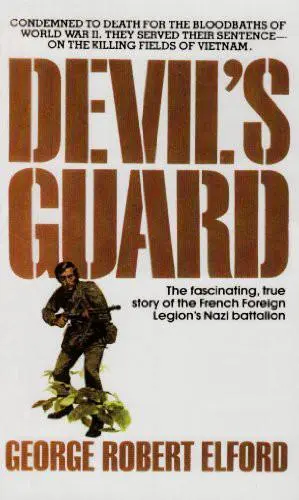
George Elford - Devil's Guard
Здесь есть возможность читать онлайн «George Elford - Devil's Guard» весь текст электронной книги совершенно бесплатно (целиком полную версию без сокращений). В некоторых случаях можно слушать аудио, скачать через торрент в формате fb2 и присутствует краткое содержание. Город: New York, Год выпуска: 1972, ISBN: 1972, Издательство: Dell, Жанр: prose_military, Историческая проза, на английском языке. Описание произведения, (предисловие) а так же отзывы посетителей доступны на портале библиотеки ЛибКат.
- Название:Devil's Guard
- Автор:
- Издательство:Dell
- Жанр:
- Год:1972
- Город:New York
- ISBN:9780440120148
- Рейтинг книги:3 / 5. Голосов: 1
-
Избранное:Добавить в избранное
- Отзывы:
-
Ваша оценка:
Devil's Guard: краткое содержание, описание и аннотация
Предлагаем к чтению аннотацию, описание, краткое содержание или предисловие (зависит от того, что написал сам автор книги «Devil's Guard»). Если вы не нашли необходимую информацию о книге — напишите в комментариях, мы постараемся отыскать её.
WHAT THEY DID IN WORLD WAR II WAS HISTORY’S BLOODIEST NIGHTMARE.
The ashes of World War II were still cooling when France went to war in the jungles of Southeast Asia. In that struggle, its frontline troops were the misfits, criminals and mercenaries of the French Foreign Legion. And among that international army of the desperate and the damned, none were so bloodstained as the fugitive veterans of the German S.S.
WHAT THEY DID IN VIETNAM WAS ITS UGLIEST SECRET — UNTIL NOW.
Loathed by the French, feared and hated by the Vietnamese, the Germans fought not for patriotism or glory but because fighting for France was better than hanging from its gallows. Here now is the untold story of the killer elite whose discipline, ferocity and suicidal courage made them the weapon of last resort.
Devil's Guard — читать онлайн бесплатно полную книгу (весь текст) целиком
Ниже представлен текст книги, разбитый по страницам. Система сохранения места последней прочитанной страницы, позволяет с удобством читать онлайн бесплатно книгу «Devil's Guard», без необходимости каждый раз заново искать на чём Вы остановились. Поставьте закладку, и сможете в любой момент перейти на страницу, на которой закончили чтение.
Интервал:
Закладка:
After the sadistic butchery of ten prisoners the guerrilla commander graciously granted one hour for the French to decide whether they wanted to witness the massacre of ten more prisoners. The mental torment of the lieutenant must have been shattering; he had arrived in Indochina only a few months before, and it was his first real experience with the Viet Minh. As he told us later he had never dreamed that something like this could ever happen in the twentieth century.
The lieutenant’s troops were aghast. Several of the Legionnaires in the stockade suffered a nervous breakdown and began to sob like children; one man went berserk and had to be locked up—but that was precisely what the Viet Minh commander had hoped to accomplish by his medieval butchery.
I was on a foray in the vicinity with only one hundred men when I received the order to assist the garrison “by all available means.”
By the time we managed to establish radio contact, fifteen of the prisoners had already been executed by the terrorists, and the lieutenant was on the verge of raising the white flag. When he learned that we were only one hundred, he almost cried in desperation. “There are more than six hundred terrorists in the woods. You will be slaughtered the moment they spot you,” he said. I implored him to hold on.
Knowing that a direct assault on the enemy would be futile, I decided to pull a desperate coup. Instead of rushing to- the aid of the fort, we descended on the nearest villages, which were almost devoid of male population. We knew where the men were! The headman was led forward in the first village. There was no time to waste. “Point out the family of the Communist commander and name all those whose men folk are assaulting the stockade!” Eisner snapped without preliminaries. The man would not tell. Eisner repeated the question with his gun against the man’s temple. He waited for a moment then pulled the trigger. “Bring here three of his kids!” he commanded his troopers, and, as the boys were gathered, their mother ran forward screaming, trying to break the ring of steel. “I will tell you!” she cried. “I will tell you!” Fifteen minutes later we were on the way toward the stockade, herding over a hundred Viet Minh relatives, the wives and children of the terrorists in front of the column. One of the hostages I sent ahead to the guerrilla commander with the demand that unless he surrendered, their relatives would be executed at five-minute intervals.
I was resolved to show the enemy that terror, brutality, and cold-blooded murder were not their monopoly, a Communist privilege, and that at least my battalion was ready to pay them tit for tat. They understood no other language.
Taking position on a dominant hill about three hundred yards from the enemy, we lined up the guerrilla relatives in plain sight on the edge of a precipice. The Viet Minh commander did not seem to care much for his own family, but his companions did. The shooting around the stockade stopped abruptly; there was a frozen silence, then we heard savage yells and arguments; the enemy camp exploded in a bloody mutiny. The terrorists whose families we were holding began to kill their own superiors and commissars, along with everyone else who wanted to fight on. Then they surrendered.
Our action saved the lives of twenty-four French prisoners and relieved the fort. The hostages were allowed to return home, but all the guerrillas who had surrendered to us were executed on the riverside and their bodies were thrown into the water.
Never in the past had the Viet Minh experienced a similar rebuff, not even under the Japanese. Our swift and stiff action had its effect. For weeks afterwards the terrorists lay low and when we moved into a village there was silence. When we asked questions they were answered without hesitation. The guerrillas held back, measuring us, contemplating, trying to determine the best way to oppose us.
They did not appreciate our kind of warfare.
We were ordered to escort a convoy of trucks with supplies for a beleaguered North African garrison near Tuyen Quang, a hundred and twenty miles from Hanoi. It was the sort of action which ordinary regulars could call a “kamikaze sortie,” because in those days to convoy a train of heavy vehicles across Viet Minh-controlled territory could rightly be called a suicide mission. The vehicles had to traverse jungles and valleys with a visibility of fifteen yards on either side; they had to pass a hundred places where a few hidden mines and machine guns could blow everything to smithereens. The French had already tried to rush a convoy through the same route. It had been destroyed by the guerrillas at a jungle section marked in our operational maps as Point 206.
“The convoy must get through,” said Colonel Houssong. “Should the guerrillas blast you, we may write off an entire brigade along with a dozen relatively loyal villages.”
We had a conference over the maps and aerial photos of the area, but from whichever angle I surveyed the situation, the project appeared grim. I discussed the mission with my officers and we came up with a feasible plan. Since I could not well present our plan to Colonel Houssong, I only stated that I could guarantee the arrival of the convoy only if I was to have a free hand to do the job by whatever means I saw fit.
“Do it, then,” Colonel Houssong consented, giving us carte blanche. “The convoy must get through. And not only five trucks but the whole convoy.”
I said, “We will take the whole convoy through, mon colonel—or we will never return.”
Forward! At a steady fifteen miles per hour, sometimes even slower. We sat on the leading tank, Schulze and I, surveying the jungle. Behind us came an armored troop carrier but it transported only four soldiers.
The rest of the passengers were civilians. Following the troop carrier came, under the command of Bernard Eisner, a half-track with four mounted loudspeakers. Behind the half-track a column of sixteen trucks loaded with ammunition, food, and other supplies. On the crates more civilians: the families of the local Viet Minh. Many of them we knew by name. They had not been harmed, and we had tried to comfort them with food and water. Of course they were crying, lamenting, but so were all those women and children whose breadwinner had been executed by the terrorists for no worse offense than a refusal to join them.
“The convoy must get through!” the colonel had said. We were resolved to take it through. We were also resolved to stay alive in the process—two hundred men against more than a thousand enemy in the area. The enemy was holding all the trump cards, save for one strong ace that we were holding—their families! Ahead of us lay the jungle, and traversing the jungle, a dirt road. On either side dense underbrush, a treacherous green sea of weeds that had swallowed up many convoys and many men. When we entered the first Communist-controlled village, we had found only old people, women, and children at home. Every man of military age—husbands, fathers, brothers, and sons—had been absent. We had known where they were—not very far away. A large army convoy represented plenty of booty for the guerrillas. When they saw us coming, they had grabbed their weapons and had withdrawn into the woods.
My earphone crackled. Eisner was reporting: “We shall be at point two-o-six in five minutes.”
Point 206, where only ten days ago the guerrillas had exterminated another convoy, blowing up twelve trucks and killing ninety men. Afterwards the enemy had withdrawn into the jungle, taking everything that could be removed. The “Paras” went to search the villages but could find no trace of either guerrillas or of the stolen army hardware. Of course the Paras had known only too well where the culprits were; at home in their villages, tending the fields, milking cattle, or carting vegetables to the markets of Hanoi. The stolen goods and the guerrilla weapons had been safely hidden to be used another day.
Читать дальшеИнтервал:
Закладка:
Похожие книги на «Devil's Guard»
Представляем Вашему вниманию похожие книги на «Devil's Guard» списком для выбора. Мы отобрали схожую по названию и смыслу литературу в надежде предоставить читателям больше вариантов отыскать новые, интересные, ещё непрочитанные произведения.












Обсуждение, отзывы о книге «Devil's Guard» и просто собственные мнения читателей. Оставьте ваши комментарии, напишите, что Вы думаете о произведении, его смысле или главных героях. Укажите что конкретно понравилось, а что нет, и почему Вы так считаете.