George Elford - Devil's Guard
Здесь есть возможность читать онлайн «George Elford - Devil's Guard» весь текст электронной книги совершенно бесплатно (целиком полную версию без сокращений). В некоторых случаях можно слушать аудио, скачать через торрент в формате fb2 и присутствует краткое содержание. Город: New York, Год выпуска: 1972, ISBN: 1972, Издательство: Dell, Жанр: prose_military, Историческая проза, на английском языке. Описание произведения, (предисловие) а так же отзывы посетителей доступны на портале библиотеки ЛибКат.
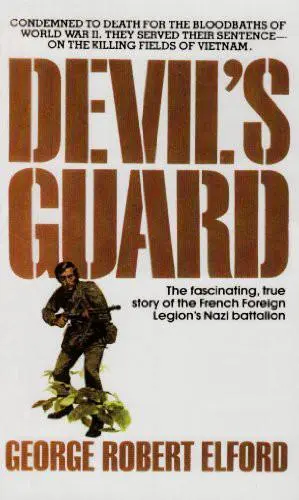
- Название:Devil's Guard
- Автор:
- Издательство:Dell
- Жанр:
- Год:1972
- Город:New York
- ISBN:9780440120148
- Рейтинг книги:3 / 5. Голосов: 1
-
Избранное:Добавить в избранное
- Отзывы:
-
Ваша оценка:
Devil's Guard: краткое содержание, описание и аннотация
Предлагаем к чтению аннотацию, описание, краткое содержание или предисловие (зависит от того, что написал сам автор книги «Devil's Guard»). Если вы не нашли необходимую информацию о книге — напишите в комментариях, мы постараемся отыскать её.
WHAT THEY DID IN WORLD WAR II WAS HISTORY’S BLOODIEST NIGHTMARE.
The ashes of World War II were still cooling when France went to war in the jungles of Southeast Asia. In that struggle, its frontline troops were the misfits, criminals and mercenaries of the French Foreign Legion. And among that international army of the desperate and the damned, none were so bloodstained as the fugitive veterans of the German S.S.
WHAT THEY DID IN VIETNAM WAS ITS UGLIEST SECRET — UNTIL NOW.
Loathed by the French, feared and hated by the Vietnamese, the Germans fought not for patriotism or glory but because fighting for France was better than hanging from its gallows. Here now is the untold story of the killer elite whose discipline, ferocity and suicidal courage made them the weapon of last resort.
Devil's Guard — читать онлайн бесплатно полную книгу (весь текст) целиком
Ниже представлен текст книги, разбитый по страницам. Система сохранения места последней прочитанной страницы, позволяет с удобством читать онлайн бесплатно книгу «Devil's Guard», без необходимости каждый раз заново искать на чём Вы остановились. Поставьте закладку, и сможете в любой момент перейти на страницу, на которой закончили чтение.
Интервал:
Закладка:
The French reinstituted the corrupt and morally weak emperor Bao Dai, and this move widened the breach between the French and the Indochinese people. Yet there was still a chance to prevent a general war. In August 1945, the unpopular emperor resigned, handing over his powers to Ho Chi Minh, who then established a popular government in the North, composed not only of Communists but incorporating the leaders of various political factions and religious sects. A hundred thousand people gathered on Hanoi’s main square to celebrate the birth of the Vietnam Democratic Republic. Strange as it may be now, Ho’s guests of honor were not Soviet commissars but United States officers who appeared entirely satisfied with the state of affairs in the North.
Ho Chi Minh had to overcome immense difficulties. The Potsdam conference had partitioned Indochina into two occupation areas and Ho could harbor little hope for uniting the South with the North. After the first general elections in 1946, the Vietnamese parliament still included some of the openly anti-Communist political parties, but the Communists had already taken control of every key position. Elected as the first President of the Republic, Ho Chi Minh assumed dictatorial powers and was free to manage the nation’s affairs the way he deemed fit. As a rule, no Communist government tolerates any opposition for long and Ho, too, chose the path of all Communist dictators. He began to liquidate his former non-Communist allies. He still wanted to preserve peace, especially with France, and was even ready to make concessions, promising that he would keep the independent Indochina within the French Commonwealth. But General de Gaulle, the hero of France and head of the government, was fully resolved to restore France to her former glory. The abandonment of an inch of French territory was out of the question. When the Fontainebleau conference ended in failure, Ho’s guerrillas began to attack remote French garrisons. General Valluy decided to deliver a lasting lesson to the Communists and (certainly with the consent of the French Government) ordered a massive bombardment of Haiphong. The strike resulted in over 4,000 civilian casualties. Nguyen Giap needed only a few weeks to assemble his guerrillas and retaliate in kind by exterminating a dozen garrisons in the South. The Foreign Legion invaded the North. Ho Chi Minh withdrew into China and the Viet Minh moved into the hills, their former and familiar battlegrounds.
The Indochina war never really had a start and one has to admit that the Viet Minh were not the only ones to be blamed for the general conflagration. British and American political ignorance and senile strategy, along with French arrogance, were even more responsible for the outbreak of the “war without an end,” as we used to call it But it was the usual Communist sadism and inhumane brutality that turned the war into massacre and Indochina into a giant slaughterhouse where the opposing forces did not fight so much as butcher each other, with no mercy given or expected.
I was there at the beginning and I know that it was not the French who started the atrocities and what one may rightly call genocide. Genocide is a Communist specialty. Even Hitler’s extermination camps were modeled after Stalin’s death camps in Siberia. The GPU existed long before the Gestapo was conceived by the Nazis; Ho Chi Minh and Nguyen Giap had been attending the Soviet schools of subversion and murder long before the chimneys of Auschwitz began to smoke.
A curious interlude…
Accompanied by Colonel Houssong and his aide, Lieutenant Derosier, two stern-looking civilians drove up to our barracks. Their visit was a short one but when they departed, Karl Stahnke was taken along with all his possessions. Tough for him, we thought. Stahnke had been a Gestapo agent during the war, the only one among us that we knew of. His life had been an enigma, even in the Legion. Stahnke never talked about his past. Except for some vivid descriptions of the various tortures the “Organization” used to employ, he said nothing of himself. “I was with the Gestapo,” he stated flatly and that was that.
Stahnke could not have been a very bright agent, for few clever Gestapo agents were ever caught and prosecuted after the war. Maybe a couple of the lower-ranking bullies, but not the sophisticated experts. The Gestapo men had excellent papers and good connections at home and abroad, in many countries, including those of the victorious Allies. They could safely approach any of their wartime “associates,” among them many influential people on whom the Gestapo was holding some compromising files. Eisner was convinced that our former Zurich refugee, the Herr Engineer, the madam, and maybe a few of the higher-ranking Canton officials and police officers had been, in one way or the other, under pressure from the German Gestapo. The fingers of the Gestapo had been very long and God knows what files may have been kept on our Swiss “friends.”
The Swiss were always good businessmen who would seldom do something for nothing. Stahnke must have been quite inept if his only escape route was the French Foreign Legion.
“That’s the last we will see of Stahnke,” Eisner remarked. “He should never have come along in the first place. The Deuxieme Bureau has him cold. Why, he even worked in France!” But Eisner was wrong. We met Karl Stahnke a few months later in, of all places, a Hanoi bar! He was wearing a clean white tropical suit, had plenty of money, and looked quite drunk.
“Merde alors, kameraden,” he greeted us cordially, shaking hands, slapping shoulders, pulling over some more chairs. “Don’t look at me as if I were a ghost… Sit down. How are you doing?”
“How are you doing, Karl?” Schulze countered. “We thought you had had it.”
“Had it? What?”
“With the Deuxieme Bureau.”
“Oh, you are talking about those boys,” he boomed. He rose. Drawing his chest full of air he fingered the lapels of his expensive suit. “What do you say to this, eh?”
“Don’t tell me that you have only been discharged,” Eisner said.
“Discharged? It is not that easy to get out of the Legion.”
He downed his beer and ordered a round for everyone. “No, fellows. Old Uncle Stahnke is doing his familiar and beloved job. They had a dozen captured terrorists at Hue who seemed to know much but wanted to talk little. The French thought that with my experience I might be of better use.”
“Hell, man!” Schulze blurted. “Are you telling us that the French know all about your Gestapo business and let you get away with it?”
“I have no idea what the French may know or may not know,” Stahnke exploded. “But they sure as hell know something, otherwise they would never have taken me to Hue. Boys,” he chuckled, “They have everything that belongs to the trade at Hue. Only the Fuehrer’s picture is missing from the walls.”
“How about the Frenchmen you worked over in Calais, Karl?” Stahnke uttered a short derisive snort. “Frenchmen? For the guys I am working with, they weren’t Frenchmen but bloody Communists.”
“Don’t say!”
“And don’t you be naive.”
Stahnke laughed. “Le Grand Chef has a complete list of the fellows I used to entertain at Calais. Do you know what was his comment? “You’ve saved us a lot of work and plenty of bullets, Stahnke.”
That’s what he said. “Now you make the Commies talk.”
“Did you make them talk?” Stahnke laughed drunkenly. “No one has ever refused to talk to good old Uncle Stahnke. I had a very fruitful panel discussion with the Communists the French were holding at Hue. I mean it was fruitful for me. One of the toughs had been at the Agitprop school in Russia. Was he ever stubborn! It took me six hours of convincing to make him sing. But it was entirely his fault. I told him at the very beginning, “Your game is up so you had better tell Uncle Stahnke everything he wants to know. You will have a quick, painless death. You won’t feel a thing.
Читать дальшеИнтервал:
Закладка:
Похожие книги на «Devil's Guard»
Представляем Вашему вниманию похожие книги на «Devil's Guard» списком для выбора. Мы отобрали схожую по названию и смыслу литературу в надежде предоставить читателям больше вариантов отыскать новые, интересные, ещё непрочитанные произведения.







Обсуждение, отзывы о книге «Devil's Guard» и просто собственные мнения читателей. Оставьте ваши комментарии, напишите, что Вы думаете о произведении, его смысле или главных героях. Укажите что конкретно понравилось, а что нет, и почему Вы так считаете.