Larry Bond - Shattered Trident
Здесь есть возможность читать онлайн «Larry Bond - Shattered Trident» весь текст электронной книги совершенно бесплатно (целиком полную версию без сокращений). В некоторых случаях можно слушать аудио, скачать через торрент в формате fb2 и присутствует краткое содержание. Город: New York, Год выпуска: 2013, ISBN: 2013, Издательство: Forge Books, Жанр: prose_military, thriller_techno, на английском языке. Описание произведения, (предисловие) а так же отзывы посетителей доступны на портале библиотеки ЛибКат.
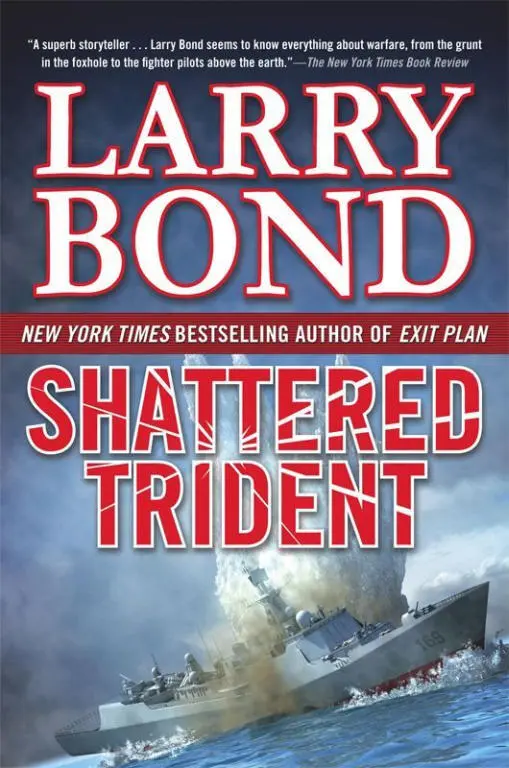
- Название:Shattered Trident
- Автор:
- Издательство:Forge Books
- Жанр:
- Год:2013
- Город:New York
- ISBN:978-0-7653-3147-2
- Рейтинг книги:5 / 5. Голосов: 1
-
Избранное:Добавить в избранное
- Отзывы:
-
Ваша оценка:
Shattered Trident: краткое содержание, описание и аннотация
Предлагаем к чтению аннотацию, описание, краткое содержание или предисловие (зависит от того, что написал сам автор книги «Shattered Trident»). Если вы не нашли необходимую информацию о книге — напишите в комментариях, мы постараемся отыскать её.
is shocked to see the Chinese boat torpedo a Vietnamese merchant ship.
This blatant act of aggression is the opening gambit in a war that has blindsided the U.S. and quickly embroiled all nations in the western Pacific. These nations, bound together in the newly formed Littoral Alliance, have begun a covert submarine campaign aimed at crippling China’s economy before China can set in motion its own plot to dominate the region.
In a desperate attempt to buy the president enough time to resolve the crisis diplomatically, Mitchell’s submarine squadron is ordered to interfere with attacks by both sides. China and the Littoral Alliance are both determined to win, no matter the cost, and as each side increases the level of violence, they approach a dangerous tipping point. In a race against time, the submarines of Mitchell’s squadron must execute their mission before the world witnesses an economic catastrophe—or worse, a nuclear exchange.
Shattered Trident — читать онлайн бесплатно полную книгу (весь текст) целиком
Ниже представлен текст книги, разбитый по страницам. Система сохранения места последней прочитанной страницы, позволяет с удобством читать онлайн бесплатно книгу «Shattered Trident», без необходимости каждый раз заново искать на чём Вы остановились. Поставьте закладку, и сможете в любой момент перейти на страницу, на которой закончили чтение.
Интервал:
Закладка:
As the Mark 48’s icon merged with the one representing the Luyang I, Jerry turned toward the starboard VLSD. Suddenly a large white disk jumped up beneath the destroyer, as the explosive shock wave reflected off the sea surface. Two grayish pulses soon followed, the second one ripping its way through the destroyer’s hull and climbing high into the sky. Mortally wounded, the ship wallowed as her forward motion came to an abrupt stop. The Jiangwei II frigate peeled off hard to port, accelerating. Jerry could only imagine the fear they were feeling after seeing their larger brother blown in two. No one in control cheered.
Halleck didn’t bother reporting on the demise of Sierra-six three; his mind was on Santa Fe . His tense shoulders leapt forward quickly, his eyes and ears straining to pull information from the acoustic sensors. “Skipper! One of the ATTs hit!” he shouted excitedly.
“Yesss!” hissed Thigpen. An anti-torpedo torpedo had just taken out one of the Yu-7s. Just one more weapon to evade, but it was not meant to be.
Halleck’s face suddenly scrunched up, contorted with grief. His report was superfluous. “Loud explosion bearing zero three one. I… I hear breaking-up noises. Loss of propulsion plant tonals…”
Jerry reached over and gently squeezed the sonar supervisor’s shoulder. “Enough, Chief,” he added quietly. A depressing silence descended on the control room. Many of the men had tears welling, two of the young women were openly weeping. Thigpen fought to retain control. “What about the frigate?” the XO asked, his voice shaky.
Jerry shook his head. “Let it go. Sinking it won’t bring Halsey and his crew back. Set course for Guam.”
20. INDECISION
9 September 2016
0100 Local Time
White House Situation Room
Washington, D.C.
“The second wave of missiles did the real damage.” The air force colonel was running through the slides a little too quickly. It was hard to see details in the photos, but the colonel’s point was still well made. “With the alliance nations still putting out fires from the first ballistic missile strike early this morning local time, China followed up with a second salvo around noon that concentrated entirely on economic and political targets. And they used twice as many missiles,” the briefer explained.
The colonel pressed his controller, and a map of Tokyo replaced ground-level photos of what had been the Tokyo Stock Exchange. “Second Artillery launched seventy-two DF-21s at Japan, and as far as we can tell, every one was aimed at something in Tokyo. They used supporting air- and submarine-launched cruise missile attacks again, designed to disrupt the Japanese air defenses, but with less success. The Japanese were ready for them this time.”
The colonel’s dress blues had the customary “fruit salad” on the left, showing long and distinguished service. The name tag on the right side of his uniform blouse read CHAMBERS. He was not wearing pilot’s wings, however. Instead, on the left, under the rows of decorations, was a stylized silver rocket, surrounded by a wreath, with a star on top. The Master Missile Operations badge was awarded to officers with at least nine years’ experience in operational ballistic missile units. This was a new kind of war, with different skills required.
“Because their missiles were concentrated in one small sector, the Chinese were able to overwhelm the batteries defending Tokyo. The Japanese had another missile ship damaged by the supporting attacks, but altogether the defenders destroyed fourteen incoming hostiles. That left sixty missiles with six-hundred-kilogram warheads hitting the city, and the Chinese chose places where it was impossible to not hit something.”
He pointed to a cluster of yellow dots. “For example, of the nine missiles aimed at the Tokyo Stock Exchange, four fell on the exchange proper, effectively leveling the building. One landed a little to the southwest, flattening a securities company, two to the north shattered an elevated expressway that is a major traffic artery, and one outlier to the west collapsed a high-rise apartment building. Casualties from this one cluster of hits alone are going to be in the high hundreds, at least.
“In addition to the stock exchange, the Chinese targeted the Tokyo Shinkansen train station, the busiest in Japan, the National Diet Building with five warheads, the business district in Marunouchi, and the Tokyo Bay Aqualine. It’s a bridge-tunnel across Tokyo Bay, and although they didn’t get a direct hit, the warheads acted like depth charges and collapsed the underwater tunnel.
“It was the same story in other countries. According to our best accounting, Seoul was hit with thirty-two missiles, Taipei with forty-seven, Manila with thirty-three. A total of at least twenty-two Chinese IRBMs were shot down by national air defenses and the U.S. units at Clark Field.
“Aside from the Chinese ballistic missile strikes, the three ocean basins—the South China Sea, East China Sea, and Yellow Sea—are all battlefields. Strike aircraft and submarines hit anything flying the other side’s flags. The Chinese are even strafing alliance-flagged fishing craft. But they’re keeping most of their fighters close to home to block alliance air and cruise missile raids.
“The Chinese ground offensive in Vietnam is all about speed. They’re taking heavy casualties, but they’re making decent progress, better than they did in 1979. They’ve committed six group armies to the initial assault wave, that’s approximately equivalent to sixteen divisions. There are another three group armies marshaling in the rear area, and we’ve seen indications several more are getting ready to transfer to the Guangzhou military region. The Vietnamese are putting up a good fight, but they were pounded by Chinese air attacks for several days before the invasion began. The terrain is probably Vietnam’s best defense. It is very unfriendly to heavy mechanized units.
“And of course, the cyber attacks and the sabotage continue.”
Colonel Chambers’s last slide showed the seal of the CJCS with the word QUESTIONS.
“Are any of the alliance nations retaliating?” President Myles asked.
“South Korea, Vietnam, and India have land-attack cruise missiles, but they haven’t targeted Chinese cities, either before or after these attacks. They’ve been aimed at China’s oil infrastructure: refineries, storage areas, even a company involved in experimental oil extraction techniques. The entire alliance remains focused on the Chinese oil supply.”
Senator Frank Weitz asked, “Colonel, you didn’t say how many civilian casualties you think the alliance countries suffered.”
Chambers sighed. “It would be an estimate, Senator, and probably a poor one. It’s only been three hours since the second wave landed. We don’t even have firm casualty figures for the first set of attacks. The missiles hit on a workday morning. The commercial and business establishments were fully occupied. The roads and trains were full, although it wasn’t rush hour. Certainly thousands of souls have been killed in each city, with several times that wounded. We haven’t seen anything like this since the mass bombing raids of World War Two.”
Malcolm Geisler, the secretary of defense, asked, “Why did the Chinese change their tactics between the two raids?”
“As I mentioned earlier, it enabled them to swamp the defenses in one narrow sector. I believe it was also a correction of their targeting philosophy. The Chinese don’t have an infinite number of missiles, and in the first wave, some shots simply missed their targets and were effectively wasted.
“A DF-21C has a fifty percent chance of striking within a hundred and thirty feet of its target. For example, the Chinese fired four missiles at the Leshan Mountain ABM radar in Taiwan. One hit and damaged some of the outbuildings, but the other three were clean misses. Military targets are small, and often designed to resist damage. Civilian targets are not.” Chambers sounded grim.
Читать дальшеИнтервал:
Закладка:
Похожие книги на «Shattered Trident»
Представляем Вашему вниманию похожие книги на «Shattered Trident» списком для выбора. Мы отобрали схожую по названию и смыслу литературу в надежде предоставить читателям больше вариантов отыскать новые, интересные, ещё непрочитанные произведения.
![Никки Сикс - Героиновые дневники. Год из жизни павшей рок-звезды[The Heroin Diaries - A Year in the Life of a Shattered Rock Star]](/books/78612/nikki-siks-geroinovye-dnevniki-god-iz-zhizni-pavshej-rok-zvezdy-the-heroin-diaries-a-yea-thumb.webp)




Обсуждение, отзывы о книге «Shattered Trident» и просто собственные мнения читателей. Оставьте ваши комментарии, напишите, что Вы думаете о произведении, его смысле или главных героях. Укажите что конкретно понравилось, а что нет, и почему Вы так считаете.