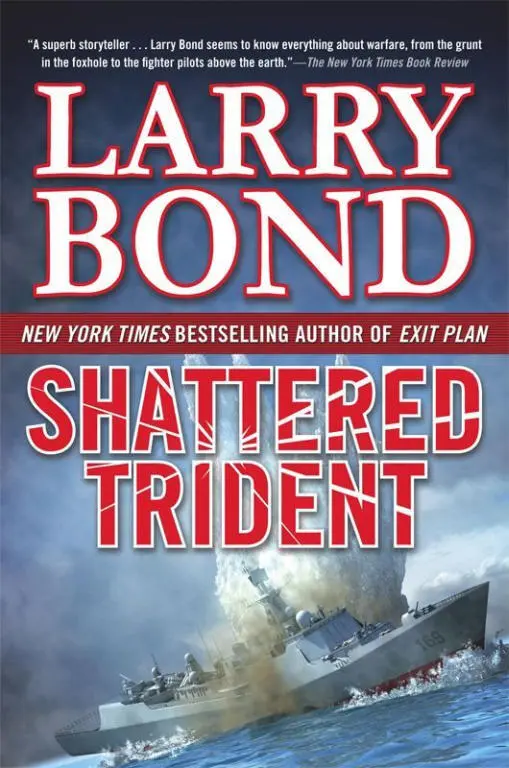
Larry Bond - Shattered Trident
Здесь есть возможность читать онлайн «Larry Bond - Shattered Trident» весь текст электронной книги совершенно бесплатно (целиком полную версию без сокращений). В некоторых случаях можно слушать аудио, скачать через торрент в формате fb2 и присутствует краткое содержание. Город: New York, Год выпуска: 2013, ISBN: 2013, Издательство: Forge Books, Жанр: prose_military, thriller_techno, на английском языке. Описание произведения, (предисловие) а так же отзывы посетителей доступны на портале библиотеки ЛибКат.
- Название:Shattered Trident
- Автор:
- Издательство:Forge Books
- Жанр:
- Год:2013
- Город:New York
- ISBN:978-0-7653-3147-2
- Рейтинг книги:5 / 5. Голосов: 1
-
Избранное:Добавить в избранное
- Отзывы:
-
Ваша оценка:
Shattered Trident: краткое содержание, описание и аннотация
Предлагаем к чтению аннотацию, описание, краткое содержание или предисловие (зависит от того, что написал сам автор книги «Shattered Trident»). Если вы не нашли необходимую информацию о книге — напишите в комментариях, мы постараемся отыскать её.
is shocked to see the Chinese boat torpedo a Vietnamese merchant ship.
This blatant act of aggression is the opening gambit in a war that has blindsided the U.S. and quickly embroiled all nations in the western Pacific. These nations, bound together in the newly formed Littoral Alliance, have begun a covert submarine campaign aimed at crippling China’s economy before China can set in motion its own plot to dominate the region.
In a desperate attempt to buy the president enough time to resolve the crisis diplomatically, Mitchell’s submarine squadron is ordered to interfere with attacks by both sides. China and the Littoral Alliance are both determined to win, no matter the cost, and as each side increases the level of violence, they approach a dangerous tipping point. In a race against time, the submarines of Mitchell’s squadron must execute their mission before the world witnesses an economic catastrophe—or worse, a nuclear exchange.
Shattered Trident — читать онлайн бесплатно полную книгу (весь текст) целиком
Ниже представлен текст книги, разбитый по страницам. Система сохранения места последней прочитанной страницы, позволяет с удобством читать онлайн бесплатно книгу «Shattered Trident», без необходимости каждый раз заново искать на чём Вы остановились. Поставьте закладку, и сможете в любой момент перейти на страницу, на которой закончили чтение.
Интервал:
Закладка:
INS Chakra
“Captain! Confirm American BQQ-10 sonar, bearing two one zero. Matches bearing to contact eight seven, range eight thousand seven hundred meters and closing rapidly!” The sonar officer sounded ruffled over the intercom.
“Solution status, Number One,” barked Samant.
“Contact is pointed right at us. Course, zero three zero, speed, thirty-two knots. Solution is ready!”
“Set torpedo course, two two zero.”
“Course set!” Jain replied.
Samant nodded. “Stand by… FIRE!”
Inside tube number eight, a Russian UGST torpedo was violently expelled by a sudden wave of fast-moving water. At first, it coasted downward in a shallow arc as the onboard computer started up the engine. Once up to speed, the torpedo turned hard to port and began climbing back to its ordered depth. Soon it was roaring toward the American submarine at fifty knots.
USS North Dakota
Jerry and Thigpen looked at the command display. The active sonar had no trouble detecting the Akula. It was just a little under 9,500 yards away, moving slowly to the northwest.
“Ping him again, XO. Let’s make him feel uncomfortable about staying here.”
“Aye, Skipper. Sonar, go active on Sierra-five two, three more pulses,” ordered Thigpen. Once again, three pulses went out, and three good returns were detected. But the Indian wasn’t reacting; his course and speed were unchanged.
“Nothin’, Skipper,” Thigpen grunted. “He’s ignoring us.”
“He’s a cool one, that’s for sure. I think he knows he’ll be able to launch his second salvo before we can get too close.”
“He certainly is a cheeky fellow,” remarked Thigpen.
Jerry ignored his XO’s comment, choosing instead to focus his thoughts on his alternate number. The man knew how to handle his boat; of that there was no doubt. But what was he like? Where did he get his education, his training? What motivated him? All these questions, and more, swirled around in Jerry’s head. And all of them were, at the moment, unanswerable.
“Skipper, you want me to hit him again?” Thigpen’s question jerked Jerry from his musings. He’d have to deal with his questions later.
“Yes, XO, but this time, hammer him. Go continuous, keep pinging him,” Jerry said resolutely.
“Aye, sir. Sonar, go continuous active on Sierra-five two.”
Jerry’s head snapped up immediately; he didn’t hear the expected repeat-back of the XO’s order. Looking toward the sonar station, he saw the supervisor and a senior sonarman staring intently at the same screen. Thigpen saw it too.
“Talk to me, Sonar Supervisor,” the XO demanded.
“XO, there’s another contact in the general direction of Sierra-five two. It’s hard to make out with all the flow noise on the towed arrays, but there is definitely something out there.”
“Petty Officer Andersen, do I need to start being worried?” Jerry was able to sound calm, but his heartbeat had just shot way up.
“I’m not sure, sir. It kind of looks like…” The sonar supervisor stopped in mid-sentence as another set of faint lines showed up on his display. After some quick manipulations of the controls, the lines were enlarged and matched against the acoustic database—a flashing red “Torpedo Warning” indicator popped on the screen. Andersen’s face went white.
“Torpedo in the water! Same bearing as Sierra-five two!” he shouted.
“Captain has the conn,” thundered Jerry. “Pilot, right standard rudder, steady on course…” He paused as he looked quickly at the geoplot on the big screen. “… one four zero, maintain flank speed. Torpedo defense, launch an ADC Mark 5 and mobile decoy, standby ATT.”
North Dakota heeled sharply to starboard as the rudder kicked over. Even with fly-by-wire controls, the submarine rolled heavily into the turn, vibrating noticeably as she swung around. Jerry knew speed was his main advantage, and he’d intentionally used less rudder to keep his speed up. The only indication that the countermeasure and mobile decoy had been launched was the blinking of icons on the large display screen. For a few tense minutes, everyone held on in silence, with only the sonar supervisor’s reports breaking the tense quiet.
Finally, he called out, “Captain, torpedo has passed CPA and is opening. Whew! ”
A collective sigh of relief was heard throughout control.
“Sonar, did the weapon ever enable?” Jerry asked tersely.
“I don’t know for sure, Skipper. I don’t think it went active, but we had the ADC pretty much in our field of view during the whole turn. We could have missed it.”
“Very well.” Jerry was unconvinced; he knew his sonar operators were good. And it would be unlike them to miss something so loud as an active torpedo seeker even with the countermeasure in the way. Turning toward the rest of the control room watchstanders, he announced loudly, “Attention in Control. I intend to stay on this course for a little longer, then we’ll slow and take a look around. I don’t believe the Akula will pursue us, but we can’t afford to make that assumption, so stay sharp, everyone. Carry on.”
Thigpen pulled up beside Jerry. “I can’t believe that son-of-a-bitch fired at us! We’re lucky he misjudged the distance, the weapon probably enabled after it passed us.”
Jerry laughed cynically. “He didn’t misjudge anything, Bernie. He’s too good to make that kind of mistake. He deliberately fired the torpedo with the seeker off. A warning shot, with a very clear message—keep off the grass.”
“What do we do now, Skipper?”
“We report in, XO,” stated Jerry flatly. “The rules of this weird game appear to have changed yet again, and we need to let our bosses know. You have the conn. I’ll be in the radio room if you need me.”
9 September 2016
0145 Local Time
Squadron Fifteen Headquarters
Guam
Simonis took a healthy slurp of coffee while he read the initial intelligence reports on the missile attacks. It didn’t look good. He’d been called at his residence as soon as NORAD put out the warning. Fifteen minutes later he was in his office. His staff came in dribs and drabs a few minutes behind him. After a quick review of the situation, the CSO sent half the staff back home, but not before announcing that they were now on a port and starboard watch rotation. A sharp knock at the door pulled Simonis’s attention from the reports. His operations officer was in the doorway with a carafe in his hand.
“Need a recharge, Commodore?”
“Sure, Rich, come on in.”
Walker strode over and poured fresh hot coffee into Simonis’s half-empty mug.
“Did you see these reports?” Simonis inquired, pointing to the intel assessments.
“Yes, sir. It would appear this war is taking a turn for the worse.”
“Ha!” Simonis blurted. “Mr. Walker, you are a master of the understatement!” The commodore picked up the last report and read from its key judgments.
“At 1710 Zulu time PLA Second Artillery units executed multiple ballistic missile strikes against targets in Japan, Taiwan, South Korea, and the Philippines. While ballistic missile defenses were moderately effective, numerous missiles still reached their targets. Moderate to heavy casualties are expected.”
Simonis threw the paper back down onto his desk. “That’s not just a turn for the worse, Mr. Walker. It’s the first step on a very slippery slope that will lead to a nuclear exchange!”
The operations officer was surprised by Simonis’s fierce outburst. The attack on the Littoral Alliance nations was shocking, to be sure, but they were still limited, given China’s conventional ballistic missile capability. If China really wanted to plaster the targets they were after, the strikes would have been much larger. Furthermore, the attacks were largely on legitimate alliance military and oil infrastructure facilities—missile strikes on civilian population centers were a rare occurrence. In the operations officer’s mind, this attack was long overdue, a logical reaction to Littoral Alliance cruise missile attacks on Chinese oil refineries and tank farms.
Читать дальшеИнтервал:
Закладка:
Похожие книги на «Shattered Trident»
Представляем Вашему вниманию похожие книги на «Shattered Trident» списком для выбора. Мы отобрали схожую по названию и смыслу литературу в надежде предоставить читателям больше вариантов отыскать новые, интересные, ещё непрочитанные произведения.
![Никки Сикс - Героиновые дневники. Год из жизни павшей рок-звезды[The Heroin Diaries - A Year in the Life of a Shattered Rock Star]](/books/78612/nikki-siks-geroinovye-dnevniki-god-iz-zhizni-pavshej-rok-zvezdy-the-heroin-diaries-a-yea-thumb.webp)






Обсуждение, отзывы о книге «Shattered Trident» и просто собственные мнения читателей. Оставьте ваши комментарии, напишите, что Вы думаете о произведении, его смысле или главных героях. Укажите что конкретно понравилось, а что нет, и почему Вы так считаете.