Larry Bond - Shattered Trident
Здесь есть возможность читать онлайн «Larry Bond - Shattered Trident» весь текст электронной книги совершенно бесплатно (целиком полную версию без сокращений). В некоторых случаях можно слушать аудио, скачать через торрент в формате fb2 и присутствует краткое содержание. Город: New York, Год выпуска: 2013, ISBN: 2013, Издательство: Forge Books, Жанр: prose_military, thriller_techno, на английском языке. Описание произведения, (предисловие) а так же отзывы посетителей доступны на портале библиотеки ЛибКат.
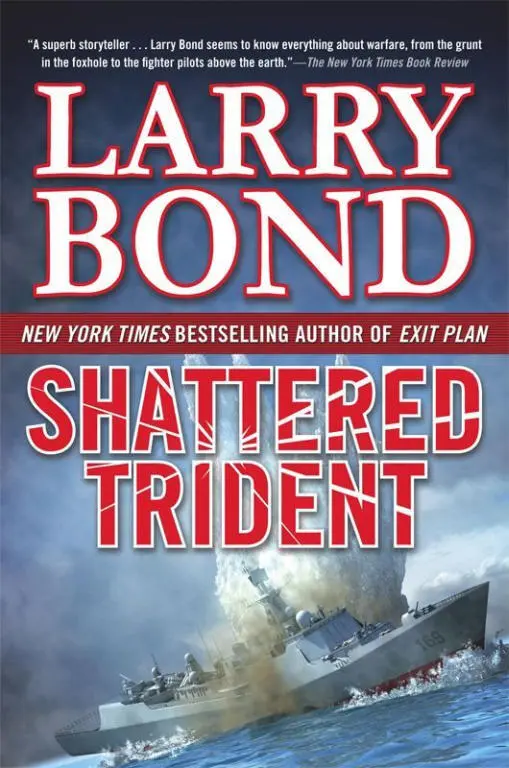
- Название:Shattered Trident
- Автор:
- Издательство:Forge Books
- Жанр:
- Год:2013
- Город:New York
- ISBN:978-0-7653-3147-2
- Рейтинг книги:5 / 5. Голосов: 1
-
Избранное:Добавить в избранное
- Отзывы:
-
Ваша оценка:
Shattered Trident: краткое содержание, описание и аннотация
Предлагаем к чтению аннотацию, описание, краткое содержание или предисловие (зависит от того, что написал сам автор книги «Shattered Trident»). Если вы не нашли необходимую информацию о книге — напишите в комментариях, мы постараемся отыскать её.
is shocked to see the Chinese boat torpedo a Vietnamese merchant ship.
This blatant act of aggression is the opening gambit in a war that has blindsided the U.S. and quickly embroiled all nations in the western Pacific. These nations, bound together in the newly formed Littoral Alliance, have begun a covert submarine campaign aimed at crippling China’s economy before China can set in motion its own plot to dominate the region.
In a desperate attempt to buy the president enough time to resolve the crisis diplomatically, Mitchell’s submarine squadron is ordered to interfere with attacks by both sides. China and the Littoral Alliance are both determined to win, no matter the cost, and as each side increases the level of violence, they approach a dangerous tipping point. In a race against time, the submarines of Mitchell’s squadron must execute their mission before the world witnesses an economic catastrophe—or worse, a nuclear exchange.
Shattered Trident — читать онлайн бесплатно полную книгу (весь текст) целиком
Ниже представлен текст книги, разбитый по страницам. Система сохранения места последней прочитанной страницы, позволяет с удобством читать онлайн бесплатно книгу «Shattered Trident», без необходимости каждый раз заново искать на чём Вы остановились. Поставьте закладку, и сможете в любой момент перейти на страницу, на которой закончили чтение.
Интервал:
Закладка:
“Not even a Chinese sub?”
“No, sir, not that we can see. And we’ve had no problem picking up lots of transients and strong tonals from Chinese boats long before we get broadband contact.”
“So, if it isn’t a surface ship, or another submarine, then…” Jerry just stopped, letting his statement dangle. He had a coaxing expression on his face, pushing his XO to finish the thought. Thigpen caught on immediately.
“Wait a minute, are you suggesting…”
“That’s what I’m thinking.”
“Oh, shit,” Thigpen uttered quietly.
“Yup, that’s about right,” concluded Jerry.
Lymburn looked back and forth at the two men, totally confused by their cryptic conversation. “What!?” she exclaimed. “What’s the matter… sirs?”
Thigpen held up his left hand, signaling for her to wait. “Patience, Grasshopper,” he said as he pivoted back toward the command workstation. “Pilot, right full rudder, steady on course zero five zero. All ahead standard.”
As the pilot responded to the orders, Thigpen grabbed an interior communications handset and punched in the number for the engineering officer of the watch. “Maneuvering, Conn. Shift reactor coolant pumps to fast speed. Stand by for flank bell.”
North Dakota heeled slightly as she accelerated through the turn. Swinging toward the contact, and gradually picking up speed, she began to close the distance.
Thigpen shook his head as he looked at the electronic plot on the port VLSD. He was not happy with the geometry. Glancing over to Jerry, he said, “Assuming it’s our friend, and assuming he’s still headed in a northerly direction, I’m biasing us to come in behind her. But I really dislike putting whatever it is in the towed arrays’ forward beam. Our bearing data will suck.”
“Do we have a choice?” Jerry asked stoically.
Thigpen sighed. “No, sir.”
“Then we don’t have a problem, XO.”
“Yes, sir,” he replied. Then more defiantly added, “But I still don’t have to like it.”
Jerry rolled his eyes; Thigpen was just being stubborn. “Very well, XO, permission granted to not like it.”
“Thank you, sir,” replied Thigpen, satisfied.
Lymburn, sensing a break, moved closer. “Captain, XO, I still don’t understand what’s going on.”
“Ah, yes, sorry about that, Q,” Thigpen apologized. “Here’s the deal. We think Sierra-five two is the Indian Akula. If so, then the mechanical transients we’ve detected are likely torpedo tube preparations. As we hold no other contacts near the bearing, the Skipper is guessing that our friend out there is about to…”
“Launch transients!” sang out the sonar supervisor abruptly. “One weapon… two, solid rocket ignition. XO, Sierra-five two is launching missiles.”
“…launch missiles,” said Thigpen dryly, completing his sentence. He then leaned forward, and acknowledged the report. “Very well, Sonar Supervisor. Did we get a range?”
“No, sir. Sierra-five two is still in the wide aperture arrays’ baffles. Contact is drawing left, bears zero three five.”
“Sonar, were you able to get a weapon count?” interrupted Jerry.
“Not a good one, Skipper. At least two missiles, probably more. The noise from the rocket motors drowned everything else out.”
“Orders, Skipper?” asked Thigpen.
“He’s not done yet, he’s probably reloading for another salvo,” Jerry opined. “Time to let him know we’re here, XO. Put the spurs to her.”
“Aye, aye, sir!” Thigpen responded enthusiastically. “Pilot, left standard rudder, steady course zero three five, all ahead flank. Sonar, stand by to go active on Sierra-five two.”
INS Chakra
“First missile salvo launch complete, Captain. Bow caps are closed on tubes one through six, and the loading of the second salvo is under way,” reported Jain.
“Very good, Number One, but tell the boys in the bomb shop to be quick about it. We just broadcasted our location to the world, and I have no desire to tarry here more than is absolutely necessary,” Samant demanded.
“Aye, Captain.”
Samant was pleased. They’d gotten off the first six land-attack cruise missiles without a hitch, and the loading of the second salvo was well under way. In another few minutes, he’d be finished launching the last of the twelve-missile strike. Some fifteen minutes later, the oil refinery at Beihai would receive a very nasty surprise. The Chinese undoubtedly expected any Littoral Alliance cruise missile that used GPS or Glonass to miss their target. How ironic that their own satellite navigation system would foil their plan. He reveled in the fact that this was the first strategic strike by an Indian submarine on Chinese soil; his place in the history books would now be secured. But Samant had little time to fully appreciate his achievement, as the intercom speaker suddenly blared.
“New contact, number eight seven, bearing two one eight. Contact is submerged and closing at high speed!”
Damn the American! cursed Samant silently. It had to be him; they would have surely heard a noisy Chinese SSN long before now. Samant’s patience was exhausted, the American had become more than a mere nuisance and he intended to deal with this interloper once and for all.
“Number One, begin tracking the new contact. Stand by for rapid-fire torpedo attack, tube eight.”
Jain looked incredulous, he seemed confused by the order. Samant didn’t appreciate his hesitation. “You heard me, Number One. Prepare to attack contact eight seven.”
“Captain,” replied Jain forcefully. “With respect, sir, I must remind you that we are not authorized to fire on any American vessel.”
Samant was irritated on the one hand by his first officer’s response, but impressed on the other. Jain was proving to be a fast learner. He’d already figured out the likely identity of the new contact.
“Very well, Number One,” Samant conceded with a slight smile. “Would you condone a warning shot?”
“A warning shot, sir? With a torpedo?” Jain sounded incredulous.
“Yes, Mr. Jain,” answered Samant, using the first officer’s name to reassert his authority. “We’ll fire a single torpedo, but the seeker will be disabled and we’ll offset the weapon ten degrees to starboard. That should suffice to make it impossible for the torpedo to hit the American submarine.”
“It’s still bending the rules a bit, sir,” said Jain carefully. “But given the circumstances, I believe a review by a higher authority will find it acceptable.”
“Splendid!” cried Samant. “Track contact eight seven, stand by for deliberate torpedo fire. Disable the seeker on the torpedo in tube eight.”
“Torpedo seeker is disabled, Captain. And tubes one through six are loaded, rear doors are secured,” reported the primary fire control operator.
“Bring tubes one through six to action state, and open the bow caps.” Samant picked up the intercom microphone and selected the sonar room. “Sonar, go active on the port flank array, three pulses.”
USS North Dakota
The alarm from the WLY-1 acoustic intercept receiver beat the sonar supervisor by only a couple of seconds. “Skat-3 transmissions, three pulses, correlates with Sierra-five two, classify the contact as an Akula class SSN.”
“Answer in kind, XO,” Jerry commanded.
“Aye, sir. Sonar, go active on Sierra-five two, three pulses.”
Three invisible, but intense sound waves shot out from North Dakota ’s active conformal array. Upon reaching the Indian submarine, the sound waves bounced off the air-filled pressure hull. Even though the Akula was covered in anechoic coating, the sub was too close for the coating to have a significant effect. North Dakota ’s passive conformal array got three good returns.
Читать дальшеИнтервал:
Закладка:
Похожие книги на «Shattered Trident»
Представляем Вашему вниманию похожие книги на «Shattered Trident» списком для выбора. Мы отобрали схожую по названию и смыслу литературу в надежде предоставить читателям больше вариантов отыскать новые, интересные, ещё непрочитанные произведения.
![Никки Сикс - Героиновые дневники. Год из жизни павшей рок-звезды[The Heroin Diaries - A Year in the Life of a Shattered Rock Star]](/books/78612/nikki-siks-geroinovye-dnevniki-god-iz-zhizni-pavshej-rok-zvezdy-the-heroin-diaries-a-yea-thumb.webp)






Обсуждение, отзывы о книге «Shattered Trident» и просто собственные мнения читателей. Оставьте ваши комментарии, напишите, что Вы думаете о произведении, его смысле или главных героях. Укажите что конкретно понравилось, а что нет, и почему Вы так считаете.