Larry Bond - Shattered Trident
Здесь есть возможность читать онлайн «Larry Bond - Shattered Trident» весь текст электронной книги совершенно бесплатно (целиком полную версию без сокращений). В некоторых случаях можно слушать аудио, скачать через торрент в формате fb2 и присутствует краткое содержание. Город: New York, Год выпуска: 2013, ISBN: 2013, Издательство: Forge Books, Жанр: prose_military, thriller_techno, на английском языке. Описание произведения, (предисловие) а так же отзывы посетителей доступны на портале библиотеки ЛибКат.
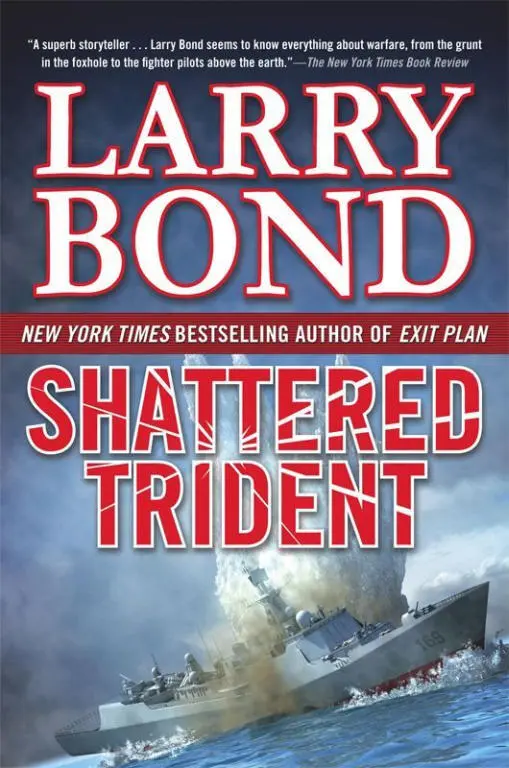
- Название:Shattered Trident
- Автор:
- Издательство:Forge Books
- Жанр:
- Год:2013
- Город:New York
- ISBN:978-0-7653-3147-2
- Рейтинг книги:5 / 5. Голосов: 1
-
Избранное:Добавить в избранное
- Отзывы:
-
Ваша оценка:
Shattered Trident: краткое содержание, описание и аннотация
Предлагаем к чтению аннотацию, описание, краткое содержание или предисловие (зависит от того, что написал сам автор книги «Shattered Trident»). Если вы не нашли необходимую информацию о книге — напишите в комментариях, мы постараемся отыскать её.
is shocked to see the Chinese boat torpedo a Vietnamese merchant ship.
This blatant act of aggression is the opening gambit in a war that has blindsided the U.S. and quickly embroiled all nations in the western Pacific. These nations, bound together in the newly formed Littoral Alliance, have begun a covert submarine campaign aimed at crippling China’s economy before China can set in motion its own plot to dominate the region.
In a desperate attempt to buy the president enough time to resolve the crisis diplomatically, Mitchell’s submarine squadron is ordered to interfere with attacks by both sides. China and the Littoral Alliance are both determined to win, no matter the cost, and as each side increases the level of violence, they approach a dangerous tipping point. In a race against time, the submarines of Mitchell’s squadron must execute their mission before the world witnesses an economic catastrophe—or worse, a nuclear exchange.
Shattered Trident — читать онлайн бесплатно полную книгу (весь текст) целиком
Ниже представлен текст книги, разбитый по страницам. Система сохранения места последней прочитанной страницы, позволяет с удобством читать онлайн бесплатно книгу «Shattered Trident», без необходимости каждый раз заново искать на чём Вы остановились. Поставьте закладку, и сможете в любой момент перейти на страницу, на которой закончили чтение.
Интервал:
Закладка:
There was plenty for them to talk about. Hunts for foreign spies, industrial sabotage, the losses at sea, and now energy shortages all powered the rumor machine. The new fuel rationing system was already corrupt, rife with hoarders and profiteers.
Protests and riots were endemic, with no relief in sight. Ethnic groups like the Uyghurs in Xinjiang province and Tibetans were restive. Dissidents throughout the country were quick to claim that the communist party’s ambitions in the South China Sea had started the war. The information supporting that argument had come from outside China.
General Shi was still explaining, but Chen cut him off. “Comrades, I believe General Shi is right, and becomes more right with each passing moment. Does anyone else wish to comment?”
A few shook their heads, and others muttered their agreement with Shi.
Chen waited for a full minute, then said, “General Shi, your recommendation is accepted. Will you please give the necessary orders?” Shi nodded and left quickly, almost at a run. Chen was sure it was the right thing to do, but why did it feel like another loss? Damnit, he was still shaking off the news about Taiwan.
General Su, the chief of staff, stated flatly, “We have to change our grand strategy.” When there was no immediate agreement, Su explained, “I’m a soldier. We’re trained to make an estimate of the situation, evaluate possible courses of action, and then choose the best one. My estimate of our situation is that we are losing this war. The trends are all in the wrong direction. What do we do about this?”
Chen answered him. “There are only two choices. We either agree to a cease-fire, which amounts to a surrender, or escalate.”
There was dead silence in the room as the others absorbed the idea. Chen reasoned, “We must evaluate both courses before we choose. Adopting either one has benefits, and costs.
“To remove the risk of anyone being accused of disloyalty or defeatism, I will discuss the benefits of a cease-fire. The damage to our economy stops. Oil begins flowing again. The losses of equipment and men cease. What are the costs, Comrades?” He gestured to the others at the table.
Zhang said, “Unbelievable loss of prestige. The world would accuse us of being a failed superpower.”
“The failure of Trident,” General Su added.
“But the plan has already failed,” General Ye Jin countered. “We will never be able to exploit the South China Sea’s resources, as we had planned.”
“We could use a cease-fire to mobilize and reposition our forces, then aim for a more limited objective,” General Wen suggested.
Su quickly shook his head. “It won’t work, Minister. Trident depended on surprise, on getting strong forces in place before our opponents could react. I don’t think anyone here truly appreciated just how vital a factor surprise was.”
Zhang added, “And we didn’t expect such a unified response. The sudden appearance of the Littoral Alliance has completely changed the political calculus in this region. If we had known of its existence, would we have even started the operation?”
“That is not the issue, Generals,” Chen insisted. “What are the costs to China of a cease-fire?”
Zhang looked thoughtful. “I’ve already mentioned the loss of prestige abroad. Domestically, we face widespread unrest. Energy supplies will be tight this winter, even if we restart imports immediately. Many industries are damaged, and our export markets will be lost for years, perhaps a decade. Unemployment, especially in the cities, will rise sharply.”
“The best we can all hope for, personally, is resignation,” Chen observed, “followed by a retirement in disgrace. That may not be the end of it, though. The next government will be looking for ways to assuage the citizens’ anger. Accusations of criminal conduct and show trials are one method of placating the masses.” Chen had stated the uncomfortable truth. Nobody expected justice in China, unless it served the party’s purposes.
“Our economy crumbling, our citizens angry, the world turned against us. Regardless of my own fate, this is not what I dreamt of for China.” Zhang’s voice was hard. “If this is the aftermath of a cease-fire, then we must keep fighting.”
“But we cannot win,” Su reminded him. “The South China Sea is lost to us.”
“Then we change the war,” Zhang explained. “Instead of three or four countries, we are fighting an expanding coalition that now encircles us. We must recognize our new situation.”
Chen asked, “Then what is our goal? How do we win?”
Zhang replied, “We bring enough force to bear to make them ask for a cease-fire, on our terms. We demand free passage of the ocean straits and removal of all economic sanctions.
“They haven’t faced our full power yet. We’ve limited ourselves because of the military ties some countries have with the United States. We know America doesn’t want this war. There’s pressure in the American government to renounce the treaties. Let’s call the alliance’s bluff.”
“We change the war,” Chen repeated, testing the idea in his mind. “A full range of attacks against all alliance members, short of nuclear weapons. We remove the restrictions we’ve placed on our submarines. Allow them to attack any alliance shipping—it won’t matter that they’ve disabled the automatic identification system. Any ship approaching an alliance port will be attacked. And we withdraw from the territories in the South China Sea we’ve captured.”
“That was one of the alliance’s demands,” Su reminded him.
“The garrisons on those islands have been under constant siege. They can only be supplied by air, which costs fuel we can’t spare. They are also at considerable risk from Japanese fighters staged in the Philippines.”
Su nodded his agreement. “You’re right. They can be sustained only with great effort, but cannot not be expanded, or exploited for further gain. What about Vietnam?”
“I see no reason to suspend that campaign,” Chen replied. “Indeed, with the cancelation of Trident, we should be able to allocate more resources to that front. And where is General Hu?”
An aide left, in search of the Second Artillery commander. Chen said, “I remember his briefing argued for missile strikes on Japan, South Korea, and the Philippines. He can now add Taiwan to the list.”
8 September 2016
1310 Local Time
North American Air Defense Directorate
Peterson Air Force Base
Colorado Springs, Colorado
They’d been on high alert since word had come from Washington about Taiwan’s decision. Not that they hadn’t been on high alert before, with half the Pacific shooting at the other half.
“Heaven help us, they went and did it!” the controller announced, hitting the audible alarm and calling the duty officer. “Multiple launches from within China!” He didn’t even try to count the dots on the screen. The computer kept track, but the number kept climbing. Finally, he reported, “I’m seeing sixty-plus launches.”
The duty officer, a major, didn’t wait to see where they were headed. They wouldn’t know that until after boost phase ended, a couple of minutes from now.
“Make sure PACOM’s seeing this,” the major ordered as he picked up the red phone. “This is Major Markowitz at NORAD. I have flash traffic for the NMJIC duty officer.”
8 September 2016
1315 Local Time
White House Situation Room
Washington, D.C.
Ray Kirkpatrick was keeping vigil when the word arrived. When he phoned the residence, Myles answered after one ring.
Читать дальшеИнтервал:
Закладка:
Похожие книги на «Shattered Trident»
Представляем Вашему вниманию похожие книги на «Shattered Trident» списком для выбора. Мы отобрали схожую по названию и смыслу литературу в надежде предоставить читателям больше вариантов отыскать новые, интересные, ещё непрочитанные произведения.
![Никки Сикс - Героиновые дневники. Год из жизни павшей рок-звезды[The Heroin Diaries - A Year in the Life of a Shattered Rock Star]](/books/78612/nikki-siks-geroinovye-dnevniki-god-iz-zhizni-pavshej-rok-zvezdy-the-heroin-diaries-a-yea-thumb.webp)



Обсуждение, отзывы о книге «Shattered Trident» и просто собственные мнения читателей. Оставьте ваши комментарии, напишите, что Вы думаете о произведении, его смысле или главных героях. Укажите что конкретно понравилось, а что нет, и почему Вы так считаете.