Larry Bond - Shattered Trident
Здесь есть возможность читать онлайн «Larry Bond - Shattered Trident» весь текст электронной книги совершенно бесплатно (целиком полную версию без сокращений). В некоторых случаях можно слушать аудио, скачать через торрент в формате fb2 и присутствует краткое содержание. Город: New York, Год выпуска: 2013, ISBN: 2013, Издательство: Forge Books, Жанр: prose_military, thriller_techno, на английском языке. Описание произведения, (предисловие) а так же отзывы посетителей доступны на портале библиотеки ЛибКат.
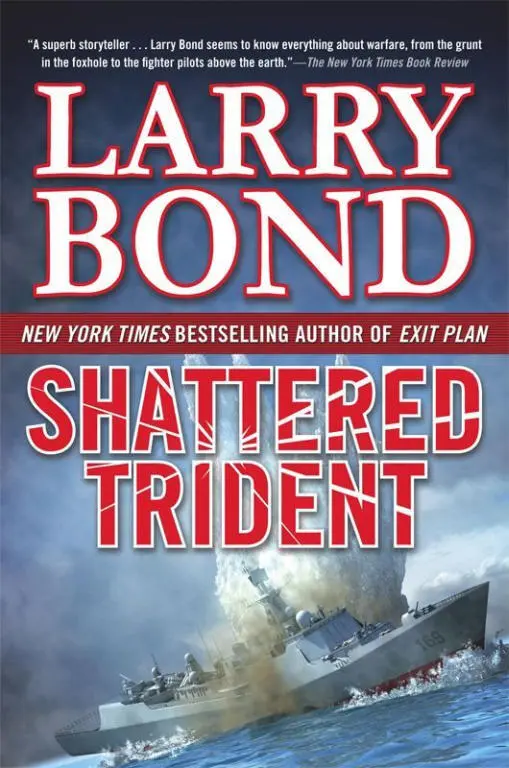
- Название:Shattered Trident
- Автор:
- Издательство:Forge Books
- Жанр:
- Год:2013
- Город:New York
- ISBN:978-0-7653-3147-2
- Рейтинг книги:5 / 5. Голосов: 1
-
Избранное:Добавить в избранное
- Отзывы:
-
Ваша оценка:
Shattered Trident: краткое содержание, описание и аннотация
Предлагаем к чтению аннотацию, описание, краткое содержание или предисловие (зависит от того, что написал сам автор книги «Shattered Trident»). Если вы не нашли необходимую информацию о книге — напишите в комментариях, мы постараемся отыскать её.
is shocked to see the Chinese boat torpedo a Vietnamese merchant ship.
This blatant act of aggression is the opening gambit in a war that has blindsided the U.S. and quickly embroiled all nations in the western Pacific. These nations, bound together in the newly formed Littoral Alliance, have begun a covert submarine campaign aimed at crippling China’s economy before China can set in motion its own plot to dominate the region.
In a desperate attempt to buy the president enough time to resolve the crisis diplomatically, Mitchell’s submarine squadron is ordered to interfere with attacks by both sides. China and the Littoral Alliance are both determined to win, no matter the cost, and as each side increases the level of violence, they approach a dangerous tipping point. In a race against time, the submarines of Mitchell’s squadron must execute their mission before the world witnesses an economic catastrophe—or worse, a nuclear exchange.
Shattered Trident — читать онлайн бесплатно полную книгу (весь текст) целиком
Ниже представлен текст книги, разбитый по страницам. Система сохранения места последней прочитанной страницы, позволяет с удобством читать онлайн бесплатно книгу «Shattered Trident», без необходимости каждый раз заново искать на чём Вы остановились. Поставьте закладку, и сможете в любой момент перейти на страницу, на которой закончили чтение.
Интервал:
Закладка:
“We’d better go back,” Azhar suggested, and the pair headed for the main house.
They could soon hear excited voices, then staff and other alliance functionaries greeted them with broad smiles, and urged them toward the dining room.
The large central room had been filled with tables. A wide-screen television at one end of the room was kept on the news, normally with the sound muted. Komamura could hear the set now, though. “… have taken this action in the belief that Mainland Chinese aggression can no longer…” They were speaking in Chinese, but he could see the text at the bottom scrolling in English, and on the right side in Japanese.
As he stood in the back, someone recognized Komamura and urged him forward. Kubo and Hisagi both spotted the commotion around him and waved. Advancing silently and half crouched, he discovered they’d saved a space for him in the center front, almost too close to the screen. At the back of the room, people continued to pour in, and he could sense an air of celebration. Had the Chinese abruptly surrendered?
Kubo saw the question in his expression and whispered, “The broadcast started exactly on the hour, 9:00 P.M. in Taipei.” Kubo stopped and smiled. It was the happiest he’d ever seen the admiral. “They’ve joined us, sensei ! Taiwan is joining the alliance. Our encirclement is complete!”
Hisagi leaned over from the other side. “I just heard from the communications department. Their delegation to the alliance is already en route. They’ll be landing at Narita in a little over an hour!”
Ever since he’d realized that the alliance might actually come to be, Komamura had struggled with the question of Taiwan. Normally, the more members that belong to an alliance, the stronger it becomes. And Taiwan not only had a small, but capable navy, it had economic power, and was a major trading partner with both Mainland China and the West.
But Beijing still considered Taiwan a “rebellious territory,” part of China. It had long been accepted that if Taipei ever formally declared independence, it would trigger a long-dreaded invasion of the island. This was worse than mere separation. Taiwan had joined in a war against her “mother country.” Beijing would—must—react.
By joining, Taiwan added her military power, economic power, and political power to an already complex set of simultaneous equations. Komamura didn’t think anyone truly could comprehend how all the variables would work together—he certainly did not. How would the results from those equations change?
The professor watched his colleagues. Kubo was almost euphoric. Why couldn’t he share their excitement? All he could see was the danger. Suddenly weak, he sat back in his chair, forcing a smile and trying to follow the subtitles. Information. He needed to know the details.
The Taiwanese minister had finished his prepared remarks, and was answering questions, still in Chinese. The image shrank to an inset and was replaced with two Japanese analysts. Komamura listened to them repeat the obvious facts for a few moments, but then one held up a map of the western Pacific. Tracing arcs with a pen, he drew a single line from Indonesia in the south to Hokkaido in the north, all of it controlled by the Littoral Alliance.
China’s access to the open sea was now completely blocked. She’d tried to seize the resources in the South China Sea, with future designs on the East China Sea. Instead, those two and the Yellow Sea were now war zones.
It was getting harder to find worthwhile targets at sea for the alliance forces to destroy. They’d already started attacking China’s oil processing infrastructure on land, but while the professional military figures agreed with the revered academic publicly, he sensed it was begrudgingly.
The urge to go after military and political targets would become even stronger, now that the alliance had added another three countries to their ranks. The combined militaries of the alliance would not want to wait for the inevitable effects on the Chinese economy. They would ask for new targets, new ways to inflict pain on their enemy.
On the screen, the two journalists were interviewing another journalist about the chances of China suing for peace, now that the Littoral Alliance had grown so strong. Economically, the clock was ticking. The big unknown was the determination of the Chinese leaders. “If they do the math,” the guest was saying, “they know they can’t win. But the men in charge may not want to hear that. They have too much to lose.”
Kubo was right. Taiwan was the final straw.
8 September 2016
2130 Local Time
August 1st Building, Ministry of National Defense Compound
Beijing, People’s Republic of China
Chen almost lived in the conference room now, so he’d seen the broadcast almost from the beginning. None of the CMC members were ever far from a television, and unlike most of China, they could watch the uncensored transmissions. Chen knew this news would be blocked. China’s censors did not have to wait for permission to block foreign media.
He wasn’t sure how the ordinary Chinese citizen would react. The party spoke of Taiwan as a wayward child, misguided, lured astray by foreigners. Disappointed, but always hopeful that eventually she would realize how wrong she’d been and would return to the loving arms of her true mother.
It would be well not to push the “mother and child” analogy too far, Chen realized, because it was the way of the world for children to leave their parents.
The chairman of the Central Military Commission and the president of China shook off his musings, as if regaining consciousness. The others seemed as shocked as him, most sitting silently. General Wen was calling urgently to an aide. General Shi was writing furiously. As the head of the political department, he would be most affected. He looked angry.
Other members of the commission started to arrive from their offices elsewhere in the building. Not everyone was there, of course. The announcement had caught them by complete surprise, which meant uncomfortable questions for General Xi Ping, chief of intelligence. They hurried in, asking questions that brought the rest out of their stunned silence.
Vice Chairman Zhang spoke first. “Why do I feel betrayed?”
“It’s because Taipei initially declared neutrality,” General Su explained. “I was relieved then. It meant one less enemy, and at least one possible path out for our trade. But after that traitorous announcement, I feel it as well.”
Shi had stopped writing, and his angry expression had softened. He spoke sharply. “Before the war, if Taipei had done this, we’d be ordering military action. Comrade Vice President, your anger is well founded. Taiwan saw which way the wind was blowing. Her neutrality helped us, to some small degree, withstand the alliance. That will now be turned against us as she tries to hasten our end.”
Zhang asked, “How will this news affect the population? How will they react?”
Shi shrugged. “I’ve been a political officer for thirty-four years, and all I’ll predict is that it won’t be to our advantage.” Shi paused for just a moment, then added, “Comrade President, members of the council, the Political Department recommends that we break all connections with the Internet immediately. As we sit here and discuss the effects of Taiwan’s defection, the rest of China is doing the same thing.”
Some at the table rose in protest, but Shi waved them down. “I understand the value of the Internet in commerce and government, but this stream of bad news is damaging the morale of the people.”
Instinctively, Chen agreed. The Chinese-controlled media was censored, of course, and her cyber security services blocked the great majority of objectionable sites. But it was impossible to completely block word from outside her borders, not with the Internet. And worse was the citizenry using it to talk among themselves. The CMC was well aware of the role that social networking had played in the collapse of other governments.
Читать дальшеИнтервал:
Закладка:
Похожие книги на «Shattered Trident»
Представляем Вашему вниманию похожие книги на «Shattered Trident» списком для выбора. Мы отобрали схожую по названию и смыслу литературу в надежде предоставить читателям больше вариантов отыскать новые, интересные, ещё непрочитанные произведения.
![Никки Сикс - Героиновые дневники. Год из жизни павшей рок-звезды[The Heroin Diaries - A Year in the Life of a Shattered Rock Star]](/books/78612/nikki-siks-geroinovye-dnevniki-god-iz-zhizni-pavshej-rok-zvezdy-the-heroin-diaries-a-yea-thumb.webp)



Обсуждение, отзывы о книге «Shattered Trident» и просто собственные мнения читателей. Оставьте ваши комментарии, напишите, что Вы думаете о произведении, его смысле или главных героях. Укажите что конкретно понравилось, а что нет, и почему Вы так считаете.