Larry Bond - Shattered Trident
Здесь есть возможность читать онлайн «Larry Bond - Shattered Trident» весь текст электронной книги совершенно бесплатно (целиком полную версию без сокращений). В некоторых случаях можно слушать аудио, скачать через торрент в формате fb2 и присутствует краткое содержание. Город: New York, Год выпуска: 2013, ISBN: 2013, Издательство: Forge Books, Жанр: prose_military, thriller_techno, на английском языке. Описание произведения, (предисловие) а так же отзывы посетителей доступны на портале библиотеки ЛибКат.
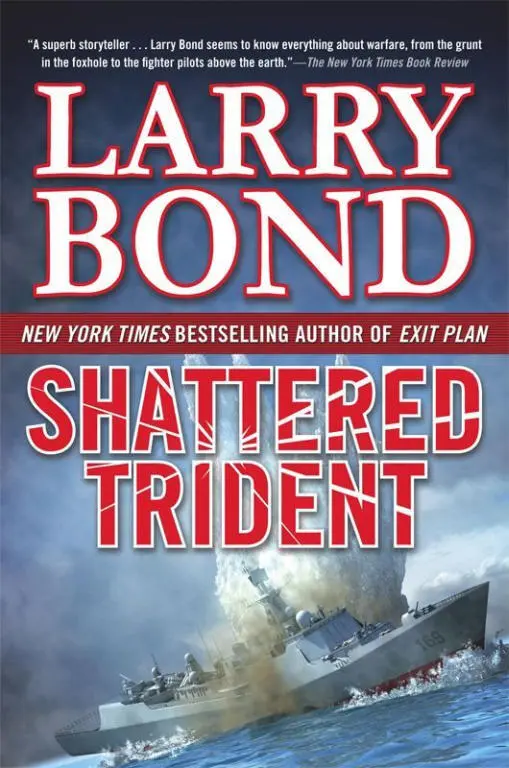
- Название:Shattered Trident
- Автор:
- Издательство:Forge Books
- Жанр:
- Год:2013
- Город:New York
- ISBN:978-0-7653-3147-2
- Рейтинг книги:5 / 5. Голосов: 1
-
Избранное:Добавить в избранное
- Отзывы:
-
Ваша оценка:
Shattered Trident: краткое содержание, описание и аннотация
Предлагаем к чтению аннотацию, описание, краткое содержание или предисловие (зависит от того, что написал сам автор книги «Shattered Trident»). Если вы не нашли необходимую информацию о книге — напишите в комментариях, мы постараемся отыскать её.
is shocked to see the Chinese boat torpedo a Vietnamese merchant ship.
This blatant act of aggression is the opening gambit in a war that has blindsided the U.S. and quickly embroiled all nations in the western Pacific. These nations, bound together in the newly formed Littoral Alliance, have begun a covert submarine campaign aimed at crippling China’s economy before China can set in motion its own plot to dominate the region.
In a desperate attempt to buy the president enough time to resolve the crisis diplomatically, Mitchell’s submarine squadron is ordered to interfere with attacks by both sides. China and the Littoral Alliance are both determined to win, no matter the cost, and as each side increases the level of violence, they approach a dangerous tipping point. In a race against time, the submarines of Mitchell’s squadron must execute their mission before the world witnesses an economic catastrophe—or worse, a nuclear exchange.
Shattered Trident — читать онлайн бесплатно полную книгу (весь текст) целиком
Ниже представлен текст книги, разбитый по страницам. Система сохранения места последней прочитанной страницы, позволяет с удобством читать онлайн бесплатно книгу «Shattered Trident», без необходимости каждый раз заново искать на чём Вы остановились. Поставьте закладку, и сможете в любой момент перейти на страницу, на которой закончили чтение.
Интервал:
Закладка:
“What bearing?”
“Northeast, on our starboard quarter,” the rating reported.
Trung waited while Mai quickly plotted the bearings from several of the ships in the squadron. It was a neat fix. “The helicopter is about fifty kilometers aft.” Mai’s voice made it clear he understood what it meant. It had them.
Trung cursed his indecision. His heart was made of lead, and it was suddenly hard to breathe. He should have ordered his ships to slow, then searched for the helicopter. Now it was too late.
He noted the time. It would take a minute for the helicopter to report, then another minute, maybe two, for the Chinese missiles to be programmed and launched. “Tell the formation, ‘Man air-defense stations,’” he ordered.
He tried to do the math while he watched the time. Even with a destroyer and that old frigate knocked out, there were at least five ships fitted with eight cruise missiles each. Their warheads were about the same size as the Uran’s, but while it had taken more than a few missiles to knock out each of his targets, one missile hit would be enough to cripple his small frigate. And a single hit would severely damage, if not sink, the even smaller Molniya craft.
He counted the seconds, then it was time. “All ships, turn left ninety degrees now. Energize all radars.” If he’d timed it right, the Chinese missiles were in the air, and it was time for a vigorous zig away from their flight path. They were subsonic, so he expected to see them in about a minute and a half at the radar horizon.
“All radars active, Captain, all air-defense stations manned and ready.”
One minute.
Trung said, “Prepare to engage air targets to port.”
The gunnery officer repeated his order. Ly Thai To didn’t have any SAM systems, and the guns could not open fire until the last moment.
Thirty seconds. Trung left combat central and went onto the bridge. All eyes were on the portside horizon. Normally he’d reprimand the deck officer, but there was open water ahead of them for miles.
He started to step out onto the port bridge wing, but remembered the Palma weapons mount just forward of the bridge. It had two rotary 30mm cannons, and when it fired, the noise would be brutal.
Any moment now.
“Radar reports high-speed contacts bearing zero seven three!” A moment later the intercom added, “Eight missiles.” The radar operator’s report was immediately followed by Mai’s command. “Chaff.”
Dull thuds amidships would have been alarming if Trung was not familiar with the sound. Explosive charges were firing cartridges filled with reflective material into the air. Hopefully, the missiles’ seekers would find the cloud a more attractive target than his frigate.
The missiles were across the horizon now, but how far away could you see a missile, head-on, with a diameter of what? Less than half a meter? He couldn’t remember exactly. With a turbojet engine, there would be no smoke trail…
“There, on the port beam!” The lookout’s warning triggered a fusillade of fire. The Palma system roared, like a giant’s chain saw cutting metal. Bright flames a meter long leaped from the muzzles. The 76mm gun on the bow thudded once, twice. Trung knew there was another rotary 30mm aft adding its own fire to the others.
Streams of tracers reached out, and that gave him a cue to his own search. They were also much closer now, and easier to spot. A puff of smoke several kilometers out marked the destruction of at least one missile. Was the chaff having any effect?
The first missile reached Ly Thai To a few seconds later. The warhead waited a few milliseconds after hitting, so that it penetrated inside the ship, rather than exploding on the outer hull plating. The explosion tore a hole ten meters in diameter amidships a few meters above the waterline. The damage was severe, but if that had been the only attacker, Ly Thai To might have survived.
Then the other three missiles arrived, at three-second intervals.
15. DELIBERATION
6 September 2016
0700 Local Time
August 1st Building, Ministry of National Defense Compound
Beijing, People’s Republic of China
Their well-appointed meeting room had become a command center. Considering that China had not fought any kind of conflict in almost forty years, Chen thought he and his staff were adapting well. Of course, knowing that they were rusty, they could have thought ahead, at least a little, Chen admitted to himself.
The room’s flat-screen display, usually used by briefers for carefully polished presentations, had been augmented by two other large displays and a standing bulletin board. Extra tables had been brought in to line the sides of the room. There was plenty of room, and they gave the new support staff places to work. Tea and coffee urns at one end of the room were always kept full. At least it was good tea.
The buzz of conversation washed over Chen, sitting at his customary place at the big table. It rose and fell as messengers arrived, or different working groups debated and discussed.
It was the pace and scope of the war. He understood that now. Chen and the other members of the Central Military Commission were used to making major decisions, of course, ones that would affect China for decades to come. But the decisions didn’t usually arrive piled one on top of another, or require split-second verdicts that could invite catastrophe. And they were all too well aware that the time they took to consider an issue was measured in lives.
Important decisions had to be made at any hour of the day or night, usually after subject matter experts and advisors were consulted. And what advisor wanted to be asleep when opinions were sought?
They resorted to catnaps and hurried meals. A doctor had been assigned to the staff to monitor everyone’s health and administer prescription medications as needed. After all, Chen was nearly seventy, and he was not the oldest man in the Central Military Commission.
With the exposure of the Littoral Alliance, problems could no longer wait for thorough analysis and the 0800 briefing. Finally identifying their enemy should have solved their greatest problem —who and where to strike. The announcement had answered that question, but the hundreds that replaced it now shouted for attention.
Chen sat at the head of the meeting table. He’d been there since five in the morning, and that was after only three hours’ sleep. His mind would not stop racing, like a rat on a wheel.
Vice Chairman Li Ju came into the room and approached Chen. The president greeted Li by pushing the tea set on the table toward an empty chair. “Join me, please,” Chen invited.
The general sat down tiredly and said, “Good morning, Comrade President,” as he helped himself to a cup of tea.
“Is it a good morning?” asked Chen expectantly. He’d set Li to work yesterday evening, and doubted that the general had slept at all.
“Yes, I believe so,” Li answered, with a satisfied tone. “We finally received the programmers’ report twenty minutes ago. The problem with the numerically controlled machines was not a virus. It mimicked a virus, though, so we would waste hours taking the wrong countermeasures. When we weren’t stopping its ‘spread’—”
“General Li,” Chen asked patiently, “what was the cause?”
“A back door in the control software. Camouflaged and appearing to function normally until it received the activation signal. Then it came to life and tried to wreck whatever device it controlled. Every controller that malfunctioned was imported from Japan, and not all from the same manufacturer.”
“And the countermeasure?” Chen asked.
Читать дальшеИнтервал:
Закладка:
Похожие книги на «Shattered Trident»
Представляем Вашему вниманию похожие книги на «Shattered Trident» списком для выбора. Мы отобрали схожую по названию и смыслу литературу в надежде предоставить читателям больше вариантов отыскать новые, интересные, ещё непрочитанные произведения.
![Никки Сикс - Героиновые дневники. Год из жизни павшей рок-звезды[The Heroin Diaries - A Year in the Life of a Shattered Rock Star]](/books/78612/nikki-siks-geroinovye-dnevniki-god-iz-zhizni-pavshej-rok-zvezdy-the-heroin-diaries-a-yea-thumb.webp)




Обсуждение, отзывы о книге «Shattered Trident» и просто собственные мнения читателей. Оставьте ваши комментарии, напишите, что Вы думаете о произведении, его смысле или главных героях. Укажите что конкретно понравилось, а что нет, и почему Вы так считаете.