Larry Bond - Shattered Trident
Здесь есть возможность читать онлайн «Larry Bond - Shattered Trident» весь текст электронной книги совершенно бесплатно (целиком полную версию без сокращений). В некоторых случаях можно слушать аудио, скачать через торрент в формате fb2 и присутствует краткое содержание. Город: New York, Год выпуска: 2013, ISBN: 2013, Издательство: Forge Books, Жанр: prose_military, thriller_techno, на английском языке. Описание произведения, (предисловие) а так же отзывы посетителей доступны на портале библиотеки ЛибКат.
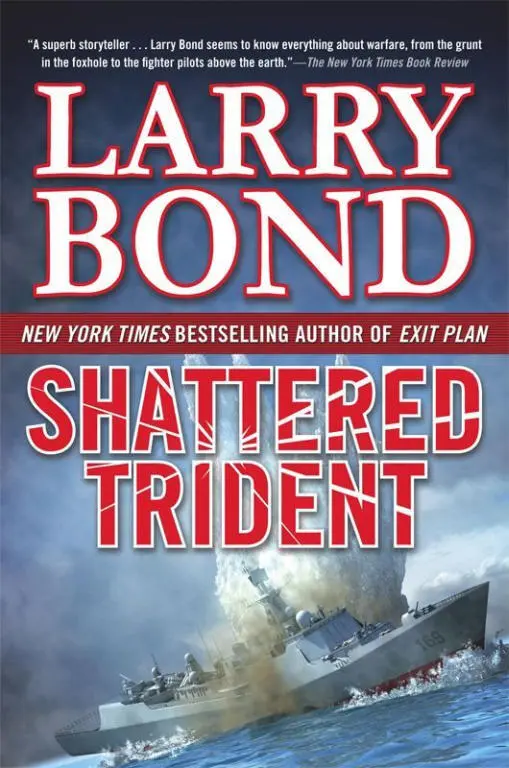
- Название:Shattered Trident
- Автор:
- Издательство:Forge Books
- Жанр:
- Год:2013
- Город:New York
- ISBN:978-0-7653-3147-2
- Рейтинг книги:5 / 5. Голосов: 1
-
Избранное:Добавить в избранное
- Отзывы:
-
Ваша оценка:
Shattered Trident: краткое содержание, описание и аннотация
Предлагаем к чтению аннотацию, описание, краткое содержание или предисловие (зависит от того, что написал сам автор книги «Shattered Trident»). Если вы не нашли необходимую информацию о книге — напишите в комментариях, мы постараемся отыскать её.
is shocked to see the Chinese boat torpedo a Vietnamese merchant ship.
This blatant act of aggression is the opening gambit in a war that has blindsided the U.S. and quickly embroiled all nations in the western Pacific. These nations, bound together in the newly formed Littoral Alliance, have begun a covert submarine campaign aimed at crippling China’s economy before China can set in motion its own plot to dominate the region.
In a desperate attempt to buy the president enough time to resolve the crisis diplomatically, Mitchell’s submarine squadron is ordered to interfere with attacks by both sides. China and the Littoral Alliance are both determined to win, no matter the cost, and as each side increases the level of violence, they approach a dangerous tipping point. In a race against time, the submarines of Mitchell’s squadron must execute their mission before the world witnesses an economic catastrophe—or worse, a nuclear exchange.
Shattered Trident — читать онлайн бесплатно полную книгу (весь текст) целиком
Ниже представлен текст книги, разбитый по страницам. Система сохранения места последней прочитанной страницы, позволяет с удобством читать онлайн бесплатно книгу «Shattered Trident», без необходимости каждый раз заново искать на чём Вы остановились. Поставьте закладку, и сможете в любой момент перейти на страницу, на которой закончили чтение.
Интервал:
Закладка:
Trung heard a few cheers from the bridge, as well as some improbable suggestions involving the Chinese and seagulls. The other sailor had hauled down the smaller ensign, and was carefully folding it.
He checked his watch again. That had taken two minutes, and it was still far too soon to hear back from Miss Tham. He looked out to the northeast. She was as close as they’d been all day, perhaps fifty-five kilometers away. That was still well out of visual range, of course. He wouldn’t see her, even when she launched. Of course, neither would the Chinese.
Trung had given her that name, although she actually had two others. The first was Dong Du, a medium-sized Vietnamese-owned container ship. The second was Ora Bhum, which was the name she would answer to if challenged by the Chinese. It hadn’t felt quite right to use the alias, but Trung was reluctant to use the container ship’s real name, even on his own ship.
Ora Bhum matched the size and configuration to Dong Du, and the freighter had even been repainted in the other ship’s colors, with the false name in white on the bow and a Singaporean flag at the stern.
Her cargo was a battery of Bastion coastal missile launchers, four vehicles each carrying two Yakhont supersonic anti-ship missiles. Lashed securely to the deck, they’d been hidden by the shells of cargo containers cannibalized to serve as camouflage. The deception was good enough to withstand even a close visual inspection.
It would take the freighter’s crew more than a few minutes to remove and discard the covers. This was the period of greatest risk, but the helicopter was the only Chinese unit that could expose them, and it was too far away.
The Russian Yakhont was faster and newer than the 3M24E Uran missiles his own ships carried, but it was also far larger. None of the VPN’s ships could be fitted with them, especially once the crisis had begun. But Vietnam had already purchased the land-based launchers from the Russians for coast defense. Now they were at sea, in a lashed-together arrangement that wasn’t pretty, but would work.
Even though the Yakhonts would be launched after his Uran missiles, the subsonic Urans would arrive after them. In the low trajectory mode, the Yakhont cruised at Mach 2.0, giving the target only moments to react as it came over the horizon. The Yakhont’s seeker package was also much smarter than the Uran’s. It could be set to home in on the signal from one specific type of radar, like the Dragon Eye radar on a Chinese guided missile destroyer. And to top it all off, as the Yakhont attacked, it maneuvered, making it a harder target than the straight and steady Uran.
Trung had time to review the tactics, and all his choices, several times as he waited for Miss Tham’s signal. They should be done soon, but the camouflage had been improvised. Was there a problem with the wind? Had the camouflage damaged the launchers or the missiles in transit, or as it was being removed?
The intercom came alive and Trung ducked back into the bridge. He’d been expecting Mai’s voice, but not his report. “Sir, our patrol aircraft reports the container ship has probably weighed anchor. She is no longer stationary. Speed is three knots and increasing.”
“Tell Miss Tham they’ve got five minutes, and recalculate the time on target.”
Mai answered quickly, “Understood.”
Trung tried to put himself on the merchant ship’s bridge. They did not have the acceleration of a warship, but all they needed was to get to ten knots or so. The wind had them facing west at anchor, and he would have to turn to sail around to the south side of the island, where the pier was located. Once the island was in the way, one of Trung’s two primary targets would disappear. But merchant ships turned slowly, especially at low speeds. Was there time to reprogram the Uran missiles on his ship? If he added waypoints…
“Sir, Miss Tham is ready, all launchers at the vertical. If we launch in sixty seconds, she launches sixty seconds after that.”
That matched his own rough calculations. Trung ordered, “Launch in sixty seconds, then.” He released the intercom key, then stepped over and closed the door to the port bridge wing. A watchstander on the other side did the same thing with the starboard door. As Trung dogged it down, a siren howled, loud even over the wind.
Trung stepped over to a small console next to the captain’s chair. As he waited, a large red button, engraved in white letters with PERMISSION TO FIRE, lit up. He immediately pressed it, holding it down for the required count of three, then walked over to the intercom. “Permission to fire confirmed.”
The Uran tubes were located midships, in the gap between the stack and the after mast. Even muffled by the wind, and through the closed doors, the roar of the rocket motors was loud, and seemed to go on forever.
Missiles burst out from the launch tubes at three-second intervals, climbing and immediately turning sharply east. A rocket booster, with a flame as long as the twelve-foot missile, burned for a moment before the missile’s turbojet engine took over. At that distance, Trung could only make it out as a small black shape, skimming the water.
The frigate’s eight missiles were all gone within ten or fifteen seconds, by his watch, and as Trung undogged the starboard door, the missile officer’s voice came over the intercom. “Launch successful, all eight weapons functioning normally.”
Trung used his glasses to check the Molniya missile craft closest to him, HQ-375 . She was still launching. The Molniyas carried sixteen missiles instead of eight, in four quad launchers on either side of the ship, and each missile appeared on a column of flame as it erupted from the launcher, followed seconds later by the next one. The wind of the ships’ passage swept the exhaust off the ships’ decks, but it formed a billowing gray smoke trail behind each vessel. The beginning marked when each ship had started firing, and its abrupt end showed when it was complete.
A radio speaker on the bridge let him hear the reports as the four missile craft reported successful launches. Keying the intercom, Trung ordered, “Mai, execute turn to two two five, all ships flank speed.” They’d done their duty for the Socialist Republic, and now it was time to look to their own welfare.
Lanzhou
Admiral Sun was still speaking to General Tian. With the pier cleared, the container ship would dock, and Tien had sufficient troops to unload it, so…
“Low-altitude contact to the northwest! Missile alert!”
“Engage!” That order had come from Lanzhou ’s weapons officer, and almost before he finished saying it, Sun heard the roaring forward as the destroyer’s vertical launchers rapidly salvoed air-defense missiles. Seconds mattered.
The radar operator passed information without wasting time on extra words. “Forty-five kilometers, eight contacts, supersonic! Speed… 1,320 knots—Mach 2.” The operator was speaking quickly, but the attackers had already covered half the distance to the ship during his report.
Sun watched the display, symbols moving almost too quickly to follow. Their outbound interceptors were even faster than the attackers, and the two groups came together as if pulled by strings. A string of characters appeared next to the hostile missiles—“Yakhont.” Sun grimaced. He knew what that meant, and could only hope they were lucky.
Three, then four of the oncoming missiles disappeared. It was a good result, out of five engaged, but there was no time for another salvo.
A harsh rattling sound carried through the bulkheads. The ship’s 30mm point-defense gun had opened fire, and a BANG! from the bow showed even the 100mm gun was firing, for all the help it would be. Again, no order had been given after the first one. There was no time…
Читать дальшеИнтервал:
Закладка:
Похожие книги на «Shattered Trident»
Представляем Вашему вниманию похожие книги на «Shattered Trident» списком для выбора. Мы отобрали схожую по названию и смыслу литературу в надежде предоставить читателям больше вариантов отыскать новые, интересные, ещё непрочитанные произведения.
![Никки Сикс - Героиновые дневники. Год из жизни павшей рок-звезды[The Heroin Diaries - A Year in the Life of a Shattered Rock Star]](/books/78612/nikki-siks-geroinovye-dnevniki-god-iz-zhizni-pavshej-rok-zvezdy-the-heroin-diaries-a-yea-thumb.webp)



Обсуждение, отзывы о книге «Shattered Trident» и просто собственные мнения читателей. Оставьте ваши комментарии, напишите, что Вы думаете о произведении, его смысле или главных героях. Укажите что конкретно понравилось, а что нет, и почему Вы так считаете.