Larry Bond - Shattered Trident
Здесь есть возможность читать онлайн «Larry Bond - Shattered Trident» весь текст электронной книги совершенно бесплатно (целиком полную версию без сокращений). В некоторых случаях можно слушать аудио, скачать через торрент в формате fb2 и присутствует краткое содержание. Город: New York, Год выпуска: 2013, ISBN: 2013, Издательство: Forge Books, Жанр: prose_military, thriller_techno, на английском языке. Описание произведения, (предисловие) а так же отзывы посетителей доступны на портале библиотеки ЛибКат.
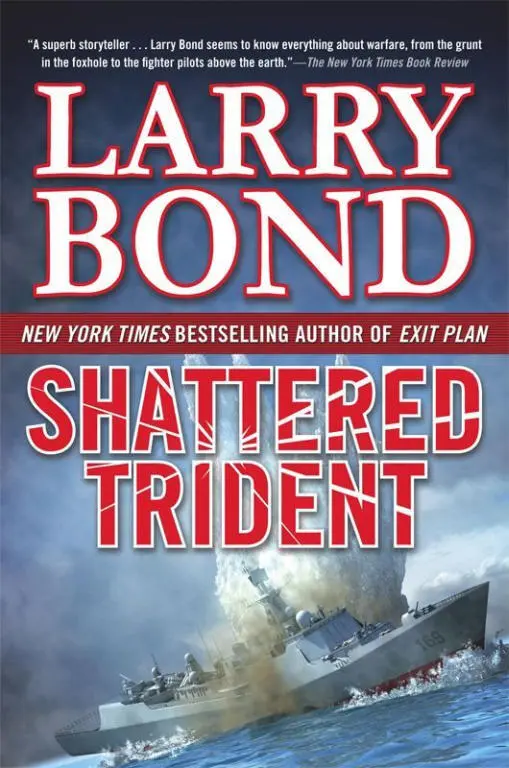
- Название:Shattered Trident
- Автор:
- Издательство:Forge Books
- Жанр:
- Год:2013
- Город:New York
- ISBN:978-0-7653-3147-2
- Рейтинг книги:5 / 5. Голосов: 1
-
Избранное:Добавить в избранное
- Отзывы:
-
Ваша оценка:
Shattered Trident: краткое содержание, описание и аннотация
Предлагаем к чтению аннотацию, описание, краткое содержание или предисловие (зависит от того, что написал сам автор книги «Shattered Trident»). Если вы не нашли необходимую информацию о книге — напишите в комментариях, мы постараемся отыскать её.
is shocked to see the Chinese boat torpedo a Vietnamese merchant ship.
This blatant act of aggression is the opening gambit in a war that has blindsided the U.S. and quickly embroiled all nations in the western Pacific. These nations, bound together in the newly formed Littoral Alliance, have begun a covert submarine campaign aimed at crippling China’s economy before China can set in motion its own plot to dominate the region.
In a desperate attempt to buy the president enough time to resolve the crisis diplomatically, Mitchell’s submarine squadron is ordered to interfere with attacks by both sides. China and the Littoral Alliance are both determined to win, no matter the cost, and as each side increases the level of violence, they approach a dangerous tipping point. In a race against time, the submarines of Mitchell’s squadron must execute their mission before the world witnesses an economic catastrophe—or worse, a nuclear exchange.
Shattered Trident — читать онлайн бесплатно полную книгу (весь текст) целиком
Ниже представлен текст книги, разбитый по страницам. Система сохранения места последней прочитанной страницы, позволяет с удобством читать онлайн бесплатно книгу «Shattered Trident», без необходимости каждый раз заново искать на чём Вы остановились. Поставьте закладку, и сможете в любой момент перейти на страницу, на которой закончили чтение.
Интервал:
Закладка:
“And this footage was just received.” A tangled complex of pipes and storage tanks appeared, billowing with black smoke and surrounded by emergency vehicles. “This is Sinopec’s Guangzhou Branch refinery in Guangdong province. Witnesses reported seeing cruise missiles striking the facility, triggering massive explosions and fires, with heavy loss of life.”
The anchor paused, as if to draw a breath before continuing. “On any other day, this disaster would be the lead story. Hundreds of people have died in the first-ever fatal accident of the Shinkansen , the Japanese ‘bullet train.’ One train, at full speed, collided with another train inexplicably stopped in front of it. Before word of the accident reached the controllers, a third train slammed into the other two.”
The footage showed rescue workers in helmets and brightly colored vests moving amid tangled wreckage. It wasn’t recognizable as a train wreck until the view changed to a longer shot, showing the tracks and parts of the train still on track. Then the image shifted to show a Shinto priest praying in front of dozens of white-draped bodies. “Hospitals in the area have been flooded with casualties, and the total count of the dead and wounded rises by the hour.”
White House Situation Room
Washington, D.C.
Kirkpatrick switched off the set. “That’s a good summary of what the rest of the world has to work with.”
Patterson, General Nagy, and Admiral Hughes all nodded. Nagy, the vice chairman of the JCS, asked, “Have we confirmed that the Japanese disaster was a cyber attack?” He was asking Kirkpatrick, but also looked at Dr. Foster, head of the CIA.
Foster answered, “Yes. The Japanese and our people came to the same conclusion. The control system was hacked. First it sent an ‘obstacle’ message to just one train, causing it to stop, but only that train. It then took over the communications network, suppressed all the real-time data, and replaced it with synthetic information. The controllers never saw any problems because they were looking at an animation.”
Patterson asked, “And the Chinese were behind it?”
“It’s likely,” Foster said. “Electrons usually don’t leave fingerprints, but we traced the hack back to a location associated with past operations run by the Chinese. Whoever did it had to be real good, because the Japanese network protections were top-rate.”
Kirkpatrick added, “We’ll see more of that in Japan now. They’re a U.S. ally, so the Chinese are pushing first covertly, to see if they can make Tokyo say uncle. We don’t have the details yet, but we think the Chinese are going to make some sort of move that will devalue the Japanese yen.”
General Nagy observed, “They don’t have that problem with Vietnam. That news report is the tip of the iceberg. The Chinese haven’t committed any ground troops yet; it looks like they’re taking a page from Desert Storm and pummeling the Vietnamese from the air for a while before they invade.”
Patterson asked, “How long before the Chinese cross the border?”
The general shrugged. “Soon, but they’ll want to make sure they have an overwhelming force before they attack. The Vietnamese are unlikely to cave in easily; they fought the Chinese before, back in 1979 and gave them a whuppin’. But in the meantime, the Chinese are inflicting a lot of damage with only moderate losses. That release from Hanoi didn’t mention that the Vietnamese have lost a lot of their own fighters trying to stop the Chinese raids.”
“And you were right, General.” Kirkpatrick smiled. “Dumb grunts can be pretty smart. EP-3 intercepts and satellite images show Chinese troops and ships all over the South China Sea, seizing islands and reefs that have been disputed territory. They’re concentrating on ones with airfields, so this is only wave one. Intel has been backtracking the movements of Chinese units, now that we know where to look, and they’ve been prepping for months.”
“And the Vietnamese mined the carrier to disrupt the operation,” Patterson concluded.
“Except it didn’t,” Kirkpatrick explained. “Beijing pressed on. But now that we know who started the ball rolling, the president can get to work. He will see the Chinese ambassador later today. And in the meantime, the State Department is advising U.S. citizens to get out of China and all the countries bordering it—basically, most of Asia. Who knows where trouble is going to pop up next?”
13. REVELATION
5 September 2016
0830 Local Time
Tokyo University, Waseda Campus
Hongo, Bunkyo Ward, Tokyo
Komamura stared at his computer screen with a mixture of apprehension and dismay; his right hand shook as he reached for his cup of tea. The professor had once again locked his office door before calling up the CNN news feed, a precaution that was becoming all too common these days. He didn’t want someone barging in on him while he watched the press conference. He had little confidence he would be able to hide his emotions. The Littoral Alliance was going public.
The debate the night before had been long, intense, and at times, heated. Komamura had argued vociferously that anonymity was still a useful weapon in the alliance’s arsenal. As long as the Chinese were uncertain as to whom they faced, their actions were constrained. Once the veil of doubt was removed, the Chinese leadership would be free to escalate the conflict—undoubtedly resulting in more casualties among the civilian populations. Many of the military participants argued that revealing the alliance’s members, as well as the current war, would allow them to invoke civil defense measures that would preclude another disaster such as the Sanyo Shinkansen train wreck.
The elderly academic had shivered when General Ijuin, the chief of staff of Japan’s Self-Defense Forces, mentioned the multiple train crash just outside of Shin-Osaka Station. At the height of the evening commute, the two sixteen-car trains and the one eight-car train carried over 3,200 people. The death toll was now just over 2,700, and expected to rise, as the vast majority of the survivors were in critical condition. Only a fortunate few had limped away from the scene.
Having ridden Japan’s bullet train system often, Komamura had trouble banishing images of the carnage that would be created when one train traveling at three hundred kilometers per hour slammed into another. The preliminary accident report showed no indication of a mechanical failure. The black boxes had been recovered quickly and the data showed all three trains were functioning normally, with the exception of the automatic train control system input. The Nozomi train recorded a track-obstruction warning signal that caused it to come to a stop; the other two trains not only didn’t show the same warning signal, they weren’t alerted that they were getting perilously close to another train.
The only possible conclusion for this highly improbable failure was deliberate sabotage. This meant someone had to hack their way into the Shinkansen’s control network and alter the signals sent to the three trains. That the incident occurred almost simultaneously with the PRC’s press release alleging Japan’s involvement with the tanker war all but proved Chinese culpability for the cyber attack. Indian cyber warfare specialists agreed.
As costly as the Shinkansen cyber attack was, Komamura had stressed that once the alliance membership was announced to the world, the cork in the nuclear genie’s bottle would be removed. Identifying India as an alliance member could potentially have the same negative effect that inviting the Americans would have. India was a nuclear power, and a desperate China could send a “message” to the alliance by using a single nuclear weapon on one of the nonnuclear members. Given the lingering psychological scar from World War II, that made Japan the most likely target. Komamura understood this scarring all too well. His mother had died of radiation-induced cancer two decades after the Nagasaki bombing.
Читать дальшеИнтервал:
Закладка:
Похожие книги на «Shattered Trident»
Представляем Вашему вниманию похожие книги на «Shattered Trident» списком для выбора. Мы отобрали схожую по названию и смыслу литературу в надежде предоставить читателям больше вариантов отыскать новые, интересные, ещё непрочитанные произведения.
![Никки Сикс - Героиновые дневники. Год из жизни павшей рок-звезды[The Heroin Diaries - A Year in the Life of a Shattered Rock Star]](/books/78612/nikki-siks-geroinovye-dnevniki-god-iz-zhizni-pavshej-rok-zvezdy-the-heroin-diaries-a-yea-thumb.webp)



Обсуждение, отзывы о книге «Shattered Trident» и просто собственные мнения читателей. Оставьте ваши комментарии, напишите, что Вы думаете о произведении, его смысле или главных героях. Укажите что конкретно понравилось, а что нет, и почему Вы так считаете.