Larry Bond - Shattered Trident
Здесь есть возможность читать онлайн «Larry Bond - Shattered Trident» весь текст электронной книги совершенно бесплатно (целиком полную версию без сокращений). В некоторых случаях можно слушать аудио, скачать через торрент в формате fb2 и присутствует краткое содержание. Город: New York, Год выпуска: 2013, ISBN: 2013, Издательство: Forge Books, Жанр: prose_military, thriller_techno, на английском языке. Описание произведения, (предисловие) а так же отзывы посетителей доступны на портале библиотеки ЛибКат.
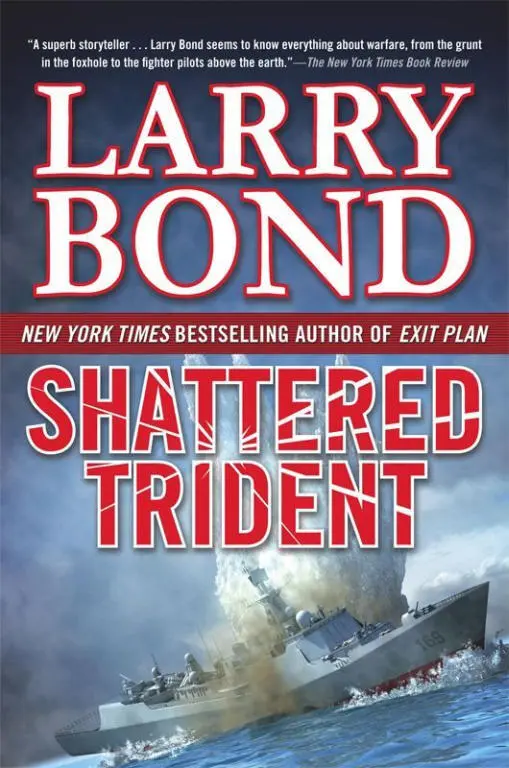
- Название:Shattered Trident
- Автор:
- Издательство:Forge Books
- Жанр:
- Год:2013
- Город:New York
- ISBN:978-0-7653-3147-2
- Рейтинг книги:5 / 5. Голосов: 1
-
Избранное:Добавить в избранное
- Отзывы:
-
Ваша оценка:
Shattered Trident: краткое содержание, описание и аннотация
Предлагаем к чтению аннотацию, описание, краткое содержание или предисловие (зависит от того, что написал сам автор книги «Shattered Trident»). Если вы не нашли необходимую информацию о книге — напишите в комментариях, мы постараемся отыскать её.
is shocked to see the Chinese boat torpedo a Vietnamese merchant ship.
This blatant act of aggression is the opening gambit in a war that has blindsided the U.S. and quickly embroiled all nations in the western Pacific. These nations, bound together in the newly formed Littoral Alliance, have begun a covert submarine campaign aimed at crippling China’s economy before China can set in motion its own plot to dominate the region.
In a desperate attempt to buy the president enough time to resolve the crisis diplomatically, Mitchell’s submarine squadron is ordered to interfere with attacks by both sides. China and the Littoral Alliance are both determined to win, no matter the cost, and as each side increases the level of violence, they approach a dangerous tipping point. In a race against time, the submarines of Mitchell’s squadron must execute their mission before the world witnesses an economic catastrophe—or worse, a nuclear exchange.
Shattered Trident — читать онлайн бесплатно полную книгу (весь текст) целиком
Ниже представлен текст книги, разбитый по страницам. Система сохранения места последней прочитанной страницы, позволяет с удобством читать онлайн бесплатно книгу «Shattered Trident», без необходимости каждый раз заново искать на чём Вы остановились. Поставьте закладку, и сможете в любой момент перейти на страницу, на которой закончили чтение.
Интервал:
Закладка:
He’d guessed right, then. Jiang stepped out onto the port bridge wing. The burning hulk loomed fine on the port bow, and Jiang tried to judge if he could steer closer. Yancheng was responding wonderfully, speed building from twelve knots, and was already past twenty-two. It was much more responsive than any tanker, but it still took some time for 3,800 tons of steel to accelerate. They had to close the distance between…
The deck officer put down the intership phone. “Captain, sonar reports the torpedo’s seeker has activated, and the weapon’s speed has increased!”
“Hard left rudder! New course back toward the weapon!” Jiang sighed. He’d lost the race. At attack speed, the torpedo would swim at forty-five knots or more. Their only hope now was a sharp turn inside the weapon’s arc.
Yancheng was continuing to accelerate, and the bow swung sharply to port, putting the tanker on the other side now. A cold wind cut at his face and tugged his clothes. He stepped back into the bridge and studied the plot, watching the angles. He ordered the deck officer, “Tell all hands to brace for impact!”
4 September 2016
1830 Local Time
Shinkansen Control Center, Kansai Region
Japan
The Japanese “bullet train” system is one of the most efficient and fastest in the world. With speeds close to two hundred miles per hour, trains operate on dedicated rail lines, separated from slower-moving freight and local trains. First operating in the early 1960s, the ever-expanding network has dramatically shortened travel times across the mountainous country, revolutionizing transportation and commerce in Japan.
Obata Takeshi had the duty at the Kansai control center when the trouble began. The three large flat-screen displays didn’t give any indication, and none of the communications staff had reported any problems.
The central display showed the Kansai region, his responsibility, in the south central part of Japan’s main island of Honshu. Heavily urbanized and populated, it holds Kyoto, Osaka, and many other major Japanese cities. The electronic map showed not only the cities and the rail lines, but could display local traffic, emergencies like fires, and even precipitation levels.
The position of each bullet train was updated constantly, using transmitters on the trains and sensors placed along the track. The Osaka–Tokyo line, one of the major runs in the system, could have as many as a dozen trains an hour in each direction, neatly separated by five-minute intervals.
The phone at the control desk connected to the first responders rang, and Obata grabbed it quickly. Nothing showed on the board, but it could be a drill, or a warning. “Obata, Kansai Control.”
“This is Battalion Chief Kawaguchi at the Fushima station. We’re rolling everything we’ve got. Who is the on-scene commander?” The firefighter’s tone was urgent, but professional.
“What?” Obata’s astonished question was loud enough to attract the attention of others in the center, and he punched a button that put the conversation on the loudspeaker. In the background, they could hear sirens and the roar of diesel engines.
“Who is in charge at the scene, dammit? We’re losing time. Can’t you people follow your own procedures? It’s bad enough we had to hear about this from civilians who saw the accident. I need to know if I should sound another alarm. Two—no, three trains, what is that? It’s over a thousand passengers per train.”
“Battalion Chief, I’m not showing any problems on any of the lines.” Obata’s confusion was obvious.
Kawaguchi replied quickly, “Your board is wrong. We’ve gotten dozens of mobile phone calls about trains colliding about five kilometers west of Shin-Osaka Station. At first, it was just two trains, but we’re getting word of a third train that’s plowed into the mess. And you don’t show any of this?” The firefighter’s question, shouted a little to be heard over the sirens, ran through Obata like an electric charge. The rest of the staff had the same reaction, and began furiously checking their systems.
Obata, thinking in terms of time and distance, shouted, “Emergency stop all trains to Shin-Osaka now! Call them on the secondary circuits!” Dozens of questions leapt into his mind, and he fought to control them. Did the trains’ conductors see what he saw here? If what Kawaguchi said was true, then the third train might be followed by a fourth, and others unless they could be warned off. “Don’t depend on the readouts! Get voice confirmation.”
“Can you tell me anything?” the firefighter demanded.
“Chief, you will have to be the on-scene commander, because I have no information here.” Hand shaking, Obata hung up the phone. His mind filled with images of cars full of people already dead if they didn’t get them stopped in time.
He turned to his deputy, Moritaka. The man’s face was as pale as the moon. “Take over. Call the regional director. Assume a major disaster, and a major communications failure. Get people busy finding out what’s wrong. I’m going to the scene to find out what’s happening. It should be only a few kilometers from here. I’ll report when I know something.”
4 September 2016
0600 Eastern Daylight Time
CNN Headline News
The anchor looked hurried, and although he spoke quickly, he kept his tone even and professional. “Good morning. Welcome to CNN’s continuing coverage of the crisis in the Pacific. We begin with the stunning announcement by the Chinese government that they have proof of Japanese involvement in the covert submarine campaign against their merchant tankers.”
As he spoke, images appeared on the screen and were replaced by new ones: maps, a burning tanker, a warship, and a submarine. “The Chinese have released an audio recording of a submarine attack on a merchant ship and escorting warship. Although both vessels were sunk, the acoustic signature was transmitted by computer datalink back to shore, which allowed it to be analyzed and classified as a Japanese Soryu -class submarine.
“The Chinese have posted the audio file on the Net, and several navies are examining the file, not only to confirm the Chinese accusation, but for evidence of tampering or falsification.
“The Chinese have also accused Vietnamese submarines of taking part, and have demanded both nations immediately cease attacks and agree to reparations, or face ‘the gravest consequences.’ The Chinese have also frozen all Vietnamese and Japanese funds in Chinese banks, and forbidden the trading of the yen.”
New scenes appeared, of a Chinese embassy guarded by Japanese police, almost surrounding the building, then a crowded airport full of worried travelers. “Chinese embassies in both countries are closed, diplomatic personnel are preparing to leave, and Chinese nationals have been instructed to leave immediately. The same situation applies to Vietnamese and Japanese nationals in China, which includes tens of thousands of tourists.
“Beyond these public announcements, reports and rumors of attacks are popping up over the entire region.
“Early yesterday, Philippine sources reported Chinese ships and aircraft operating near their possessions in the Spratly Islands, followed shortly by a total loss of mobile phone and radio contact. Ownership of the Spratlys is disputed by China, Vietnam, Taiwan, the Philippines, and other nations. Sources online have confirmed the presence of Chinese naval vessels, and probably Chinese troops there.
“The Vietnamese government has reported scores of aircraft attacks along its border with China, and ballistic missiles falling in both Hanoi and Haiphong, with deadly results. The government has ordered the entire country ‘mobilized to repel the Chinese invader.’ The Vietnamese claim to have shot down almost a dozen aircraft in the initial wave of attacks.
Читать дальшеИнтервал:
Закладка:
Похожие книги на «Shattered Trident»
Представляем Вашему вниманию похожие книги на «Shattered Trident» списком для выбора. Мы отобрали схожую по названию и смыслу литературу в надежде предоставить читателям больше вариантов отыскать новые, интересные, ещё непрочитанные произведения.
![Никки Сикс - Героиновые дневники. Год из жизни павшей рок-звезды[The Heroin Diaries - A Year in the Life of a Shattered Rock Star]](/books/78612/nikki-siks-geroinovye-dnevniki-god-iz-zhizni-pavshej-rok-zvezdy-the-heroin-diaries-a-yea-thumb.webp)





Обсуждение, отзывы о книге «Shattered Trident» и просто собственные мнения читателей. Оставьте ваши комментарии, напишите, что Вы думаете о произведении, его смысле или главных героях. Укажите что конкретно понравилось, а что нет, и почему Вы так считаете.